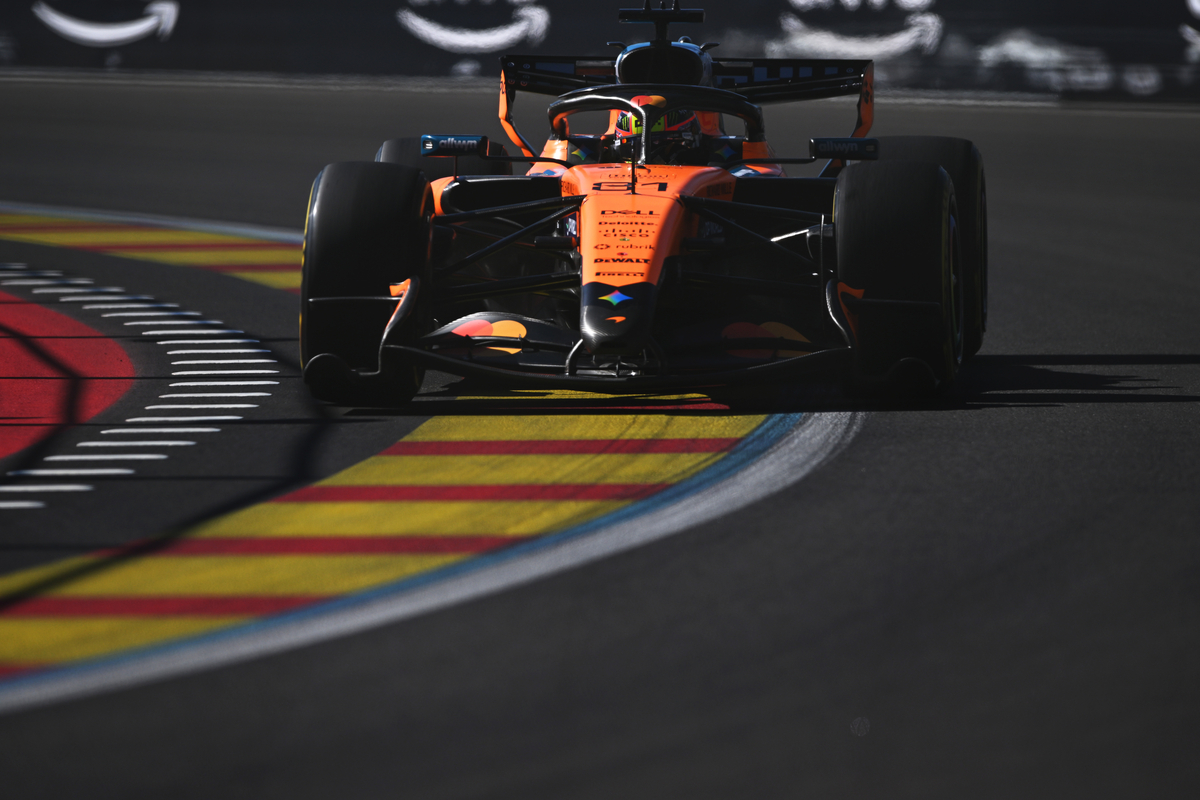
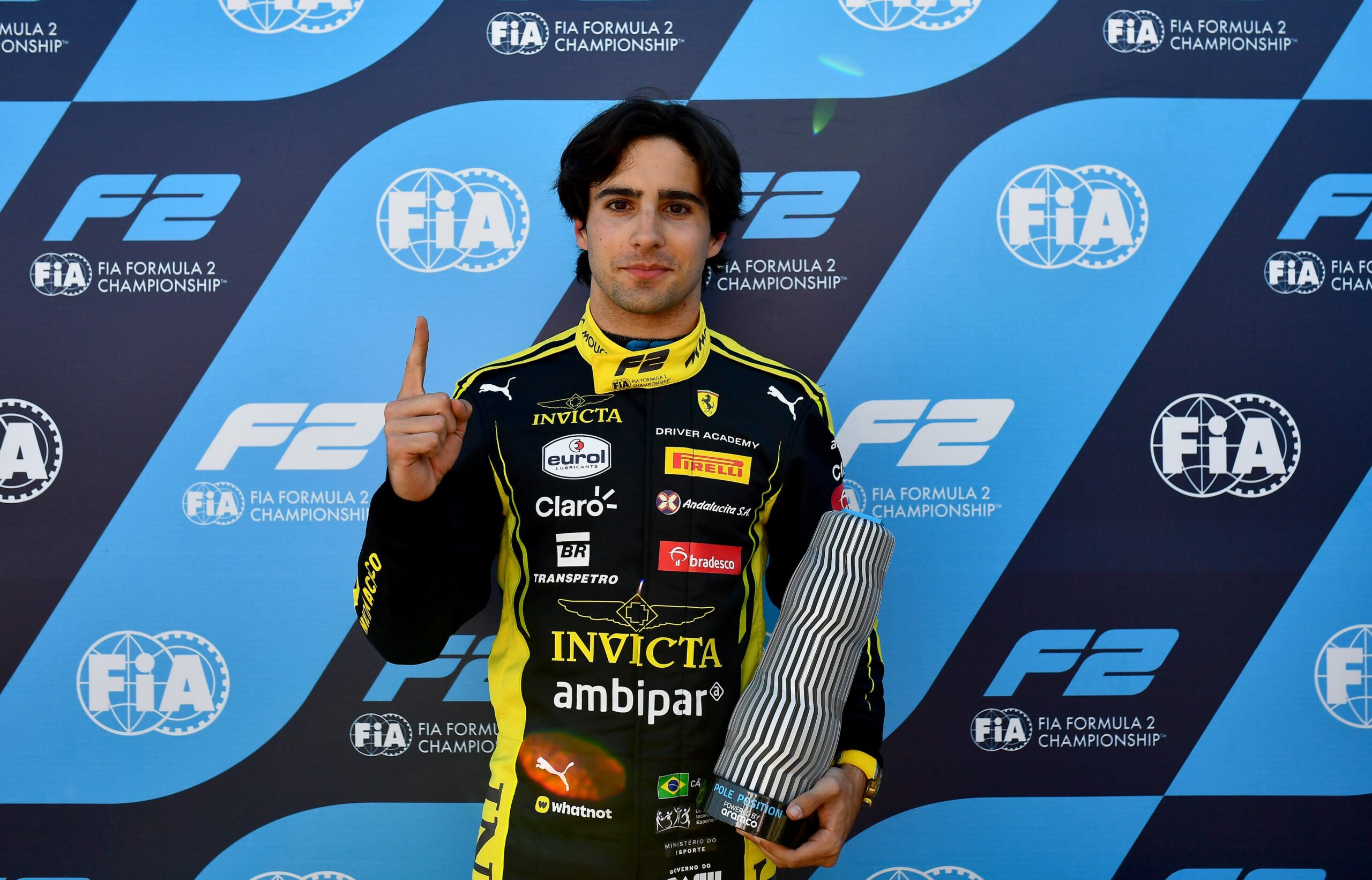
Rafael Câmara secured pole position for the 2026 Formula 2 (F2) Feature Race at the Circuit de Barcelona-Catalunya after delivering his fastest lap during the opening half of qualifying.
The Invicta Racing driver produced a 1:24.810 to finish 0.135s ahead of teammate Joshua Dürksen, while Rodin Motorsport’s Alexander Dunne took third. Câmara topped all three sectors on his pole lap before Ritomo Miyata’s late crash interrupted the final attempts. Few drivers improved after the session resumed, leaving the Brazilian’s earlier benchmark unbeaten.
Speaking in the post-qualifying press conference attended by Pit Debrief, Câmara said he had felt comfortable with the car from Free Practice and knew he needed to maximise the tyre on his first flying lap.
“Very good pole position. The session, I think, went very well. I was already able to get a very good lap on lap one. Here in Barcelona, you always need to deliver on that one lap because the tyres don’t last very long, and already from FP I was feeling good with the car.”
“I think we sat in a very good place, and then qualifying was just about looking into things and putting everything together for both runs. Unfortunately, I couldn’t get the second lap, but it was good enough to be on pole. Now, we’re just focusing on the races on Saturday and Sunday.”
High temperatures increased tyre challenge
Track temperatures reached approximately 50°C during the session, placing further strain on the soft tyres around a circuit already known for demanding significant energy from them.
Câmara explained that degradation and overheating became noticeable before the end of a single flying lap, particularly through the final sector.
“Through one lap, you feel a bit of degradation in Sector 3 with overheating, and the tyre is not feeling good in the last sector. But you just try to survive. You have to manage the driving and keep it clean.”
“I think, in the races, it will be a big thing to look after your tyres and make sure that you’re doing things properly. I’m just going to be looking with the team at what we need to do for the races and making sure we are prepared for the conditions.”
The Brazilian expected Invicta to move away from its aggressive qualifying set-up before the two races. He believed the team needed to protect the tyres over longer stints rather than chase the outright performance required over one lap.
“For sure, you cannot run the same as in qualifying. I think that would be a bit too aggressive. Going into it, the team and I will change it a bit to make sure our tyres are good in the race.”
“But it’s just about looking through everything with them, making sure that we’re preparing well and can have a good race.”
Câmara targets stronger Invicta weekend
Invicta had regularly demonstrated pace during the opening rounds but had not always converted it into the points the team expected.
Câmara acknowledged that the previous races had fallen below expectations. However, he said the team had continued improving its understanding of how he worked while strengthening its collaboration throughout the season.
“Yeah, I think the last races have not been ideal for us. Obviously, the pace, I think, has always been there. On my side, it could have been much better.”
“But I think sometimes it happens. It’s good experience for the future. Like I said, we’re just trying to keep it positive and do our best.”
“I think, by working how we work every race weekend, it feels like we’re more connected as a team. I’m learning, the team is learning, and the team is also learning how I work as well. For sure, I think we’re just getting stronger through the season.”
“Like I said, I’m not focusing too much on the result. I’m just trying to do the best we can in the moment.”
Câmara initially appeared to have led an Invicta front-row lockout. However, the stewards later handed Dürksen a five-place grid penalty for both races after determining that he had failed to slow sufficiently under yellow flags following Miyata’s Turn 14 crash. The decision promoted Dunne to the front row alongside Câmara for the Feature Race.
The stewards found that Dürksen had set his fastest mini-sector time of the session in the area covered by the single yellow flag. They also added two penalty points to his record, taking his 2026 total to five.
Changing track conditions demanded adaptation
The Formula 1 cars running during the same weekend caused the circuit to evolve considerably between Formula 2 sessions. Câmara said the grip available in qualifying differed noticeably from Free Practice, forcing the drivers to adapt their expectations and racing lines.
“Yeah, for sure. The situation in Free Practice was not the same as qualifying. You always know that there will be a big jump from each session.”
“Obviously, from Friday to Saturday, the track is always getting a bit better, but it’s not as big as the jump from Free Practice to qualifying. Even the lines were not very… let’s say, what we’re used to was a bit different.”
“The grip was not what we were expecting, and then you had to adapt a bit as well. In Free Practice, you always try to learn as much as you can.”
“Even if you make a mistake, you know what you don’t need to do in qualifying. Through the experience you gain from doing things, you want to make sure that you experience everything so you can go into qualifying prepared.”
How experience on track helps
“Here, it is a track that we know quite well, so that makes things a bit simpler. But, like they said, we don’t get a lot of laps in Free Practice. I don’t think there is a lot of time in Free Practice, so we always try to learn as much as we can, get the best feeling and go into qualifying already with everything planned or knowing what to do.”
“I think the race here is also quite a big thing. You’re always really looking after the tyres because the degradation can be very… Sometimes, you can easily go the wrong way and find yourself in a tough situation afterwards.”
“But I think all we can do is try to prepare in the best way and be ready for all the scenarios.”
Câmara explains extracting performance from the soft tyre
Different drivers used varying warm-up strategies throughout qualifying as they attempted to bring the soft tyres into the correct operating window without taking too much performance out of them before the flying lap.
When asked by Pit Debrief how much performance the drivers could extract before the tyre began to drop away, and how difficult it was to remain within track limits, Câmara explained that the dashboard data and feedback from the car offered some guidance.
“I mean, we can see the pressure on the dash and see how the warm-up is going and where you want to start the lap. Obviously, it’s not like F1, where you have everything. But with the feeling, I think you’re quite able to understand where you are and how the tyres will be at the beginning of the lap.”
“So, yeah, you can have a good read before starting the lap. In F2, as you know, you don’t have so many laps. Especially going from the hard to the soft, there’s already a big gap.”
“In a way, on the first lap, you’re guessing the grip and, through the corners, how close you are to the limits. You can easily under-push or overdo it a bit, so it’s definitely not easy to judge.”
“But I felt that today was great. The read on the warm-up was very good, and on the first lap, I was able to deliver.”
Pole lap puts Câmara in control
The official final classification confirmed Câmara’s 1:24.810 as the fastest lap, with Dürksen initially second and Dunne third. Gabriele Minì qualified fourth, ahead of Rafael Villagómez and Nikola Tsolov.
Miyata lost his quickest lap after the stewards found him solely responsible for causing the red flag. His remaining time fell outside the 107 per cent requirement, although the stewards granted him permission to start both races from the back of the grid.
For Câmara, the late disruption made his first effort even more valuable. While others waited for the track to improve or searched for more performance during their final runs, the Brazilian had already produced the lap that mattered.