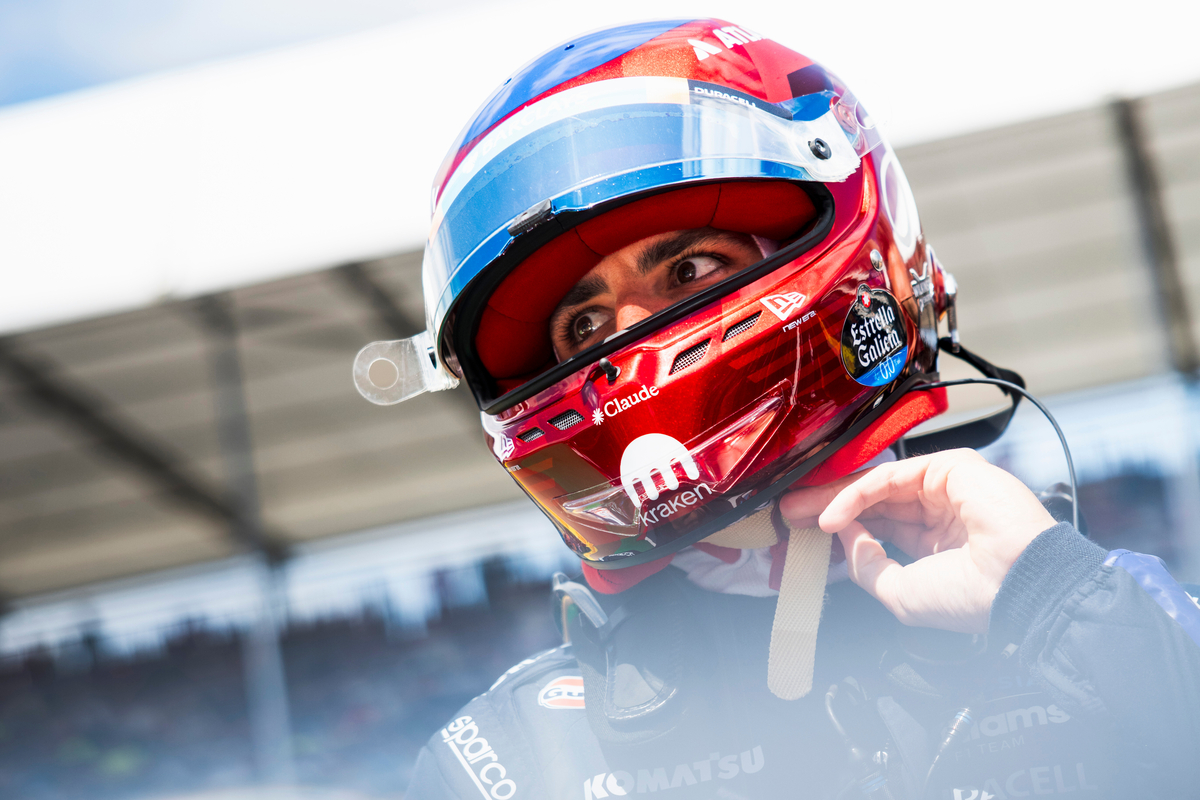
Grand Prix Drivers’ Association co-director Carlos Sainz declared ahead of the 2026 British GP that he is in favour of punishing drivers who bring out yellow or red flags in F1 qualifying sessions with an automatic grid penalty—leading to fellow racers like Max Verstappen, George Russell, Kimi Antonelli, and Charles Leclerc weighing in on the polemic issue.
The Spaniard’s proposal was prompted by Verstappen’s Q3 crash at Turn 9 of the Red Bull Ring, the confusion over yellow flags, and the subsequent pole position secured by Russell.
The stewards initially displayed single waved yellow flags when the Dutchman crashed into the barriers in the final segment of qualifying for the 2026 Austrian GP. They upgraded to double waved yellow flags 22 seconds later.
Meanwhile, this delay allowed Russell to improve his time, as long as he could demonstrate that he had lifted sufficiently for the single yellow flag in place when he passed it.
While he made a 100m lift through the penultimate corner, the Brit had built such a massive advantage earlier in the lap that he still stormed to pole position, beating Leclerc by a margin of over 2 tenths.
In the meantime, championship leader and Russell’s Mercedes teammate, Antonelli, abandoned his flying lap after misidentifying the single waved yellow flag as a double waved one.
Under double waved yellows, F1 drivers must slow down significantly and be prepared to stop, thereby making them abandon any attempt to set a meaningful lap time.
Sainz believes Verstappen’s crash in Austria should’ve triggered a double yellow or red flag immediately
Speaking in a print media session in the lead-up to the 2026 British GP, Carlos Sainz reflected on Verstappen’s qualifying crash in Austria and the chain of events that followed and shared his thoughts on whether the yellow flag rules in F1 should undergo a change.
Revealing that he has an idea that has yet to be discussed, the 31-year-old made it abundantly clear that the four-time champion’s crash should’ve triggered a double yellow or a red flag.
Although he commended Russell for making the rulebook work in his favour and claiming pole position, Sainz added that the regulatory framework shouldn’t have allowed the Mercedes driver to complete his flying lap under dangerous circumstances in the first place.
“I have a very personal idea about this that hasn’t been discussed among the GPDA yet, which I will potentially bring forward as an idea.
“Then we can maybe discuss if it should be the case or not. I think this weekend because of being a Sprint, maybe we don’t have a proper meeting about it. But I think we should.
“It’s clear to me at least, that situation should have been a double yellow or a red. The way George [Russell] handled it I think was perfect—for what the rulebook allows you to do. He deserved that pole position, because he played the rules to perfection.
“But he should have never been allowed to finish that lap or to close a lap in that kind of dangerous situation.”
How allowing a driver’s pole lap to stand after causing a crash is unfair
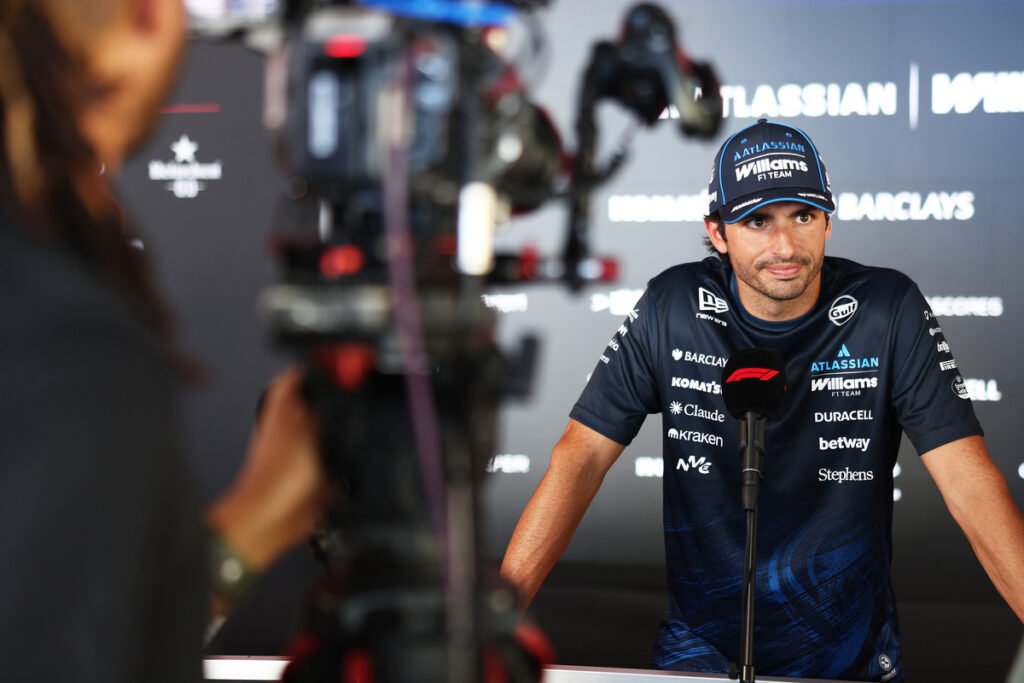
Citing a hypothetical scenario where Verstappen was provisionally on pole and crashed on his final run in Spielberg, Carlos Sainz underlined how it would’ve been unfair to the Mercedes drivers and others if they were no longer able to improve their lap times.
“If Max [Verstappen] would have been on pole in the first run, then he produces that crash, and then everyone is on a red flag and no one improves the lap, I think it would be unfair for George, Kimi [Antonelli], and everyone, because the guy that is on pole is not letting us improve the lap time.”
Additionally, the four-time F1 race winner referred to his own intrusive thoughts during the red flag-filled qualifying session in Azerbaijan last year, where he put his FW47 on provisional pole until the Dutchman pipped him at the last moment.
“Like typically in Monaco. I could have done it last year in Baku, when I was on pole and I was the first car out of the pits. I said, ‘if I crash now, I’m on pole’. We all have these thoughts; we all have these second thoughts. We all know how the rulebook works.”
Sainz calls for new rule that punishes drivers with a grid penalty for disrupting F1 qualifying
Arguing that his proposed solution would sanction those who put others at a disadvantage and disincentivise the abuse of certain loopholes in the F1 regulations, Carlos Sainz suggested that drivers who trigger a yellow or red flag in qualifying should incur a three-place grid penalty going forward.
“And for that I think that anyone who generates a yellow flag or a red flag in qualifying, it should be three-place grid drop.
“So, at least you get penalised for it, and you get disincentivised to go flat out into something, which was not the case for Max, because Max was, I think, P3 at the time. He obviously crashed through a failure of the rear wing. Or something like this.
“But I think we should find a solution for that, and that’s my only idea, that if you generate a yellow or a red you should get some kind of penalty.”
Asked if this penalty would only apply to drivers who find themselves in a crash after provisionally setting the fastest lap in Q3, Sainz clarified that he is advocating for penalising everyone who interrupts a qualifying session, regardless of their ranking on the timing sheet or the nature of their accidents.
“No, if you push flat out but you push too far, and you’re not letting others improve. You’re earning a position by not letting others do a better job than you. Even if non-intentional.”
Whether F1 should permit drivers to complete their laps in the aftermath of an accident
In terms of whether there has ever been a discussion with F1’s Race Director Rui Marques regarding him allowing drivers to finish their laps even after an incident has occurred, Carlos Sainz admitted that the FIA remains inclined to do so unless a really disastrous accident triggers an immediate red flag.
At the same time, the Madrid native highlighted the risks involved when a driver attempts to complete his lap in the presence of a stricken vehicle stationary at the side of the track.
While conceding that the Race Director can let the drivers continue if a minor incident occurs in the first sector, Sainz, nonetheless, maintained that it would be unfair if the timing and location of the crash inconvenienced even a single driver.
“I guess so, yeah. I think the tendency is always to, if it’s not the most severe accident, to finish the lap.
“But for me that’s why when it comes to safety, even trying to finish the lap, something in another Red Bull breaks the rear wing and you crash in the same place.
“If it’s all of the miles behind, yes, [it’s fair to let you finish the lap]. But I think as soon as there’s one guy behind you, it’s unfair because that guy doesn’t get a chance to finish the lap.”
Sainz claims some drivers’ incidents in qualifying have been deliberate
Although he reiterated that Verstappen was not to blame for his qualifying shunt in Austria, Carlos Sainz made it clear that he believes some drivers have been intentionally setting off yellow or red flags to their advantage in the different segments of qualifying.
“At the same time, you could argue the same thing. You have 10 minutes to complete the lap. Why do we all leave it to the last moment? Why don’t we all go eight minutes to go, post our lap, and we are sure that a yellow doesn’t or a red doesn’t disrupt you? Which could be a perfect argument to say we don’t need a penalty for producing a red.
“But I’ve seen it in so many cases by now, that in places like Baku and Monaco, people are forcing yellows in Q1, Q2, and Q3.
“It’s impossible for stewards, unless you are a very clever ex-F1 driver, to know how it works. That for me, shows a solution needs to be found.
“I’m not saying Max did it on purpose. I think Max had a failure. Max was not even on pole. So, he had zero incentive to do that. But I think we need to come up with ideas to try and solve those situations.”
Doubling down on his assertion that such deliberate acts have taken place on the streets of Baku and Monte Carlo, Sainz further suggested that there have been other occasions that the wider F1 community is in the dark about.
“I’ve seen it multiple times in Baku and in Monaco. I think you’ve also seen it in Monaco.
“You’ve seen it. The other thing is that you don’t know, but you’ve seen it.”
Verstappen in favour of harsher penalties for intentional incidents but against current rule that allows completion of laps
Asked to comment on Carlos Sainz’s proposed rule change in qualifying, Max Verstappen responded in Thursday’s print media session ahead of the F1 British GP that deliberate acts that bring out a yellow or a red flag should receive harsher penalties than what the Spaniard had suggested.
In terms of potential solutions, the 28-year-old noted that he is well aware of other motorsport series [like IndyCar] where the punishment for interrupting a qualifying session entails automatic lap time deletions. Nevertheless, he revealed that his bigger concern is the existing rule in F1 that permitted Russell to go fast enough to take pole under a yellow flag.
“I think when someone does it deliberately, there should be a bigger penalty than that. But from my side, of course, it was out of my control what happened there.
“It’s a topic that we have been talking about for a long time. In other series, I think when you create a double yellow or red, you lose your lap, for example. So yeah, it’s things to look at for sure, but that still doesn’t solve what actually happened.
“People are still completing a lap or others are backing out of it. Now you, of course, can read the rules really well. You complete your lap and you’re allowed to keep it.
“But I think, first of all, it should not have been a single yellow. That is at least a double yellow or a red, first of all.
“The driver then, of course, optimises around it. I think that’s fair play. I probably would’ve tried to do the same. That’s just how it goes.
“But it should not even be allowed or be possible to finish your lap like that. That’s, for me, the main concern in all of it.”
Russell believes there are pros and cons to Sainz’s penalty rule in qualifying
Sharing his thoughts on Carlos Sainz’s proposal, GPDA co-director George Russell asserted that there are both positives and negatives to hitting F1 drivers with a grid penalty for causing an incident during qualifying.
Even though he concurred that drivers triggering a yellow or red flag should receive some form of punishment for compromising the laps of other drivers, the seven-time race winner argued that discouraging drivers from taking risks and pushing flat out over a single lap would be detrimental to the spectacle element of the sport.
“It has definitely been spoken about before. If somebody causes a yellow or a red flag, it kind of should be punished. Because it does have an effect on other drivers whether your fastest lap is deleted, and we see that in other series.
“But on the flip side, people will also say that drivers are not taking as much risk come Q3, and you want to see the drivers push the limits.
“No one wants to see someone get hurt. But you want to see drivers going off the track at points and going beyond the limit. So, there are pros and cons both ways.”
Unlike Sainz, Antonelli argues a penalty is fair only in cases of deliberate interruption in F1 qualifying
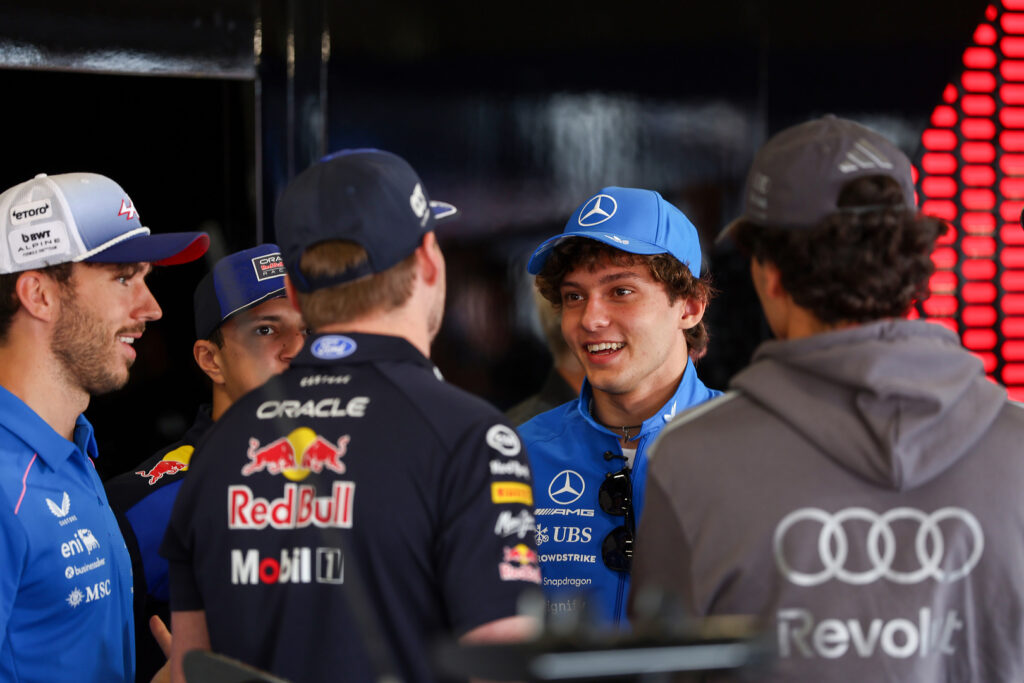
Urged to share his stance on the matter, F1 championship leader Kimi Antonelli expressed the opinion that drivers who make intentional off-track excursions to gain an unfair advantage in qualifying should receive a grid penalty, as Carlos Sainz has recommended.
However, the Italian was also quick to add that instances where drivers make genuine mistakes while pushing hard or encounter mechanical failures should be exempt from such punishments.
“Well, I think the penalty should only come if it was done on purpose, if it’s clear that it was done on purpose. I think if it’s a mistake or a failure, you shouldn’t be implementing any penalties.
“I mean, Max in Austria, he was pushing to the absolute limit and he lost the car and went off. But there’s no reason why he should be getting a penalty for that because he was just trying to go to the limit. Actually me, George, and him were so close, you know, all three fighting for pole, so I don’t see any reason why I would give him any penalties.
“Of course, there have been occasions in the past where drivers, I mean the most common is Monaco, where they go straight on purpose or they do something just to create some mess or a yellow flag, and that should be a penalty, of course.
“But if it’s a mistake because you’re trying to reach the limit or if it’s a mechanical failure, there would be no reason to implement any penalties.”
Leclerc thinks penalties for qualifying incidents shouldn’t be a hard-and-fast rule in F1
Carlos Sainz’s former Ferrari teammate Charles Leclerc said that while he is open to the enforcement of the proposed sanction on certain tracks, he is against it as a blanket rule in qualifying.
Emphasising how Verstappen’s crash had already penalised him—costing him a potential front row—the nine-time F1 race winner reiterated that it would be unreasonable to hand drivers a grid penalty for disrupting qualifying sessions in every round of the F1 calendar.
“I mean I’m not the only one that has crashed in Monaco in qualifying.
“It’s true that it’s one of those races that you can play with the yellow flags a little bit. And I think there are specific tracks where maybe we need to look at that closer.
“Whether this needs to be a general rule… I think the person that ends up in the wall, Max for example in the last race, I think he pays enough price of ending up there and not finishing the lap, which would have been good enough for him to be second. So, I don’t think that, as a general rule, it makes much sense.
“But in some tracks, it’s something that we’ve discussed, as drivers. To install that for the whole season, I don’t think makes sense.”