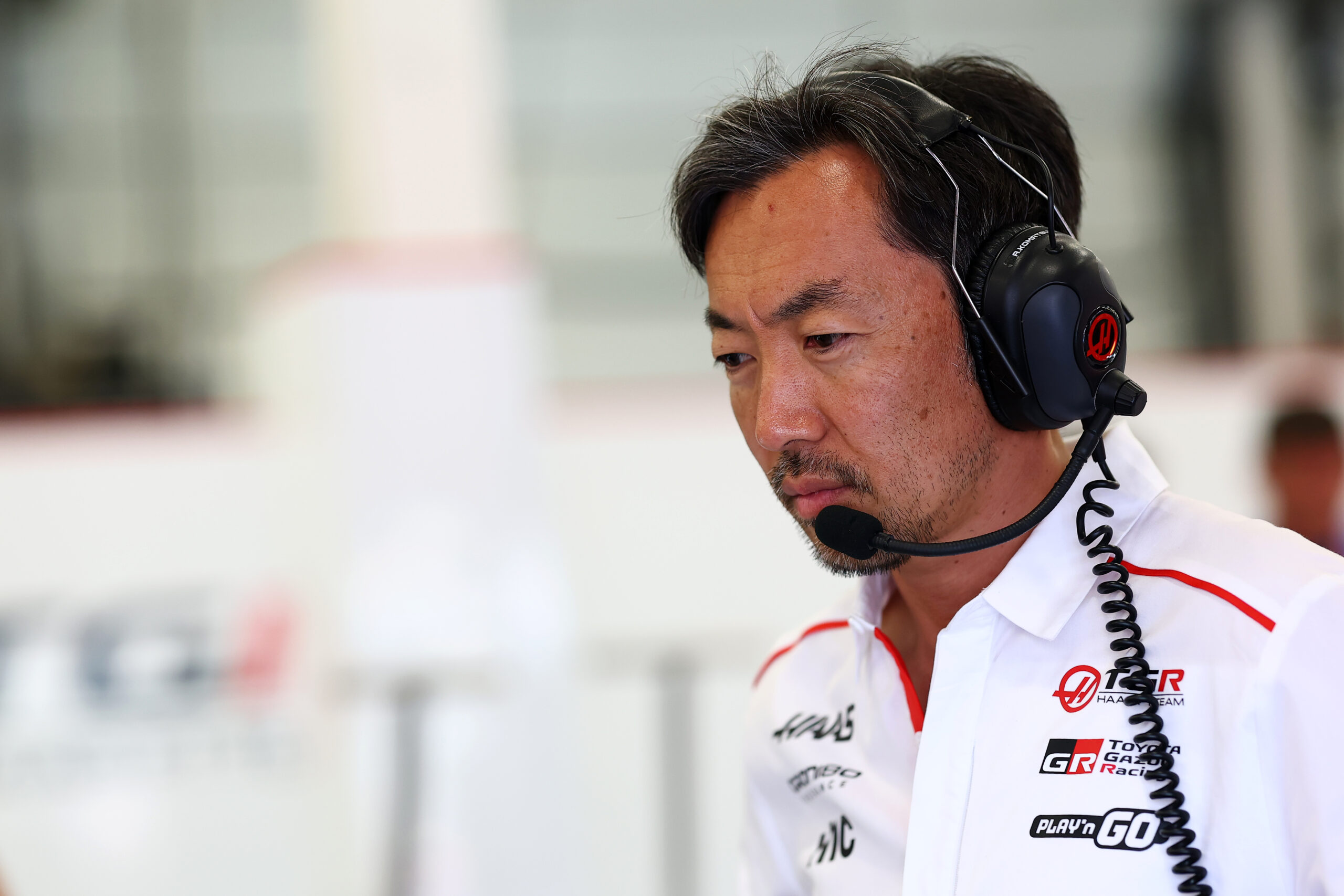
Haas F1 Team heads into the Belgian GP weekend on the back foot as the American-owned squad have fallen behind in the development race versus the likes of Racing Bulls, Alpine and Audi.
Esteban Ocon and Ollie Bearman never looked like top 10 contenders at Silverstone. Following a great start to 2026 where they ran as high as P4 in the Constructors’ Championship, they have slipped to P7, 38 points behind Racing Bulls.
Although it is common for Formula 1 teams to shift their development focus early ahead of the next campaign, Haas Team Principal Ayao Komatsu rejected the notion of writing off working and improving their 2026 F1 challenger.
He insisted on solving the VF-26’s immediate weaknesses, as the Japanese Team Principal believes it is the only way to build the team’s long-term engineering capabilities and understand things for the 2027 package.
Haas F1 Team does not accept excuses, focus on learning and improving
For Komatsu, ignoring current issues on track to focus solely on the future development of the car for the next season is a flawed mentality.
Pointing directly to the issues exposed at recent Grands Prix — they have not scored since Monaco — Komatsu made it clear that the team must learn to quickly diagnose, improvise, and fix their problems as they arise. The Japanese engineer’s approach to Haas F1 Team’s development is shaped by a long-term projection rooted in on-the-spot problem solving.
Under his leadership, the Haas F1 Team has worked hard to dismantle any culture of kicking problems down the road.
Instead, the former Race Engineer insists that writing off a season only breeds excuses, complacency, and a lack of drive for further growth.
“No, it’s not close to cut-off time. But also like it’s about, you know, building a capability.
“So as we said that moment, if you look at the Austria result, it’s pretty clear that we’re missing rear end grip in the medium to high speed, right? If we cannot solve that this year, how are we going to solve any problem next year?
“So you’ve got to build up that capability with the problem you are facing in front of you. Honestly, like previously when we used to say like, ‘Okay, we started the year well, but we’re focusing on next year. So this year doesn’t matter.’ That just creates an excuse, right? So we’re not doing that.“
“Parallel Process” and the financial reality
Some F1 teams decide midseason that they will sacrifice a good chunk of the current season to try and make big gains in the following one with a new car.
However, these operations go hand in hand with whether the team can afford to take this risk in relation to its financial capabilities. Komatsu points out that the Haas F1 Team faces tight financial realities, and they are the smallest squad on the grid.
Since prize money, sponsorships, and future budgets are directly tied to where they finish in the Constructors’ Championship, abandoning the current car development and focusing solely on the next season is simply not an option for them.
Thus, Komatsu calls for a “Parallel Process” as they did last season. While some F1 teams barely brought updates in the previous season to focus on the massive changes with the 2026 regulations, Haas continued developing their 2025 car as well as preparing themselves for the current season.
“We have to do the parallel process, which is what we did last year as well. Like ’25, it’s not like we could throw away ’25 like some other teams could, because sporting result matters for the budget for this year. So we have to do this parallel process, facing the problem in front of you, do as best as you can to improve the car, which we did.“
Becoming better
Looking further down the road, Komatsu warned against the trap of banking entirely on future car concepts without first establishing a proven, functioning one in the present.
Therefore, Haas F1 Team continues to lay the groundwork for the upcoming seasons’ success by finding solutions to its current aerodynamic deficits.
“While we’re preparing for ’26, if you look at how we started this year, I think we’ve done the parallel process very well. But now we’ve got another issue where we’re really lacking medium to high speed, rear downforce. We’ve got to solve that. You know, if we don’t build up that kind of capability next year, car’s going to be terrible again, right?
“So it is a parallel process. It’s not a cut-off point where, ‘Okay, we’re done with ’26, we can go for ’27.’ Because if you just do ’27, until ’27 car runs, you’re not going to prove anything, right? Then if you find in February, ‘Oh, it’s not behaving as it should,’ it’s too late.
“So we’ve got to really take every single opportunity of, let’s say, underperforming as an opportunity to refine your process, improve your process, so we can do a better job.“