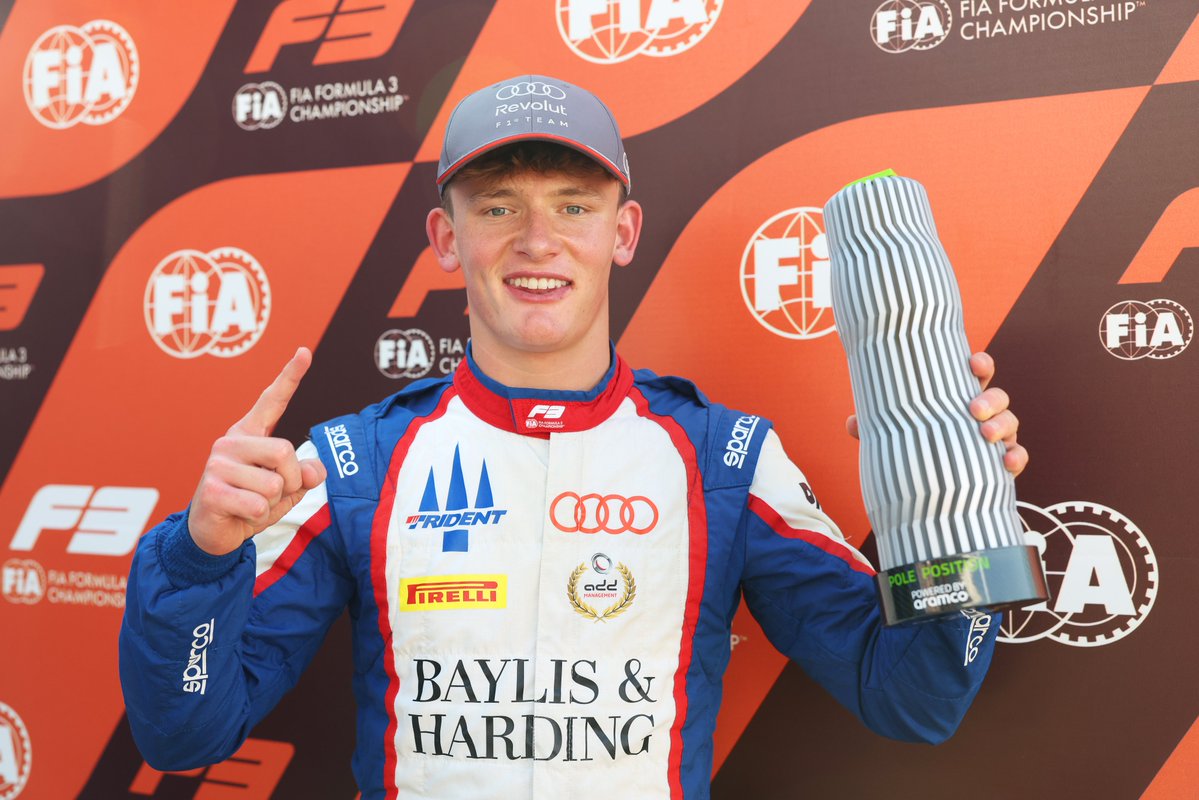
The 2026 FIA F3 Drivers’ Championship will be decided at Madrid, with Freddie Slater arriving at the season finale holding a 15-point advantage over Ugo Ugochukwu and only four drivers remaining mathematically capable of winning the title.
Slater leads on 141 points after Monza, with Ugochukwu second on 126. Campos Racing teammates Ernesto Rivera and Théophile Naël remain mathematically involved on 76 and 75 respectively, but the 65- and 66-point deficits they carry into Madrid leave both requiring extraordinary combinations of results. Everyone from Brando Badoer, Taito Kato and Hiyu Yamakoshi, who are tied on 71, has already been eliminated.
Madrid’s expanded format is what keeps Rivera and Naël alive. The finale features two consecutive Qualifying sessions, one Sprint Race and two Feature Races. Each pole position awards two points, while the two Feature Races retain the normal points allocation. Including fastest laps, a driver can theoretically collect 67 points across the weekend.
The mathematics therefore leaves four possible Champions. The realistic battle, however, remains centred overwhelmingly on Slater and Ugochukwu.
Four drivers remain, but their Madrid equations are very different
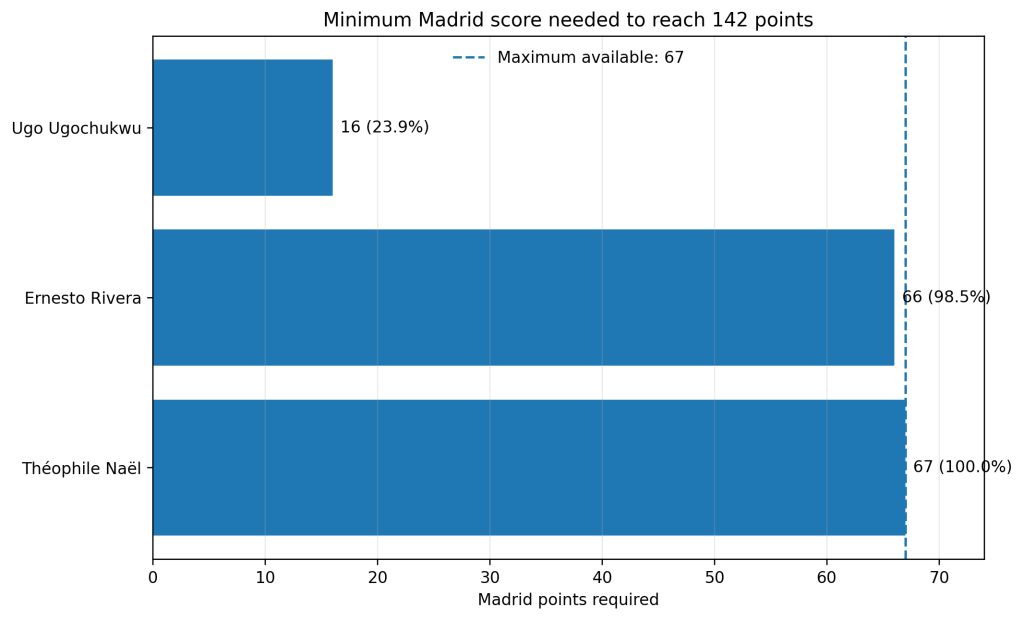
The 15-point gap between Slater and Ugochukwu is significant without being decisive. Ugochukwu needs to gain 16 points across the weekend to finish ahead outright, while a 15-point swing would leave the pair level and send the Championship to countback. Rivera requires a 66-point gain on Slater to finish ahead outright, while Naël needs the full 67-point swing.
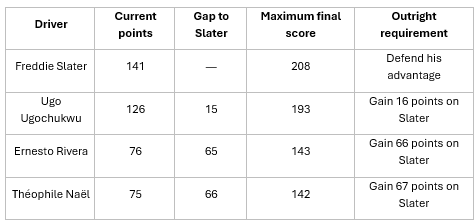
Those figures immediately divide the Championship into two very different contests. Slater and Ugochukwu possess numerous realistic routes to the title, while Rivera and Naël require near-perfect weekends combined with almost no scoring from the Championship leader.
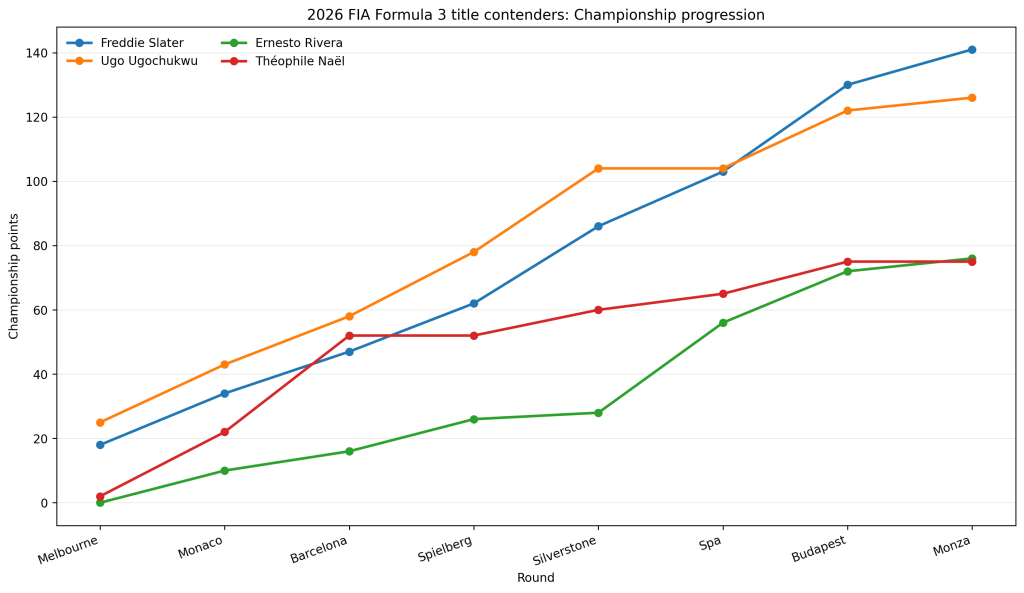
Figure 1: Championship progression through Monza
Slater transformed the Championship before arriving in Madrid
Slater’s position is particularly notable because Ugochukwu led the Championship through much of the season. After Melbourne, Ugochukwu held 25 points to Slater’s 18, before extending that advantage through Monaco, Barcelona and Spielberg. By Silverstone, the Campos driver had 104 points compared with Slater’s 86, creating an 18-point margin.
Spa changed the momentum. Ugochukwu failed to score while Slater collected 17 Feature Race points, reducing the deficit to one. Budapest then put Slater ahead for the first time after he won the Feature Race with Ugochukwu second.
Monza strengthened Slater’s position despite an unusual weekend. He finished second in the Sprint while Ugochukwu failed to score, increasing his lead from eight to 17 points. However, Slater then retired from the Feature Race, but Ugochukwu could only recover from the back of the field to eighth, reducing the final margin to 15.
Slater therefore enters Madrid having turned an 18-point deficit after Silverstone into a 15-point lead, a net swing of 33 points across the last three rounds.
Slater does not need to win in Madrid
The Championship leader’s biggest advantage is the number of different scenarios available to him. Slater does not need pole position, a race victory or even a particularly large Madrid score if Ugochukwu fails to gain enough ground.
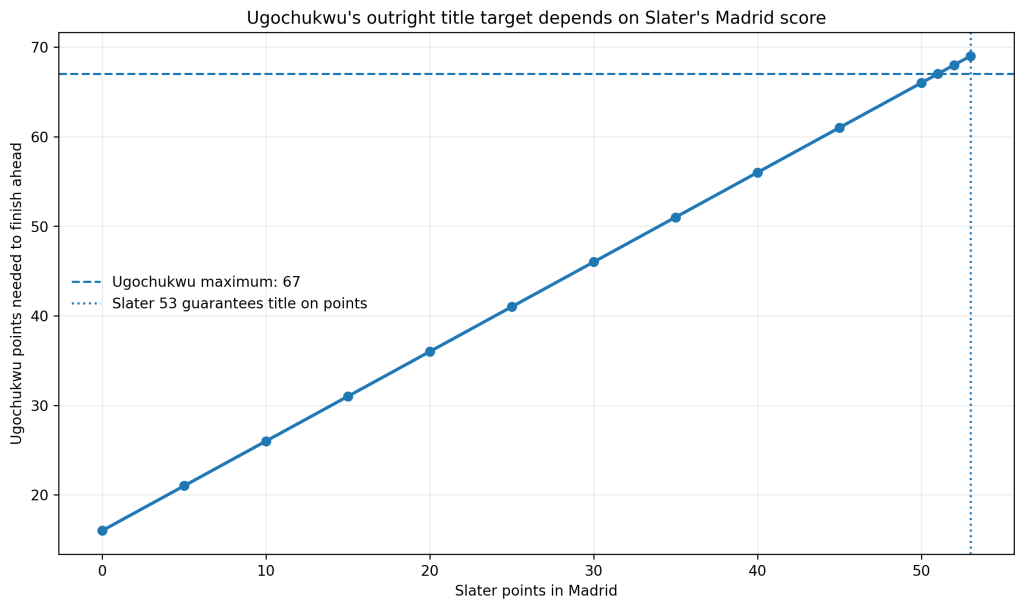
The basic equation is relative. Whatever Slater scores, Ugochukwu must score at least 16 more to finish ahead outright. If Slater scores 20 points, Ugochukwu needs 36. If Slater collects 30, the American requires 46. A 40-point Slater weekend means Ugochukwu must find 56.
There is also an absolute target that removes Ugochukwu from the equation entirely. Ugochukwu’s maximum final score is 193. Slater therefore guarantees the Championship on points if he scores 53, taking himself to 194 regardless of what his rival achieves.
A 52-point score would leave Slater on 193. Ugochukwu could then only draw level by scoring the full 67, which would shift the Championship onto countback rather than giving Slater an automatic title.
Figure 2: Ugochukwu’s required score relative to Slater
Ugochukwu needs a significant swing, but not a miracle
Ugochukwu’s position is far more difficult than it was before Monza, but a 15-point deficit with 67 available remains entirely recoverable. He does not require Slater to fail completely; he simply needs to produce a substantially stronger weekend.
If Ugochukwu scores the maximum 67, Slater can collect as many as 51 and still finish behind on points. A 60-point Ugochukwu weekend allows Slater no more than 44, while 50 points for the Campos driver requires Slater to score 34 or fewer.
The Feature Races provide the largest opportunities for those swings. A victory is worth 25 points, with another point potentially available for fastest lap, while pole adds two. If Ugochukwu were to take pole, victory and fastest lap for 28 points while Slater finished fourth for 12, the entire 16-point swing required for an outright Championship lead could occur in one sequence.
That makes Qualifying particularly important. Madrid offers four pole-position points across the two sessions, and with such a narrow Championship margin, even those bonuses can materially change the equation before racing begins.
Monza increased the pressure on Ugochukwu
The 15-point deficit is also larger than the one Ugochukwu carried into the Italian weekend. He arrived at Monza only eight behind, but qualifying and the Sprint allowed Slater to build additional separation.
Slater took pole for the Feature Race before charging from 12th to second in Saturday’s Sprint. Ugochukwu finished outside the points, leaving the American 17 behind before Sunday.
The Feature Race then offered Ugochukwu an opportunity to recover when Slater retired with an issue. Starting from the back, Ugochukwu climbed to eighth but only added four points, reducing the deficit by two rather than making a major impression.
That weekend illustrates the danger of Madrid for Ugochukwu. Slater does not have to beat him in every session. The Championship leader can afford to concede points provided the losses remain controlled.
For Ugochukwu, simply finishing ahead will not necessarily be enough. He needs to create meaningful gaps between himself and Slater across multiple scoring opportunities.
Rivera’s Championship requires an almost perfect Madrid
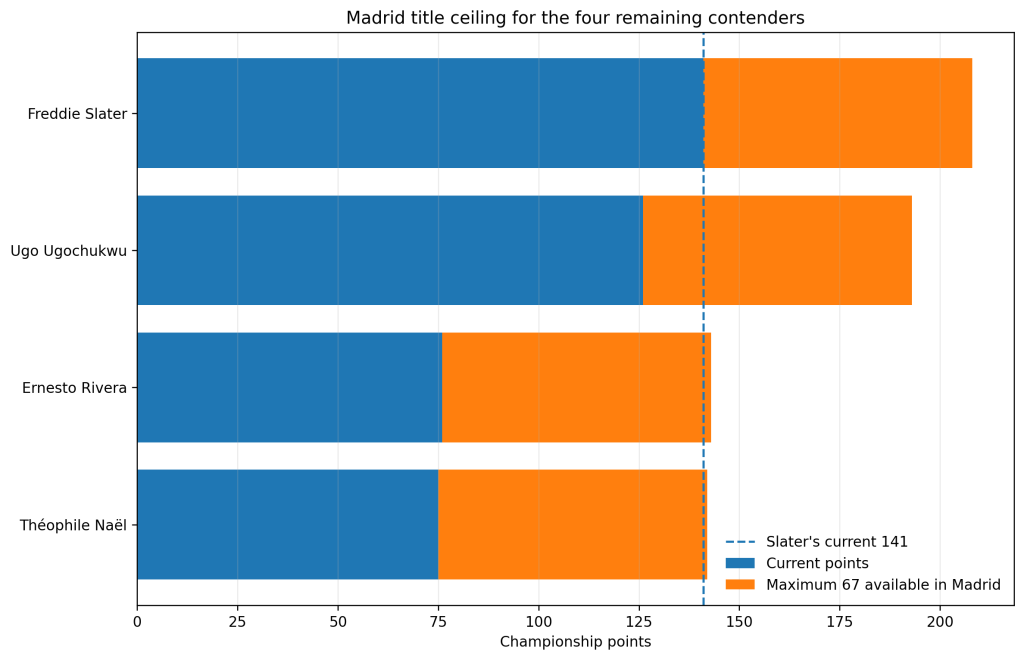
Rivera remains third with 76 points, but his 65-point deficit to Slater leaves almost no room for error. His absolute maximum is 143, only two points higher than Slater’s current 141.
To finish ahead of Slater outright, Rivera needs at least 66 Madrid points if Slater scores nothing. That would take him to 142. A perfect 67 would give Rivera 143 and allow Slater to collect only one point while still finishing behind outright.
Countback creates a small additional route. Rivera could potentially score 65 and finish level with a scoreless Slater on 141. A 65-point Madrid would necessarily include an exceptional collection of race results and could give Rivera a superior Feature Race victory count, depending on exactly where the two missing points were lost.
The larger issue is Ugochukwu. Even if Rivera reaches 142 or 143, the current second-placed driver must also remain below that total.
Rivera therefore needs three events to align: an almost perfect personal weekend, virtually no scoring from Slater and a poor enough Madrid for Ugochukwu to remain behind him.
Figure 3: Madrid title ceilings
Naël effectively needs perfection from Friday onwards
Naël’s situation is narrower again. With 75 points, his maximum possible total is 142. To finish ahead of Slater outright, he must collect all 67 Madrid points while Slater remains on 141.
His Championship could therefore be in immediate danger during Friday qualifying. Once the first two-point pole bonus is awarded, only 65 points remain available. Naël begins 66 behind Slater, which means he must score in that first Qualifying session simply to remain within the mathematical window. Because only pole awards points, he must take it.
The same calculation then repeats in Qualifying 2. Having reduced the deficit to 64 with the first pole, only 63 points remain once the second session ends. Naël therefore needs the second pole as well if Slater remains scoreless.
A 66-point weekend could still potentially produce a Championship through countback if Slater scores nothing, because Naël would finish level on 141. However, anything below 66 is insufficient even before Ugochukwu and Rivera are considered.
For Naël, the title bid effectively requires a perfect or near-perfect weekend from the moment Friday qualifying begins.
Rivera and Naël could be eliminated very quickly
Madrid’s structure creates a series of clear elimination points. Naël is the most vulnerable because he needs both poles simply to remain alive beyond Friday. If Slater takes either pole position, Naël cannot match the points. He will be mathematically eliminated.
Rivera has marginally more flexibility. He begins 65 points behind, meaning he can survive the first Qualifying session if neither he nor Slater scores. However, once both sessions are complete, only 63 points remain. Rivera therefore needs to have gained at least two points on Slater across qualifying, effectively requiring at least one pole while Slater takes neither.
Slater can eliminate Naël completely by adding two Madrid points to his total, because 143 would exceed Naël’s maximum of 142. Rivera remains mathematically capable of tying Slater if the leader scores two, but three Slater points would take him to 144 and beyond Rivera’s maximum of 143.
That means the Championship could realistically be reduced from four drivers to two before the weekend has progressed very far.
Figure 4: Minimum score needed to reach 142 points
The Sprint could finish the outsiders’ title hopes
If Naël survives qualifying by taking both poles while Slater scores nothing, his deficit would fall from 66 to 62 with 63 points still available. Once the Sprint is complete, only the two Feature Races remain, carrying a maximum combined 52 points.
Naël therefore needs to gain at least another 10 points relative to Slater during the Sprint simply to stay within range. That means a victory or equivalent high-scoring result while the Championship leader scores little or nothing.
Rivera faces a similar calculation. If he takes only one pole and Slater scores no qualifying points, he enters the Sprint 63 behind. He would then need the maximum 11-point net gain to reduce the gap to the 52 points remaining afterwards. Taking both poles would provide slightly more flexibility.
The outsiders’ routes consequently become narrower after every session. By the time the first Feature Race begins, Rivera and Naël would need to have already completed much of an almost perfect weekend while Slater remained virtually scoreless.
Their mathematical eligibility is real, but it is extremely fragile.
The first Feature Race is the major elimination checkpoint
Once Saturday’s first Feature Race is complete, only the final 26 points remain available on Sunday. At that point, any driver more than 26 behind the Championship leader is eliminated.
For Ugochukwu, that creates his first realistic elimination checkpoint. He begins Madrid 15 points behind and cannot be mathematically knocked out during qualifying or the Sprint alone because too many points remain available. If, however, he leaves Feature Race 1 more than 26 behind Slater, his Championship is over.
A 26-point deficit would still leave a potential tie available if Ugochukwu scored the maximum in the final race while Slater scored nothing, making countback relevant.
Slater, by contrast, is guaranteed to reach the final Feature Race with a mathematical Championship chance. Even if Ugochukwu scores every available point before Sunday and Slater scores nothing, the largest lead the American can establish is 26 points — exactly the number still available.
The title can therefore be decided before Sunday for Ugochukwu, but not for Slater.
Countback could become a genuine Championship factor
A tie on points cannot automatically be treated as a Slater victory. Under the FIA regulations, dead heats are settled first by the number of Feature Race victories, followed by Sprint Race victories, then second places, third places and subsequent finishing positions.
Slater, Ugochukwu, Rivera and Naël currently each have one Feature Race victory according to the official standings. Ugochukwu, Rivera and Naël also each have a Sprint victory, while Slater has none.
Madrid can completely alter that order because two Feature Race victories remain available. If one title contender wins one or both, that result could become decisive if the final points totals are equal.
For Ugochukwu, a 15-point net gain would produce a tie with Slater rather than an outright Championship lead. The identity of the Madrid race winners would then matter enormously.
The same applies to Rivera and Naël in their narrow tie scenarios. Their extreme points requirements would likely involve multiple victories, which could give either a substantial countback advantage if they somehow draw level with Slater.
Madrid testing offered little indication of a clear favourite
The new circuit also removes much of the historical advantage usually available at a season finale. F3 has never previously raced at MADRING, although the field completed a two-day in-season test there in August.
That test did little to separate the two principal Championship contenders. Ugochukwu finished fastest overall after setting the quickest time in the second morning session, while Slater topped the final afternoon with a 1:49.685. Ugochukwu was second in that session, just 0.105s behind. Naël finished third and Rivera fifth, placing all four remaining title contenders inside the top five of the final afternoon.
Testing cannot be treated as a direct prediction because programmes, fuel loads and tyre usage differ, but there was no indication that either Slater or Ugochukwu struggled to adapt to the circuit.
That makes the final weekend harder to forecast. Slater has the Championship advantage, but Ugochukwu has already demonstrated outright pace at the venue where he needs to overturn it.
Slater has the widest route, Ugochukwu still has a realistic one
The clearest distinction heading into Madrid is not simply between the four drivers who remain mathematically alive, but between the number of routes available to each.
Slater can become Champion without winning a race and without scoring anywhere near the maximum, provided Ugochukwu fails to gain 16 points. A 53-point weekend makes him unreachable on points regardless of anybody else.
Ugochukwu still possesses a genuinely realistic path. Sixty-seven points are available and he needs a net gain of 16. That is significant, but it can be achieved through strong qualifying, a race victory and consistent separation from Slater across the three races.
Rivera and Naël are in a different category. Rivera needs an almost flawless Madrid while Slater scores almost nothing, while Naël requires something even closer to perfection and can see his Championship end during Friday qualifying.
The mathematics keeps four names in the fight. The performance and points requirements reduce the realistic contest to two.
Madrid gives the Slater-Ugochukwu rivalry one final twist
Slater enters the finale with the advantage built from one of the strongest late-season turnarounds in the Championship. He went from 18 points behind Ugochukwu after Silverstone to 15 ahead after Monza, despite retiring from the most recent Feature Race.
Ugochukwu arrives needing to respond after seeing the title lead gradually move away from him. His task is now clear: he must outscore Slater by 16 to avoid relying on countback.
Behind them, Rivera and Naël remain mathematical wildcards rather than conventional title challengers. Their presence nevertheless matters because both are Campos Racing drivers capable of taking poles, victories and points away from Slater while potentially helping Ugochukwu indirectly.
Madrid therefore begins with four mathematical contenders, but the central Championship question is much simpler. Slater has 141 points, Ugochukwu has 126 and there are 67 left to score.
Slater has the margin. Ugochukwu has the opportunity.
Across two qualifying sessions and three races, the 2026 FIA F3 Championship will finally decide which advantage matters more.
Summary
Championship leader: Freddie Slater — 141 points
Second: Ugo Ugochukwu — 126 points
Third: Ernesto Rivera — 76 points
Fourth: Théophile Naël — 75 points
Maximum points available in Madrid:67
- Two Qualifying sessions: 2 points for pole in each
- Sprint Race: up to 11 points
- Feature Race 1: up to 26 points
- Feature Race 2: up to 26 points
Only four drivers remain mathematically capable of winning the title
- Slater
- Ugochukwu
- Rivera
- Naël
Realistic title fight: Slater vs Ugochukwu
- Slater leads Ugochukwu by 15 points
- Ugochukwu must outscore Slater by 16 points to finish ahead outright
- A 15-point net gain would leave them tied on points and send the title to countback
Slater’s maximum final score:208Ugochukwu’s maximum final score:193Rivera’s maximum final score:143Naël’s maximum final score:142Slater’s guaranteed-title target:53 Madrid points
- 141 + 53 = 194
- Ugochukwu cannot score more than 193
Slater does not need to win in Madrid
- If Slater scores 10, Ugochukwu needs 26 to finish ahead
- If Slater scores 20, Ugochukwu needs 36
- If Slater scores 30, Ugochukwu needs 46
- If Slater scores 40, Ugochukwu needs 56
- If Slater scores 51, Ugochukwu needs the maximum 67
Slater’s late-season turnaround
- Trailed Ugochukwu by 18 points after Silverstone
- Leads by 15 points after Monza
- Net swing: 33 points across Spa, Budapest and Monza
Ugochukwu remains a genuine contender
- Needs only a 16-point net swing
- One major Feature Race result can make a large difference
- Example: pole + Feature Race win = 27 points before fastest lap
- If Slater finishes second for 18, Ugo gains 9 points in that sequence alone
Rivera’s position
- Trails Slater by 65 points
- Needs a 66-point net gain to finish ahead outright
- Needs at least 66 of the 67 available points if Slater scores zero
- A perfect 67 points takes Rivera to 143
- Slater could then score only 1 point for Rivera still to finish ahead outright
Rivera’s title route is almost perfect
- He can afford to lose only one point from the Madrid maximum if Slater scores nothing
- His route likely requires:
- both pole positions
- both Feature Race wins
- near-maximum Sprint and fastest-lap scoring
- He also needs Ugochukwu to stay below his final total
Naël’s position
- Trails Slater by 66 points
- Maximum final score: 142
- Needs the full 67-point maximum to finish ahead of a scoreless Slater outright
- Anything less than 66 points cannot even draw level with Slater’s current 141
Naël could be eliminated in qualifying
- After Qualifying 1, only 65 points remain
- Because he starts 66 behind, Naël effectively needs the first pole to stay alive
- He then needs the second pole as well to remain within the points still available
- Slater scoring either pole could eliminate Naël
Rivera can also be eliminated early
- Rivera starts 65 behind
- He needs to gain enough points in qualifying to stay within the shrinking points window
- Slater scoring 3 Madrid points takes him to 144, beyond Rivera’s maximum of 143
Slater needs only 2 points to eliminate Naël outright
- 141 + 2 = 143
- Naël can reach only 142
Slater needs only 3 points to eliminate Rivera outright
- 141 + 3 = 144
- Rivera can reach only 143
After the Sprint
- Only 52 points remain
- Rivera and Naël need major gains on Slater before that point to stay alive
After Feature Race 1
- Only 26 points remain
- Any driver more than 26 points behind the leader is eliminated
Ugochukwu’s first major elimination point
- If he leaves Feature Race 1 more than 26 points behind Slater, his title challenge is over
- If he remains within 26, the Championship reaches the final race
Slater is guaranteed to remain mathematically alive until the final Feature Race
- Even if Ugochukwu scores every available point before Sunday and Slater scores zero, the maximum swing before the final race still leaves Slater within the 26 points available
Countback matters
- A tie on points does not automatically favour Slater
- FIA countback prioritises:
- Feature Race wins
- then Sprint Race wins
- then second places, third places and so on
- Madrid has two Feature Races, so the countback order can still change significantly
Overall picture
- Slater: favourite, widest range of winning scenarios
- Ugochukwu: genuine challenger, needs a manageable 16-point swing
- Rivera: mathematical outsider, needs essentially 66–67 points
- Naël: extreme mathematical outsider, effectively needs a perfect 67-point weekend
Bottom line: Four drivers can still win mathematically, but the realistic Championship fight is Slater vs Ugochukwu. Rivera and Naël need near-perfect Madrid weekends combined with major problems for both leaders.