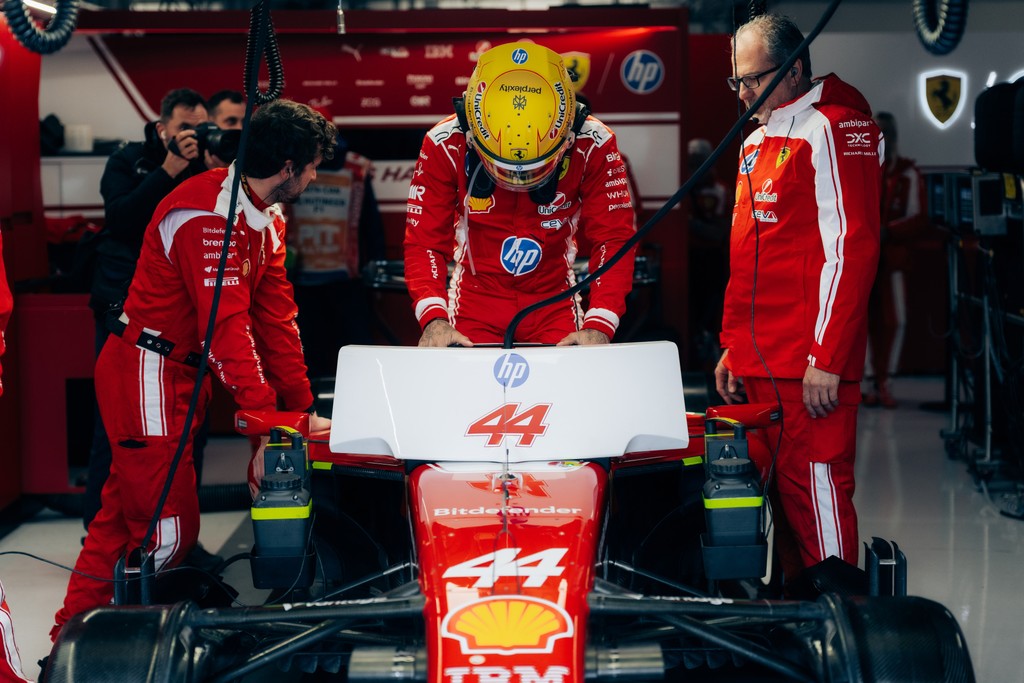
The F1 paddock arrived in Monte Carlo with rival teams positioning Scuderia Ferrari as the concrete package to beat. However, Lewis Hamilton remained firmly grounded before the weekend’s upcoming 2026 Monaco GP sessions.
The seven-time world champion understood that these unique street boundaries demand perfect mechanical compliance under the current 2026 regulations. Straight-line speed deficits severely hindered his qualifying performance at the previous round in Montreal and throughout the year so far. It makes this low-speed layout a crucial structural turning point.
Navigating the unique characteristics of the circuit will determine whether the marquee partnership can claim its first street circuit victory of the season.
Hamilton assesses Ferrari balance changes ahead of the 2026 F1 Monaco GP
Ferrari historically thrives in high-downforce configurations, yet the current technical regulations demands a highly specific operational balance. The team struggled to extract consistent deployment metrics during recent flyaway rounds.
This meant that minimising drag efficiency losses was now the highest engineering priority. Evaluating the performance delta ahead of the competitive sessions, Lewis Hamilton remained cautious about how his F1 machinery will handle the unique bumps of the Monaco GP weekend.
“I would say that this probably, this track would bode better for us than some of the others, obviously because straight line, the long straights we’ve had for example in Montreal where we’ve lost quite a lot of time. Obviously here, we would lose a lot less and I don’t think power is going to be necessarily so much of an issue.
“And our car is good in low speed so I think we’ll be competitive. I don’t necessarily think we’ll necessarily be the quickest but I think we can, especially with Mercedes upgrade at the last track, they were quite quick through the low speed. But I think we’ll be competitive. Where that is exactly we’ll see.”
The top speed deficit suffered in Canada left him exposed to Max Verstappen in the first stint, compounding the frustration in the cockpit.
While the front suspension geometry of the Scuderia car handles kerb compliance exceptionally well, his former team introduces a major threat.
Their latest floor upgrade drastically improved low-speed rotation, introducing a direct mechanical threat that must be actively countered during the single-lap qualifying shootout.
Locked corner mode standardises the aero settings
The FIA safety directive radically alters the engineering playbook by banning Active Aero straight-mode activation for the entire weekend. This has locked the field into maximum-downforce wing configurations.
Generating consistent tyre temperature without the assistance of traditional ground effects forces everyone to rely entirely on mechanical traction. Facing the physical reality of lower grip through the famous tunnel, Hamilton knows every F1 driver will find the limits of their cars pushed to the absolute edge during this Monaco GP.
“I have not driven the sim. I don’t know what it will be like. I’m sure it’s the lowest downforce that we’ve ever had on this track. I imagine it still will be flat out through the tunnel. If we’re lifting, it’s going to be really bad.”
Skipping virtual simulator preparation meant the engineering crew would have to nail the set-up look during Friday practice using live telemetry markers. Since the regulatory framework also mandates a restrictive ‘Rev 1’ engine map that cuts electric deployment power from the MGU-K at 200km/h rather than the standard 290km/hr, top speeds on the pit straight will drop.
If the car feels excessively lively through the high-speed Swimming Pool chicane, the Brit will lack the necessary precision to extract maximum performance when track evolution peaks.
Securing a front-row grid slot depends entirely on conquering the fierce intra-team rivalry currently defining the Maranello squad. Charles Leclerc, who recently extended his contract with the historic team, held a superb head-to-head tracking data across street circuits.
Hamilton will have to closely study the Monegasque’s throttle trace maps as this internal psychological battle dictates the operational energy of the F1 team at the 2026 Monaco GP.