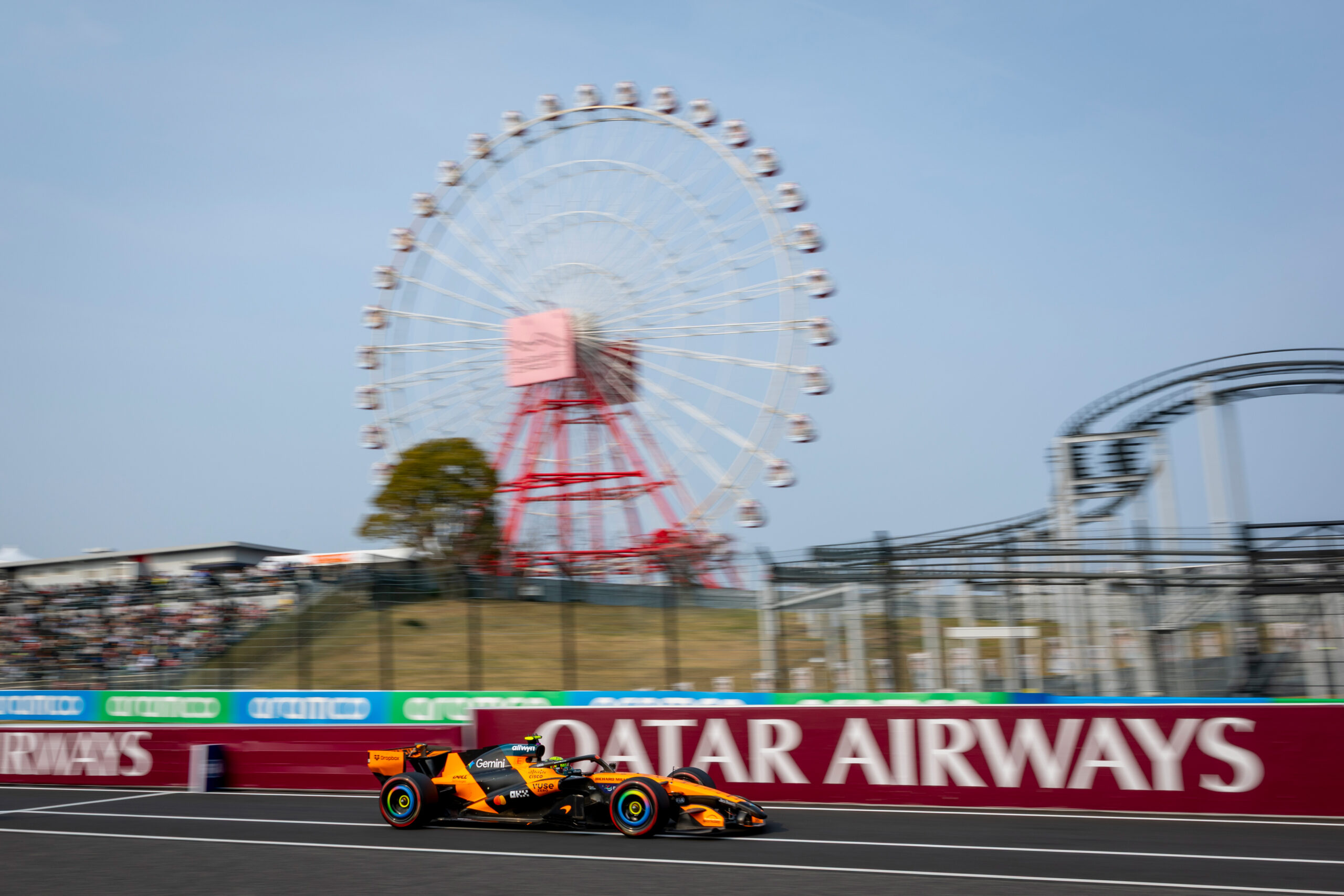
McLaren’s Lando Norris and Oscar Piastri have spoken about the limitations the 2026 F1 regulations place on drivers in qualifying, and how those rules have forced them to adapt their approach to a flying lap. The current regulations have come under heavy scrutiny following the 2026 F1 Japanese GP, which exposed its significant flaws.
From Ollie Bearman’s high-speed crash to super-clipping, drivers across the grid have publicly voiced their concerns about their experiences under the new set of regulations just three races into the season. While the start of the 2026 F1 season hasn’t been the easiest for the reigning Constructors’ Champions, both Norris and Piastri weighed in on the issue.
During a recent media session at McLaren’s Woking base on Wednesday, Norris and Piastri gave detailed responses when asked how much of a qualifying lap now depends on a driver, rather than the car and its systems.
2026 F1 regulations have removed the small margins that once created unpredictable pole positions
While the current regulations have forced drivers to approach qualifying laps differently, Norris explained that they represent a sharp contrast to how execution of a lap has differed compared to last year.
“It depends how many laps you’ve done in practice as well. The system starts to, to a certain extent, learn about certain things and it can still change, it can do little things. You know, it’s more, if you compare it to last year, you can never really have, there’s nothing really to have as an excuse for something happening.”
He noted that while qualifying still requires the same level of commitment, the extra risk-taking that once produced unexpected pole positions has disappeared, reducing the element of unpredictability in the session.
Norris added: “Like, the driver made a mistake or there might’ve been a fundamentally bigger issue with the car. But you know, you’re trying to break as late as possible everywhere. You’re trying to get on the throttle everywhere. You’re trying to carry as much speed as possible in high speed corners, crack open the throttle, do those little things to be as much on the limit as possible at all times. And it’s just that extra who can push it is, you know, 1-2% more in qualifying went away.”
“But those 1 or 2% are the special 1 or 2% that make it exciting, that you might surprise you in terms of this guy suddenly on pole because he’s taken those couple little risks.”
“And you’ve kind of taken that element away. So, Japan and all those places where, you know, you’re trying to push the high speed a little bit and you’re really trying to fight the car. You kind of eliminated some of those instances.”
Qualifying should reward pure pace rather than turning mistakes into advantages
The 26 year-old continued by explaining how the current battery systems can sometimes reward mistakes, which was the case in Shanghai. In an ideal scenario, Norris hopes that qualifying will simply reward a driver’s pure pace.
“The problem is sometimes like we had in China and a couple of other places, sometimes when you make a mistake, it kind of, sometimes it benefits you because the battery gets saved in some ways and then redeploys in a different place and you actually gain. So, you know, in an ideal world, we just wouldn’t have any of that. It’s just drive as quickly as you can.”
Norris believes that the aim is to still drive as quickly as possible. However, he noted how the current regulations have limited drivers from reaching full throttle in certain areas. While the limitations have made it harder to quantify performance, the Briton stressed that drivers still need to execute well to deliver a strong lap.
“It’s still drive as quickly as you can, but within certain aspects, don’t go on throttle here, don’t go on throttle here, which is just not what you’ve ever done in single seaters or GTs or anything really. So, it’s hard to quantify, X amount of this, X amount of that. You still have to do a good job as a driver.”
Norris: “That’s the way it is now” as drivers adapt to qualifying under the current regulations
“I don’t think, you can’t take anything away from whoever puts it on pole because they still have to drive, you know, George, Kimi, whoever it’s been. You still have to drive incredibly well to get everything out of it.”, Norris said.
The Briton believes that drivers no longer get the extra feeling from perfecting a qualifying lap, as the current systems can punish well-executed risks with unexpected time losses. While drivers have had to make compromises when approaching a lap, Norris said the experience feels less satisfying than in previous years and accepted that they now have to work within those constraints.
Norris said: “It’s just, you don’t get that extra couple percent special feeling when you’re on a quali lap because sometimes I think Charles said it. I had it in Shanghai where it gripped up a little bit more car. I cracked open the throttle five, 10 metres earlier. Feels good. You see the delta coming down, you get to the straight and you just go slower. That doesn’t feel good inside the car. You know, you’re like, I did a better job here.”
“I took that risk, I balanced the car, I felt like I was trying to fight perfection and find perfection. And then you just get paid with a silly penalty of going 10 kph slower on the straight, and you lose more than you ever gained. So that’s just the kind of thing that you have to kind of battle your inner qualifying, fight for and learn about that. That’s the way it is now.”
“So, yeah, it’s not the way we want compared to previous years where I think it was very nice, but, it’s also the way it is. And it’s just, you have to maximise what you’ve got nowadays.”
Piastri echoes similar views
Like Norris, Piastri echoed similar sentiments, saying: “I think, I don’t know for sure, but I think some of the tweaks have hopefully removed some of those problems. Because yeah, I agree. I think every qualifying session so far, one of us has made a mistake somewhere and actually it’s helped us rather than hurt us, which is not how it should be.”
With several regulation changes introduced ahead of the 2026 F1 Miami GP, the Australian believes they will address some issues but do not represent a long-term solution.
“So, I’m pretty sure that these tweaks that they’ve just introduced will, you know, maybe not fully solve it, but certainly go a ways to solving it. And yeah, you still have to drive the car on the limit, but just on the limit within a lot more kind of, restrictions now, like, you know, Suzuka.”
Piastri: “Hopefully with these tweaks, it’s a little bit more back to normal”
Explaining how teams decided to approach a qualifying lap in Suzuka, Piastri shared how teams chose to avoid getting back on the throttle between the two Degners. While he acknowledged that it created an unintended element of risk-taking, the Australian hopes the changes should help bring qualifying back to a more natural and less restricted approach.
He said: “You know, we decided, and I think a lot of teams decided that the fastest way around the lap was to not get back on the throttle between the two Degners.”
“But actually what it meant was you had to be probably even braver than normal on the way into the Degner because you knew if you went, you didn’t go hard enough into the corner. If you got back on the throttle afterwards, it was going to be a penalty. And obviously, we shouldn’t be having that debate in the first place, but ironically, it makes some places braver than they used to be before.”
“So, hopefully with these tweaks, it’s a little bit more back to normal and you’re not so restricted in the way you have to try and find that time.”