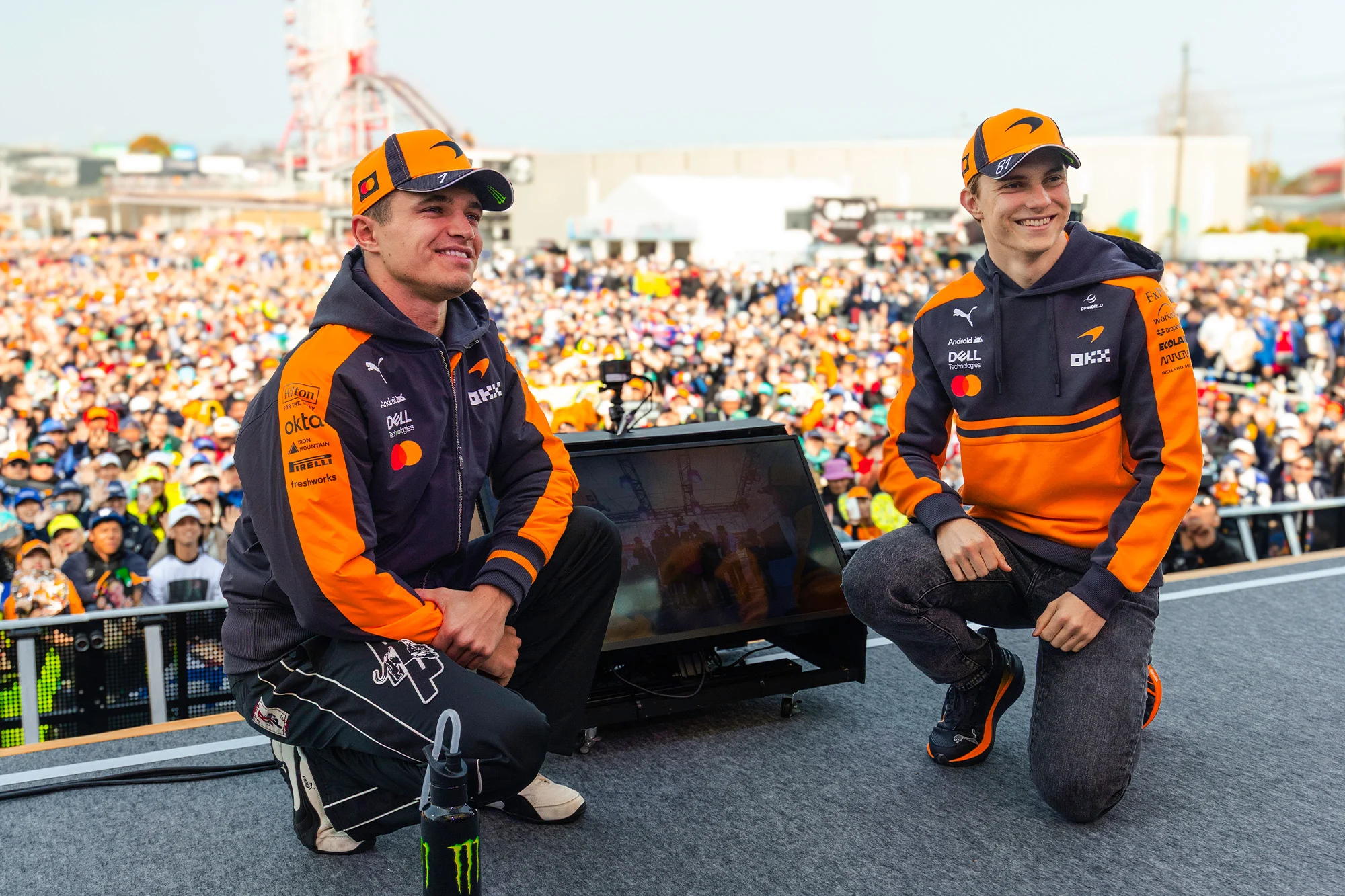
As the 2026 F1 season continues to find itself in an ever-changing climate of rule changes, McLaren drivers Lando Norris and Oscar Piastri find themselves directly in the eye of the storm, where the first three races have been anything but smooth for the Papaya duo.
Piastri was unable to start his home Grand Prix in Australia following a crash. 2025 F1 Drivers’ Champion Norris salvaged a fifth-place finish.
China was the most troubling of races for the team as both drivers were unable to participate due to problems on the power unit side.
It wasn’t until Japan that things gradually started falling into place. Piastri scored the team’s first podium with a P2, while Norris followed in P5.
Following a hiatus from racing during April, Norris and Piastri sat down for a conversation with McLaren during Pirelli tyre testing at the Nürburgring. They shared their verdict on the newest era of F1 cars.
Oscar Piastri views the 2026 F1 car differences as a positive challenge for McLaren
Oscar Piastri wasn’t surprised when he first got behind the MCL40; granted, the drivers had an idea of just how drastic the changes would be.
These changes include more than just an external revamp, but rather changes on a more fundamental level through the foundation of the car itself.
“Overall, these cars are very different to anything I have driven before. But we’ve known this would be the case since the new regulations were shared. It being so different is a new challenge for us as drivers, which isn’t a bad thing.”
One of the more obvious differences in the McLaren comes from being behind the wheel. While one of the main driver complaints in 2025 was the fact that the cars are heavy and challenging to drive in slow-speed corners, the newer versions are lighter, shorter and overall easier to drive.
“One of the big differences with these cars is that they’re lighter and much shorter and narrower than 2025. This means they can be a bit more agile and can feel nicer in the lower-speed corners,” Piastri shared.
But these regulations also bring a plethora of downsides for a driver. Piastri credits one such issue that remains unsolved.
“But the challenges around dirty air still stand and neutralise some of those benefits, as following is still an issue.”
Piastri says decision-making is critical as McLaren adapts to the 2026 F1 regulations
The new regulations introduce perhaps the biggest surprise, with a 50/50 split between internal combustion engine and electrical energy. Drivers now have far more to think about than just managing tyres, placing extra focus on their tactical decision-making abilities.
The introduction of electrical energy forces drivers to hold back significantly, especially in the corners before hitting long straights.
“There is also a lot more to think about in the car as a driver. You also have to think more tactically around quite a few things, especially on the power management side.”
This complexity, however, makes the car a lot more volatile in terms of how it would react in certain scenarios — Piastri acknowledges that this trait would require refinement as the season progresses, since it can be detrimental for the person behind the wheel.
“These cars are also more unpredictable. You’ll have seen we often get spikes of power which makes these cars do unexpected things,” Piastri shared.
“This is just one area of quite a few that needs to be looked at and changed in the imminent future, highlighted further by a few different incidents across the season so far.
“I know we are working closely with the FIA, F1 and other teams to ensure these things are being looked at to ensure safe, but fun and exciting racing for everyone.”
Lando Norris on how McLaren’s 2026 F1 car compares to 2025
Piastri’s teammate, Lando Norris, describes these changes as “quite complex” compared to last year, focusing on the intricate details that set this new era of cars apart from anything before.
“These cars are certainly very different from the cars from last year, and the differences are quite complex. Some of which I enjoy, some of which I’ve found a bit more difficult so far.”
Last year’s high-downforce cars delivered ample performance, but only within a narrow operating window because of how sensitive the ride height was, leaving drivers with little room to influence the car once they exceeded that limit.
“Last year we had loads of downforce, cars that really felt like they were on rails when we got them dialled in and what felt like never-ending speed.
“However, when you lost grip, that was it, you were just losing time at best or heading for the gravel.”
Drivers often found that rigidity frustrating, as performance hinged more on a perfect set-up than their own instinct or ability to adapt in the moment.
“That could be quite frustrating as it didn’t feel like you could make as much of a difference yourself as a driver, you needed the car underneath you and needed to ensure you stayed within the limits of the car.”
A throwback to junior formula days
Fast-forward to 2026: the cars with less downforce philosophy has shifted the balance back towards the driver.
“This year the cars are much lower downforce and much more on the limit. You can catch slides more easily, and the slightly lower grip makes for a very exciting car to drive.
“As a car, I’m enjoying driving them, they remind me of some of the cars I drove coming up through the junior series, and I say that as a big compliment, you really feel like you can make a difference.”
Norris feels the new cars restrict control when it matters most
Despite the positives, Norris is clear that not every aspect of the new regulations has had the same effect. In particular, the power unit systems have introduced complications that take control away from the driver at critical moments.
“I’ve said before that it’s not the car I’m struggling with, it’s the bit behind us that I’m not enjoying as much, the power unit regulations.”
Norris provided an example during a moment between himself and Scuderia Ferrari driver Lewis Hamilton at the 2026 Japanese GP that resulted in an unprompted overtake.
“I had a scenario in Japan where the battery deployment triggered, even though I didn’t really want it to, and I had to overtake Lewis as a result.
“That meant I was then a sitting duck on the next straight, where I had actually wanted to use the battery.”
Too much control taken from the drivers
The Briton has joined a growing number of drivers expressing discontent over the new 50/50 split and the significant impact it has on decision-making during the decisive points of a Grand Prix.
“For me, that’s taking too much control away from the driver, but I know that the FIA and all the stakeholders of the sport are looking into it.
“There has been good dialogue with the FIA on this topic, so I am confident that something will be done for when we go racing in Miami again.”
However, this new era has already produced some exciting racing with overtakes like the season-opener in Australia, where Charles Leclerc and George Russell battled for the lead during the opening eight laps.
Norris was quick to remind that at the end of the day, F1 is an “entertainment sport” which means the public want to see on-track battles between some of the most unpredictable teams and drivers, and F1 is almost close to reaching an exciting period of racing.
“One important point though, is that we’re glad the fans are enjoying the racing, because we’re an entertainment sport at the end of the day.
“Fans want to see us out on track battling each other and the limits of grip. We need to avoid artificial elements of racing where we can, but we’re not too far away from achieving that and having a really exciting era of racing.”