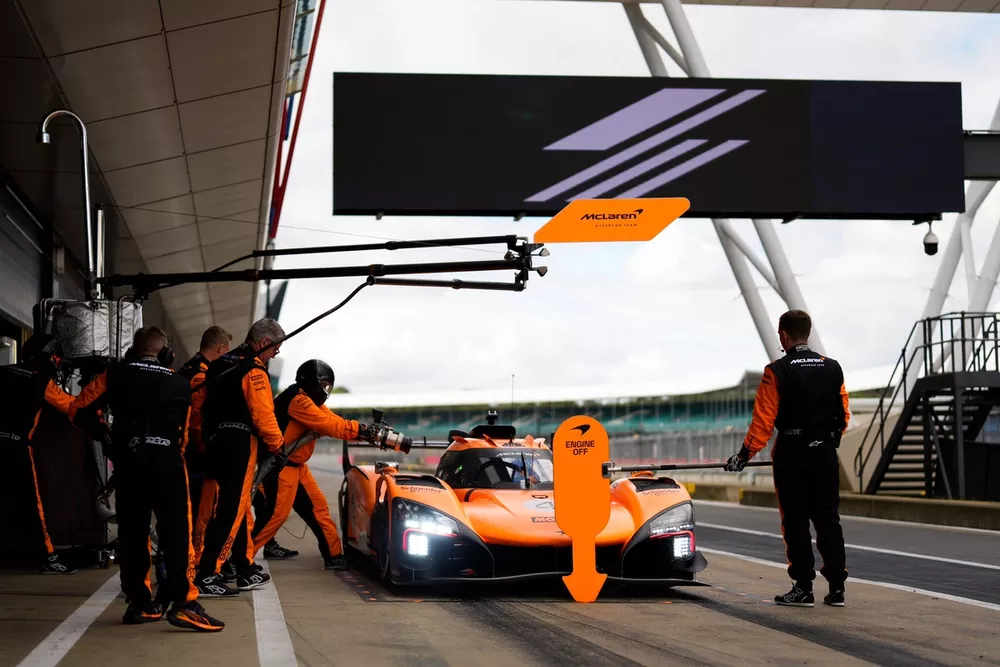
McLaren has completed the first full endurance test of its MCL-HY Hypercar as development intensifies ahead of the manufacturer’s return to the top level of the FIA World Endurance Championship (WEC) in 2027. The LMDh prototype ran for more than 30 hours at MotorLand Aragón during a programme designed to replicate the demands of an endurance race and test the reliability of the car, its systems and the newly formed McLaren Hypercar Team.
McLaren began running the MCL-HY in May with its first shakedown at Varano before moving through tests at Imola, Magny-Cours, Aragón and Silverstone. While the team has not disclosed its total mileage, Team Principal James Barclay said the programme has already accumulated considerable running as it moves closer towards homologation.
McLaren clears first major endurance hurdle
The Aragón programme marked a significant step beyond the shorter development tests McLaren conducted earlier in the year. Although the MCL-HY did not run uninterrupted for the entire 30 hours, the team only made brief inspection stops rather than needing lengthy periods in the garage to rectify major problems.
“We did our 30-hour test as planned, which was great,” said Barclay, before adding, “We did over 30 hours, so we went beyond. We were running it as if we were running a race. There are things we want to stop and check for because we don’t want to damage something inherently. We do a quick stop and a check and go again, but it was a 30-hour test.”
The early endurance exercise allowed McLaren to expose components to stresses that dynamometer and simulator work cannot fully reproduce.
The MCL-HY uses a Dallara LMDh chassis but combines it with several bespoke McLaren elements, most notably its aerodynamic package and purpose-built 2.9-litre twin-turbocharged ATM V6 engine.
Consequently, the team needed to understand how the complete package behaved after sustained running over kerbs and through repeated pit stops, refuelling procedures and driver changes.
“Systems-wise, does everything work as it should do? It’s everything from refuelling… it’s the team operation side of things. It’s the powertrain, absolutely the ICE side,” Barclay notes. “You can do dyno, but doing dyno is one thing. But when you’re riding over kerbs for a race distance, does everything hold together the way it should do?”
McLaren enters ‘fail-fast’ development phase
The test also allowed McLaren to begin understanding the lifespan of individual components before locking down its final specification. Some parts need significant mileage before engineers can determine their limits, while others have lengthy manufacturing lead times and therefore require early validation.
McLaren has deliberately pushed components during testing so that weaknesses appear with enough time to redesign them before homologation.
“We’re in that kind of fail-fast phase as well to see where are we with certain lifeing and mileaging on parts,” Barclay said. “There’s only so much we can do on a dyno. We have to kind of pound round and see where we are on some of those bits and pieces in the car.”
That philosophy made the successful completion of the Aragón programme encouraging, although McLaren has not interpreted it as proof that the car has completed its reliability development.
Barclay admitted that the team entered the test without knowing precisely how the MCL-HY would respond to such sustained running.
“We weren’t confident. We weren’t unconfident,” Barclay admitted of the team’s expectations before the test. “You know, we had good tests, but we couldn’t… we didn’t really know. What we don’t know, we don’t know. The whole point of doing it early is to understand where we are.”
The team encountered minor issues related to the maturity of some bespoke components but avoided a fundamental problem that halted the programme.
McLaren has subsequently worked on smaller details including fixings, mountings, brackets and cooling arrangements as it refines the prototype.
Endurance test also develops new Hypercar team
McLaren has not simply created a new car for 2027. The project has also required the manufacturer to establish an entirely new race operation.
The Hypercar programme now employs just under 100 people, drawing experience from Formula 1, Formula E and sportscar racing. As a result, the Aragón test also served as an endurance exercise for the organisation itself.
Mikkel Jensen and Laurens Vanthoor drove alongside Ben Hanley, Grégoire Saucy and Richard Verschoor during the Aragón running. Jensen, Vanthoor and Hanley then continued the programme at Silverstone.
Barclay highlighted the importance of allowing personnel from different racing backgrounds to experience the demands of running deep into a long-distance test.
“Cars have a team operation. They’re really important,” says Barclay. “A really group of experienced people from sportscar racing, but yes, some from Formula One side as well. And we’re almost kind of gelling that group together.
“For those who come from Formula One or the Formula E background, taking them into uncharted territory around running a car beyond 24 hours… is a different mindset. At the end of that test, the camaraderie in the group was fantastic. You bond as a group.”
The exercise therefore provided McLaren with an opportunity to refine operational procedures and working relationships alongside the technical development of the MCL-HY.
Silverstone test shifts focus towards performance
With the car now accumulating meaningful reliability mileage, McLaren has started moving beyond basic systems validation.
Early tests concentrated on ensuring the engine, hybrid system, chassis, software and other systems communicated and functioned correctly. More recent running has allowed the team to explore the MCL-HY’s performance characteristics in greater detail.
At Silverstone, McLaren conducted sweeps involving brake balance, aerodynamic settings, aero mapping, systems and controls.
Rather than pursuing an outright headline lap time, the team has started exploring how the car behaves across the range of conditions it could encounter under WEC’s Balance of Performance system.
“We’re not sat here running low fuel,” Barclay said. “We’re being realistic and understanding where, with the BOP window as well in terms of weight and power, and understanding how the car performs across that range, which we’ll have to race with as well.
The MCL-HY has run at full power since its initial shakedown, but McLaren now needs to understand its wider operating window instead of optimising it for only one particular power and weight configuration.
Tyre work has also become increasingly important as the team evaluates the Michelin range already used by current Hypercar competitors.
“And everyone is racing the new tyre already. So now it’s starting to understand the different compounds, how they overlap, where the overlap is, how they differ, what suits the car as well.”
Dedicated simulator supports track development
McLaren has also brought a dedicated Dynisma driving simulator online at the McLaren Technology Centre to support the Hypercar programme.
The driving-loop simulator became fully operational around the end of June and beginning of July and now forms part of an increasingly integrated development cycle. Drivers can prepare for a test in the simulator, complete the real-world running and then return to Woking to compare the two datasets.
“Mikkel’s example was in the sim before coming here, and then we’ll do a correlation after,” Barclay said. “Every test we can kind of prep, test, come back and close that gap.
“The closer we get the correlation, then we can really start relying on that for setup information, for tuning as well.”
Improving that correlation will become increasingly valuable once McLaren finalises the physical specification of the MCL-HY and can focus more heavily on race preparation and set-up development.
MCL-HY approaches homologation specification
McLaren does not expect major visual changes to the prototype before homologation. The team will continue refining individual components, but Barclay indicated that the car running at Silverstone closely represents the basic specification it expects to take forward.
McLaren also intends to continue testing primarily with one chassis until it feels confident in the package. Building multiple examples while components remain under development would create unnecessary complexity and force the team to manufacture several versions of parts that could soon change.
Only when the design reaches a sufficiently mature stage will McLaren introduce a second MCL-HY.
“We’ll go eventually to two cars when we’re kind of comfortable and ready.”
The approach also allows the engineering group to concentrate driver feedback through one development car rather than attempting to process input from several prototypes simultaneously.
More endurance running planned
McLaren still has considerable testing ahead before its competitive debut. The team plans further endurance tests and intends to push beyond the 30-hour benchmark established at Aragón. Meanwhile, shorter outings will increasingly focus on performance as engineers explore setup options and refine the car.
However, McLaren does not intend to accumulate mileage simply for the sake of running.
“It’s great to say we’ll test again next week. But if we roll out exactly the same thing with no updates, kind of pointless.”
Instead, engineers want enough time between outings to analyse data, introduce improvements and ensure each test advances the programme. That approach applies equally to the people involved.
“It’s team development, not just car development,” he said. “We’ve been testing nonstop since May, and a lot of development behind the scenes.”
‘No showstoppers’ as McLaren stays on schedule
McLaren still faces the considerable challenge of entering a class populated by manufacturers with several seasons of accumulated experience. Toyota, Ferrari, Cadillac and BMW already possess extensive knowledge of their respective Hypercar programmes, while McLaren must create both a competitive prototype and a race-ready organisation before its 2027 debut.
Nevertheless, the opening months have kept the programme on its intended timeline. The MCL-HY has run at full power, experienced wet conditions, begun performance development and completed an endurance test lasting beyond 30 hours without encountering a fundamental reliability problem.
“We’re in really good shape here,” said Barclay. “The baseline of the car is really positive, and the fact that we’re on time, we have no showstoppers, which is really important as well.”
However, McLaren will only discover where it truly stands when the MCL-HY competes against the established Hypercar field.
“It’s going to be a long journey. We got out, the drivers are smiling, with full power on the first full day, it has potential but that doesn’t mean anything right now. When the green light goes in pit lane and we do our first competitive session, our first qualifying or two or the first race or two, then we can judge where we are. But the indications are that we’re in that ballpark.
Barclay believes McLaren has established the underlying structure it needs. The coming months will determine how effectively the team can add the finer details before its first WEC race.
“We’ve got an outline of a painting. We’re kind of colouring it in.