Michelin enters the 2026 24 Hours of Le Mans with history, performance and sustainability firmly connected. The French manufacturer can secure its 35th overall victory at the event and claim the record for the most wins by a single tyre manufacturer. To reach that milestone, Michelin will rely on its latest Pilot Sport Endurance range across all 18 cars in the Hypercar field.
However, the new tyres represent more than another attempt to win endurance racing’s most prestigious event. Michelin has also used their construction and appearance to highlight advances in renewable and recycled materials, temperature management and long-distance performance.
Wider temperature windows increase strategic freedom
Michelin developed its latest endurance tyres through simulation before completing an extensive testing programme in Europe and the United States.
The tyres have already competed during the opening rounds of the 2026 FIA World Endurance Championship. During those events, Michelin recorded improvements in warm-up performance and expanded the operating windows of its soft and medium compounds.
Pierre Alves, manager of Michelin Motorsport’s endurance racing programmes, explained the development process.
“Our latest endurance racing tyres were developed using sophisticated simulation technology before being signed off following an extensive test programme in Europe and the USA,” reveals Pierre Alves, manager of Michelin Motorsport’s endurance racing programmes.
He then outlined how those developments have translated into competitive gains.
“They have since confirmed the significant progress we have achieved in terms of warm-up performance and wider temperature windows in the opening rounds of the 2026 FIA World Endurance Championship.
“The soft MICHELIN Pilot Sport Endurance slick now covers track temperatures of up to nearly 30°C, while the medium performs strongly down to 15°C. This means the two compounds are comparable from 15°C to 25°C, which in turn gives the teams more strategy options. At low-wear circuits like Le Mans, this degree of versatility is clearly a huge asset.”
The overlap between the soft and medium compounds gives teams more flexibility when temperatures change. Consequently, engineers can respond to shifts between daytime heat, cooler evening conditions and the lower track temperatures that often arrive overnight.
That versatility could play an important role at Le Mans, where teams must balance outright pace against tyre life, traffic management and unpredictable weather.
Triple stints could prove crucial
Each Hypercar may use up to 56 slick tyres during the race. Therefore, teams must manage their allocation carefully across 24 hours of competition.
Michelin recommends that its partners prioritise triple stints. That approach would allow a car to cover more than 500 kilometres on one set of tyres and reduce the time lost during pit stops.
Alves nevertheless acknowledged that teams may adopt more aggressive strategies depending on their circumstances.
“Our recommendation to our partners is to favour triple stints, which is equivalent to more than 500 kilometers on the same set,” explains Alves. “That said, those who prefer to explore more ‘aggressive’ alternatives know they can count on the advice of our experienced technicians who work within the different Hypercar teams.”
Long tyre life can deliver a decisive advantage at Le Mans. A team that changes tyres less frequently can shorten its pit stops, protect track position and create more strategic options during safety-car periods.
However, drivers must also maintain consistent pace as the tyres accumulate mileage. As a result, Michelin has focused not only on durability but also on predictable handling and sustained performance.
Michelin makes hidden technology visible
Michelin has also changed how its 2026 Hypercar tyres look.
At high speed, spectators usually see little more than a black rotating circle. Nevertheless, each tyre contains years of research, testing and material development. Michelin has therefore used visual design to communicate the technology that normally remains hidden beneath the surface.
The company has introduced a patented micro-velvet finish to the Pilot Sport Endurance range. The finish changes how light reflects from the tyre and creates a distinctive patterned appearance.
A special coating only a few hundredths of a micron thick produces the effect. The coating performs a purely visual role and does not alter the tyre’s competitive characteristics.
Through this design, Michelin aims to draw attention towards the engineering and material innovation inside each tyre. The company has effectively transformed the sidewall and tread into a visual representation of its wider development programme.
Renewable and recycled materials reach 50 per cent
The new Pilot Sport Endurance tyres contain 50 per cent renewable or recycled materials.
Michelin uses several alternative ingredients, including carbon black recovered from old tyres, oil and resins produced from biowaste, recycled steel, silica derived from biowaste and natural rubber from rubber trees.
Crucially, Michelin has introduced those materials without sacrificing competitive performance. Instead, the company has reported improvements in warm-up behaviour, consistency and handling.
This achievement follows a development path that Michelin publicly demonstrated in 2021. At that time, the manufacturer introduced a tyre containing 46 per cent sustainable materials for the hydrogen-powered H24 prototype.
Five years later, Michelin has raised that figure to 50 per cent in tyres that will compete across the entire 2026 Le Mans Hypercar field. Therefore, the project has moved beyond a technological demonstration and into front-line competition.
Le Mans continues to accelerate innovation
Michelin has used the 24 Hours of Le Mans as a development laboratory since the inaugural race in 1923.
That first event produced Michelin’s opening Le Mans victory, as the winning car used the company’s removable tyre technology. More than a century later, Michelin continues to test new ideas under the extreme loads and rapidly changing conditions that define the race.
Le Mans places tyres under sustained pressure through high-speed corners, heavy braking zones, long straights and repeated changes in track temperature. Moreover, the circuit combines permanent racetrack sections with public roads, creating different surfaces and grip levels around the lap.
Those demands allow Michelin to test technologies in an environment that exposes weaknesses quickly. They also help the company assess how new materials and manufacturing methods behave during prolonged high-performance use.
Michelin ultimately aims to produce tyres entirely from renewable or recycled raw materials by 2050. It has also set an interim target of 40 per cent across its wider tyre range by 2030. The new Le Mans tyre already exceeds that interim percentage, although racing tyres and mass-market products face different production demands.
Eight manufacturers pursue victory on Michelin tyres
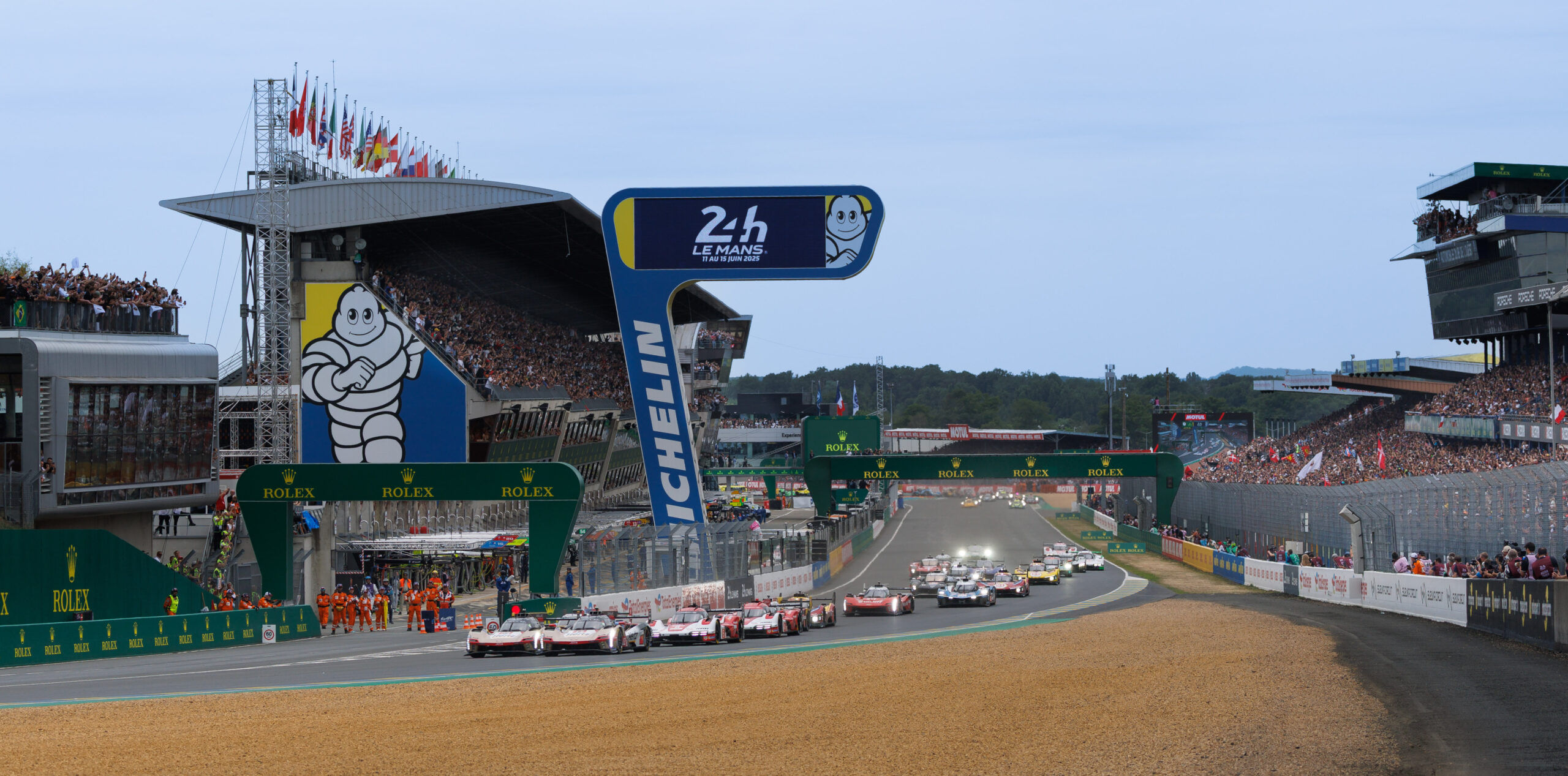
Michelin supplies all eight manufacturers competing in the 2026 Hypercar category.
Ferrari arrives at Le Mans after winning the previous three editions, while Toyota hopes that its new TR010 Hybrid can return the Japanese marque to the top step of the podium.
Meanwhile, BMW and Cadillac demonstrated strong one-lap performance during Hyperpole and secured the front row for the 94th running of the race.
Those manufacturers have developed cars with different chassis concepts, aerodynamic characteristics and powertrain layouts. Nevertheless, Michelin must provide tyres that work across the full field while maintaining performance, reliability and strategic flexibility.
That challenge makes the 2026 range particularly significant. The tyres must support every Hypercar manufacturer, withstand triple stints and operate across overlapping temperature windows while incorporating a substantially higher proportion of sustainable materials.
Michelin stands one victory away from history
A win in the 2026 24 Hours of Le Mans would give Michelin its 35th triumph and establish a new record for a tyre manufacturer at the event.
However, the company’s latest development programme already carries broader importance. Michelin has created tyres that offer teams more strategic freedom, support long-distance running and incorporate 50 per cent renewable or recycled materials.
At the same time, its new micro-velvet design makes that technical progress more visible to spectators.
Therefore, Michelin enters Le Mans with two connected objectives. It wants to secure another historic victory, but it also wants to demonstrate how endurance racing can drive material innovation and shape the tyres of the future.