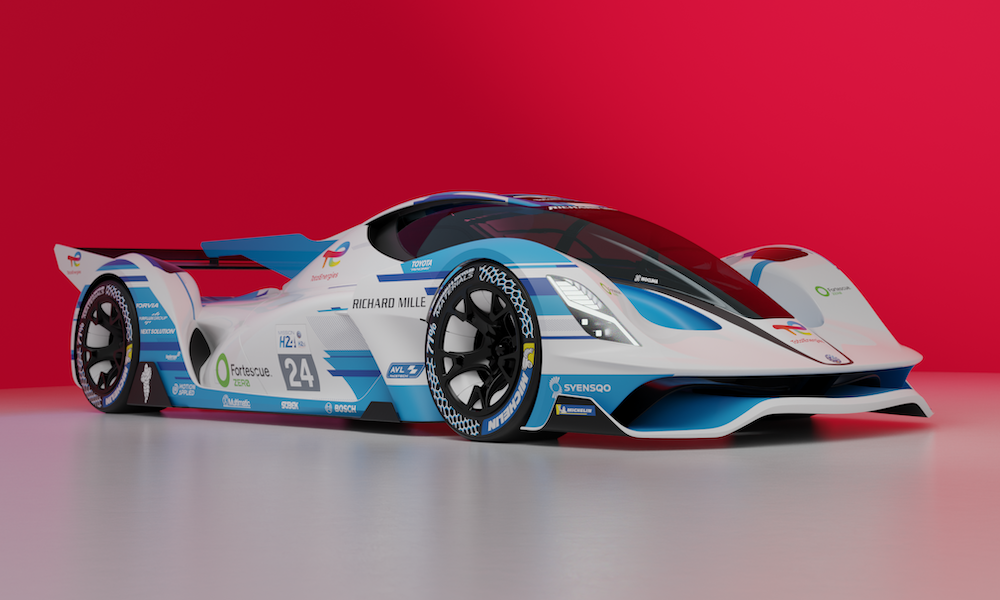
MissionH24 has expanded its partnership with Toyota Racing, with the Japanese manufacturer set to supply a hydrogen combustion engine for the H24EVO concept car.
The H24EVO will use a 3.5-litre V6 developed specifically for motorsport by Toyota, replacing the fuel cell-based powertrain previously planned for the prototype. Work has already begun to integrate the new engine with the chassis and gearbox as MissionH24 prepares for the next phase of the car’s development.
The agreement significantly expands an existing relationship between Toyota and MissionH24. The two organisations had already joined forces to work on the H24EVO’s aerodynamics and cooling, but Toyota will now provide the technology at the centre of the prototype as endurance racing prepares for the introduction of hydrogen machinery.
Toyota expands its MissionH24 involvement
Toyota’s involvement in the H24EVO initially focused on cooling and aerodynamic development, with the partnership forming part of the Japanese manufacturer’s wider exploration of hydrogen technology.
The two organisations publicly detailed their collaboration during the FIA WEC’s Fuji weekend, when Toyota’s engineers began supporting MissionH24 with aerodynamic and cooling development for the H24EVO.
Toyota will now take a considerably greater role by providing the car’s powertrain. Instead of retaining the fuel cell system originally planned for the H24EVO, MissionH24 will install Toyota’s purpose-built 3.5-litre hydrogen combustion V6.
The change means the H24EVO will become another testbed for hydrogen combustion rather than remaining focused solely on fuel cell technology. It also brings MissionH24’s programme closer to Toyota’s own development direction as the manufacturer continues investigating the possibilities of hydrogen-powered internal combustion engines.
ACO President Pierre Fillon described the expanded collaboration as another step in the organisations’ shared effort to explore different routes towards reducing motorsport’s environmental impact.
“This new collaboration between MissionH24 and Toyota Racing reflects our respective commitments, shared by all MissionH24’s partners, to successfully achieve the energy transition,” said Fillon.
“Hydrogen is one of the solutions for decarbonizing mobility.
“This pioneering program involves various phases. We stated this from the very beginning, hence the name ‘MissionH24’, because while we know our goal, we do not necessarily know every step we will need to take to get there.
“Gaseous and liquid hydrogen, fuel cells, and engines all offer opportunities for hydrogen storage and utilization.
“Toyota’s support demonstrates MissionH24’s determination and ambition.”
H24EVO moves away from fuel cell power
The decision represents a significant change in direction for the H24EVO. When the ACO and H24Project originally revealed the prototype, they designed it around a hydrogen fuel cell system as the next stage of MissionH24’s development programme.
The H24EVO followed the LMPH2G and H24, with MissionH24 using each prototype to explore how hydrogen technology could function in an endurance racing environment. The organisation has continued developing the concept as both hydrogen technology and the regulations surrounding its potential use in competition have evolved.
The project has also remained visible within the FIA WEC paddock. MissionH24 showcased the H24EVO during the 2026 São Paulo round, giving the prototype demonstration runs at Interlagos as part of the championship’s broader focus on hydrogen technology.
Toyota’s hydrogen combustion engine now provides the next route for that development. The change also reflects the wider scope of MissionH24, which has increasingly developed into a programme for evaluating different hydrogen solutions rather than promoting one specific technology.
Toyota brings extensive hydrogen experience
Toyota arrives at the expanded partnership with considerable experience in hydrogen combustion technology. The Japanese manufacturer has used motorsport as a development environment for several years, particularly through its activities in Japan’s Super Taikyu series.
That programme allowed Toyota to develop hydrogen combustion under genuine racing conditions, giving engineers experience with areas such as fuel storage, refuelling, reliability and performance. The manufacturer has gradually expanded that work towards technology more directly applicable to prototype endurance racing.
Toyota demonstrated the next stage of that development at the 2026 24 Hours of Le Mans with the TR LH2 Racing Prototype. The liquid-hydrogen-powered machine completed public running at Circuit de la Sarthe, with Toyota reaching another hydrogen milestone through its TR LH2 demonstration during the Le Mans weekend.
The TR LH2 programme uses knowledge Toyota accumulated through its Super Taikyu activities while applying the technology to a prototype closer in concept to the machinery used at the highest level of endurance racing. That experience now gives MissionH24 access to a manufacturer that has already worked through many of the practical challenges associated with hydrogen combustion.
Toyota’s experience also fits with the direction of future endurance racing regulations. The FIA plans to accommodate both fuel cell and hydrogen combustion technology, allowing manufacturers to select the route that best suits their technical objectives.
Nakajima highlights importance of collaboration
Toyota Racing Vice-Chairman Kazuki Nakajima described the expanded MissionH24 partnership as an important step in the manufacturer’s continued exploration of combustion engine technology.
“I would like to thank MissionH24 for their trust and expectation for Toyota Racing’s hydrogen combustion engine,” said Nakajima.
“This is an important milestone for Toyota Racing since our mission is the continuous pursuit of the possibilities for combustion engine development, including hydrogen technology, and to deliver its potential to a wider range of stakeholders.”
Nakajima has played a visible role in Toyota’s hydrogen programme since ending his full-time racing career. The three-time Le Mans winner drove the TR LH2 Racing Prototype during its public demonstration at Le Mans, directly connecting Toyota’s experimental hydrogen work with its long-running endurance racing programme.
Toyota’s involvement with MissionH24 now provides another avenue for that development. While the H24EVO remains a technology demonstrator rather than a future Toyota race car, the project gives engineers another platform through which they can evaluate hydrogen combustion in prototype machinery.
MissionH24 continues to explore hydrogen technology
MissionH24 has worked with the ACO since 2018 to demonstrate how hydrogen could become part of endurance racing. Its earlier LMPH2G and H24 prototypes provided practical experience with gaseous hydrogen and fuel cell technology before development moved towards the H24EVO.
The programme has continued to evolve alongside changes to the FIA and ACO’s plans for hydrogen competition. The FIA WEC highlighted MissionH24’s development work at Interlagos, where the H24EVO formed part of the championship’s presentation of hydrogen technology and its potential role in endurance racing.
MissionH24 co-president Jean-Michel Bouresche described Toyota’s increased involvement as a “powerful signal to all stakeholders in the hydrogen sector and to all MissionH24 partners.”
The arrival of Toyota’s combustion engine broadens that experimental role further. MissionH24 has now worked across gaseous and liquid hydrogen concepts while exploring both fuel cell and internal combustion technologies, giving the programme a wider base of experience as regulations continue to develop.
Hydrogen category targeted for 2030
The H24EVO’s revised direction comes as the FIA, ACO and other stakeholders continue preparations to introduce hydrogen machinery into top-level endurance racing.
The FIA WEC is working towards the introduction of hydrogen-powered prototypes from 2030. The developing regulations will accommodate different approaches to using hydrogen, allowing manufacturers to explore both fuel cell and internal combustion solutions.
The decision gives manufacturers greater freedom to determine how hydrogen technology fits their individual engineering philosophies. It also increases the relevance of experimental programmes such as MissionH24, where different approaches can undergo development before manufacturers commit to competition programmes.
Toyota’s work represents one potential route towards that future. Its TR LH2 Racing Prototype has already demonstrated liquid-hydrogen combustion technology at Le Mans, while the H24EVO will now provide another opportunity to explore the concept within a different prototype platform.
The relationship between the two programmes should also provide useful data as endurance racing works towards its hydrogen regulations. Toyota can apply experience gained from Super Taikyu and the TR LH2 to MissionH24, while the H24EVO provides another environment in which engineers can evaluate the technology.
Integration work begins ahead of 2028 testing
Work has already begun to integrate Toyota’s 3.5-litre V6 into the H24EVO. The revised powertrain requires MissionH24 and Toyota to determine how the combustion engine will interact with the prototype’s existing chassis and gearbox while addressing its cooling, packaging and fuel-storage requirements.
The move away from the original fuel cell configuration makes that integration a substantial part of the next development phase. However, the existing relationship between the two organisations should provide a useful foundation, particularly given Toyota’s previous work on the H24EVO’s cooling and aerodynamics.
MissionH24 currently plans to begin testing the latest iteration of the car in February or March 2028. The organisation then intends to unveil the completed prototype publicly at Le Mans later that year.
That schedule places the H24EVO’s first running around two years before the FIA WEC’s planned introduction of hydrogen machinery in 2030. The prototype will not directly represent a future WEC entrant, but it should provide another valuable development platform as manufacturers, organisers and regulators work towards bringing hydrogen technology into top-level endurance racing.
Toyota’s expanded role therefore represents more than a simple change of engine supplier. After MissionH24 explored gaseous hydrogen and fuel cells through its earlier prototypes, the H24EVO will now combine liquid hydrogen with combustion technology as the programme continues investigating how hydrogen could shape endurance racing’s future.