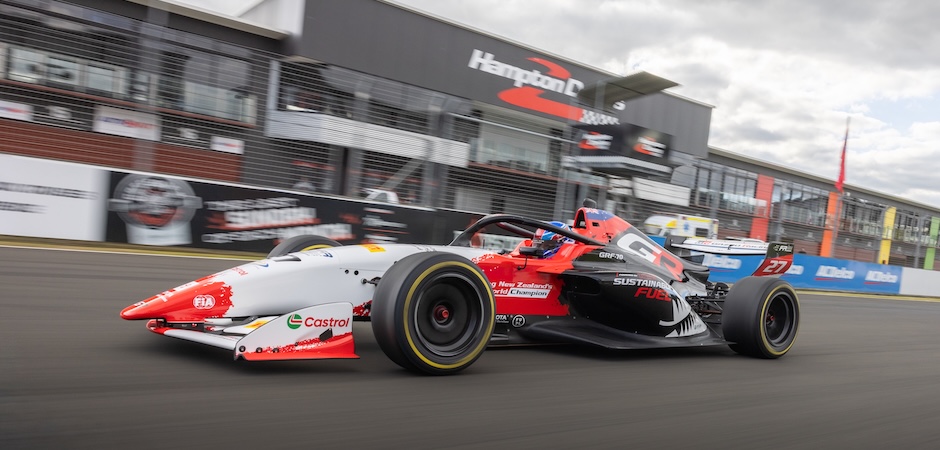
GAZOO Racing New Zealand has officially unveiled the GRF-70, the next-generation single-seater that will contest the Castrol Toyota Formula Regional Oceania Trophy (CTFROT) from 2027.
Revealed at GAZOO Racing New Zealand’s headquarters at Hampton Downs Motorsport Park, the new car uses the FIA Formula Regional Gen 2 Tatuus T-326 chassis and an evolution of Toyota’s established 2.0-litre turbocharged 8AR-FTS engine. The package will produce approximately 280 horsepower as New Zealand’s premier junior single-seater championship moves into the latest Formula Regional era.
The GRF-70 also continues a relationship between Toyota’s New Zealand single-seater programme and Tatuus that dates back more than two decades. It follows the FT-40, FT-50 and FT-60, while its new name reflects the programme’s deeper integration into GAZOO Racing.
Gen 2 move continues long-standing Tatuus partnership
The introduction of the GRF-70 follows Formula Regional’s global move towards second-generation machinery. GAZOO Racing New Zealand Motorsport Manager Nicolas Caillol explained that adopting the latest Tatuus chassis represented a natural next step given the championship’s FIA status and its long-standing relationship with the Italian manufacturer.
“Following our close collaboration with FIA – being an official FIA Formula Regional Championship since 2023 – it was natural for us to follow the introduction of the Formula Regional Gen2 cars which happened in 2026 globally,” explained GAZOO Racing New Zealand Motorsport Manager Nicolas Caillol.
“The choice of the Tatuus chassis was an obvious one for us, continuing our relationship of more than 20 years. We believe this is the longest relationship Tatuus has had with any championship.
He continued, “We started with the FT-40, then the FT-50 and most recently the FT-60 and all were high level, high performance and safe racing cars. We know that will continue with the GRF-70.”
That relationship has remained a constant throughout the different generations of Toyota-powered machinery used in New Zealand since 2005. However, the GRF-70 introduces a new naming convention alongside the technical change.
GRF name reflects GAZOO Racing integration
Previous generations carried the FT prefix, representing Formula Toyota. For the new car, GAZOO Racing New Zealand has instead adopted GRF as the single-seater programme becomes more closely aligned with the wider GAZOO Racing identity.
“And for those interested, the change of prefix for the next generation of car from FT to GRF simply reflects the embedding of the single seater programme into GAZOO Racing DNA. In other words we move from Formula Toyota (FT) to GR Formula (GRF).”
The change goes beyond branding. The GRF-70 aligns with the FIA’s Gen 2 targets across performance, efficiency and sustainability while maintaining the championship’s emphasis on driver development and close competition.
Testing begins ahead of 22-car build
Former New Zealand Grand Prix winner Liam Sceats has already begun initial testing of the GRF-70. GAZOO Racing New Zealand plans to build 22 cars before the next CTFROT begins in January 2027.
As in previous seasons, organisers will release the cars to teams on the Monday immediately before the opening race weekend. That approach aims to maintain a level playing field and limit any advantage gained through additional preparation time.
Six teams will start the new era: M2 Competition, mtec Motorsport, Kiwi Motorsport, Hitech GP, TJ Speed Motorsport and new entrant Rodin Motorsport.
Pirelli will also continue supplying tyres as part of its role as the nominated supplier across FIA Formula Regional Championship and Trophy competitions.
Aerodynamic changes to GRF-70 target closer racing in CTFROT Gen 2
Although the GRF-70 maintains approximately the same power level as its predecessor, the Gen 2 package introduces significant changes to the way the car generates performance.
Caillol highlighted the work completed by the FIA and Tatuus to improve several areas of the previous-generation Formula Regional concept.
“A lot of work has been done by FIA and Tatuus into the Formula Regional Gen2 car,” he added. “That has involved a focus on improvement at every level – an approach which is in line with both the GAZOO Racing and Toyota ‘kaizen’ approach.
“Work has been done by the FIA, with support of engineers from F1 to design a car which would allow the drivers to drive closer to each other and offering better opportunities for passing, and that has meant a lot of work has been done on aerodynamic side of the Gen2 car.”
By reducing the difficulty of following another car closely, the new aerodynamic philosophy aims to improve wheel-to-wheel racing and create more passing opportunities.
Driver comfort receives significant attention
The Gen 2 design also addresses concerns surrounding cockpit ergonomics and the physical demands of the previous Formula Regional generation.
“The previous generation was widely criticised for driver comfort and this is another area where Gen 2 machinery has made a significant step forward. The design has a better seating position for the driver and an ability to accommodate a wider range of driver heights.
“A redesign of the front suspension means less effort is required on the steering wheel which had been another hot topic of discussion in the past.”
Those changes should make the car more accommodating to a broader range of drivers while reducing unnecessary physical strain. For a championship that attracts young drivers from around the world, the improvements should also help teams adapt the car more effectively to different body types.
Proven Toyota engine evolves for new generation
GAZOO Racing New Zealand will retain the 8AR-FTS engine that has powered the FT-60 since 2020, although engine developer and builder David Gouk has revised the package for its new application.
“We have a successful and reliable power plant for the new car in the 8AR-FTS engine which we have been using since 2020 in the FT-60. But as with everything, we have focussed on continuous improvement and David Gouk, our engine developer and builder, has worked on enhancing the package by redesigning some components to produce a lighter version of the engine we used in the FT-60.”
The updated engine will produce power in line with FIA regulations, keeping output broadly similar to the previous generation. Meanwhile, the series will retain the push-to-pass system introduced in 2026 after GAZOO Racing New Zealand credited the feature with immediately improving the racing.
“Power will be in line with the regulations from the FIA and will stay similar to what we had in the past. We also carry over the push-to-pass system which was successfully introduced last year and instantly improved the racing.”
GRF-70 strengthens FIA pathway for CTFROT in Gen 2 era
The move to Gen 2 machinery also reinforces the championship’s position within the FIA single-seater ladder. Drivers can progress from FIA-certified Formula 4 into Formula Regional before moving towards FIA Formula 3 and higher levels.
For GAZOO Racing New Zealand, that role remains closely connected to its long-standing objective of developing future international talent. The championship has traditionally attracted competitors seeking intensive race mileage during the Southern Hemisphere summer, and the GRF-70 gives them machinery aligned more closely with other Formula Regional championships.
Caillol believes the new car strengthens that development pathway while preserving the programme’s wider ambitions.
“And of course it also shows our own commitment to finding New Zealand’s next World Champion,” concluded Caillol. “There is a lot of work to do between now and the 2027 Castrol Toyota FR Oceania Trophy but we will be ready, with a field of up to 22 cars.
“Today the motorsport world gets their first glimpse of what is to come.”
The GRF-70 therefore marks both a technical and structural evolution for the 2027 CTFROT. After more than 20 years of Toyota-powered Tatuus machinery, the championship will begin its next generation with a car designed to improve racing, driver comfort and alignment with the wider FIA pathway.