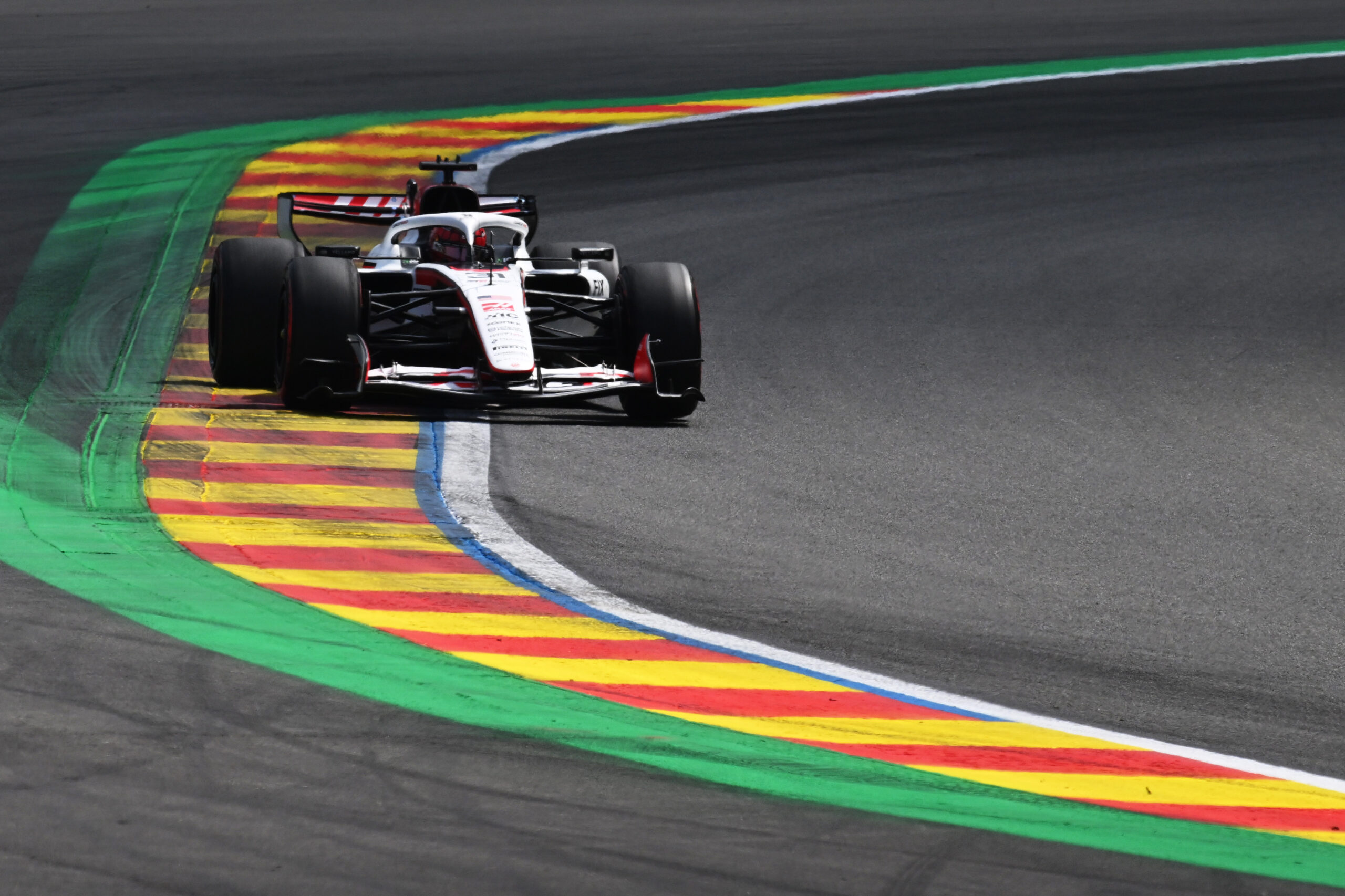
Haas endured a difficult afternoon at the 2026 F1 Belgian GP, with Ollie Bearman finishing 14th and Esteban Ocon 17th after both drivers were compromised by separate incidents on the opening lap. Despite the results, Bearman pointed to signs of genuine progress from the team, while Ocon continued to flag a persistent performance deficit that has troubled him for much of the season. Haas head into Hungary sitting seventh in the Constructors’ Championship with 21 points.
Bearman on his opening lap drama at the 2026 F1 Belgian GP
Bearman and Ocon touched on the opening lap at turn 13 and suffered punctures, forcing them to pit at the end of Lap 1 for hard tyres. The incident happened when the pair found themselves three-wide as the field navigated the middle sector, with Bearman’s gear problem having caused him to slow suddenly and the rest of the pack forced to manoeuvre around him.
The bigger issue for Bearman, however, came from the gear failure itself.
“Unfortunately picked up a puncture in that. Really the main issue came in Pouhon where I basically got locked in fourth gear for two or three seconds and just was stuck on the limiter, couldn’t get out of fourth gear for some reason and ended up losing three spots. On top of that, picking up a puncture with Esteban. I didn’t see what happened, you know, with regards to that incident, but it was very unfortunate,” Bearman stated.
Despite the early chaos, Bearman was encouraged by the pace both he and Ocon showed once they had recovered from their pit stops. “For both of us, yeah, after that we had decent pace. You know, compared to last week we were a step forward relative to the Williams which was not really the case in Silverstone race pace. And we seemed to have closed a bit the gap to Audi, you know, and I was more or less similar to Nico’s pace for the majority of the final stint there,” he said.
“So it shows that we’re in a better place and, you know, the positive is that the car feels much better to drive. I can lean on it more, I can push it more to the limit and do less mistakes because it’s much more consistent and that’s good. But, you know, we still need to find more performance.
“The good thing is that the characteristics have been fixed and now we just need more downforce,” Bearman stated.
Bearman explains the gear shift problem
Bearman later received an explanation from the team about what had caused the gear lock. High oscillations had triggered automatic gear-shift rejections designed to protect the power unit for reliability, but the timing could not have been worse given how close the field was at the start.
“The team told me oscillations. When there’s high oscillations, the gear shifts get rejected for reliability, but I’ve never felt that before. It was just a shame.
“I think it led me into fourth, but I was right on the limit already and then I had massive oscillations, I couldn’t get back out of it again. So that’s really a big shame, especially on Lap 1, you know, everyone’s so close. I was having a really good Lap 1 and then I got stuck in fourth gear and that really fucked me.”
Bearman on the energy management challenges at the F1 Belgian GP
Spa has always been a unique challenge, and under the 2026 regulations it has become even more demanding. Bearman was candid about how the deployment differences between power units affected his ability to race and overtake throughout the afternoon.
“It was OK, I mean, it was the same as what we were expecting, not better, not worse. Yeah, it’s tough, you know, particularly to the Mercedes Power units. We were deploying very differently and it’s so hard to mount an overtake.
“Even with, in the case of Alex [Albon], I was, you know, decently faster, but I just couldn’t overtake easily because they have so much power in different places to us. It’s tough. And then, of course, you spend a lot of time in Superclip, a lot of time in just ICE, which means you have less power than F2, which is not the most fun, but that’s how it is in reality,” he explained.
Bearman looks ahead to Budapest after the 2026 F1 Belgian GP
With a circuit far better suited to Haas’s strengths arriving next, Bearman sounded more optimistic about what Hungary might bring after the difficulties he had at the F1 Belgian GP. He was careful to acknowledge the limitations shown at Spa whilst keeping his focus firmly on the next round.
“Yeah, I’m looking more forward to Hungary, you know. We have a downforce limitation, but we’re also quite limited in the straights this weekend. So, hopefully, Hungary can bring a bit more performance and I’m more looking forward to it, given I was confident with the car out there today.”
“So, let’s see what it brings next week,” Bearman stated.
Bearman on the challenges of racing under the 2026 F1 regulations
Asked about driver satisfaction with the car more broadly under the 2026 regulations, Bearman was blunt. He stressed that complaining serves little purpose when the limitations are structural to the current rules.
“No, none of us are happy with what we’re driving. That’s very clear. That’s never changed.
“Of course, we get used to it and we deal with it and we know it’s not going to change, so we’re not going to, you know, complain about it every weekend. But this track, Silverstone, Spa, Monza, these are all going to be horrible ones for the next few years, unfortunately,” Bearman concluded.
Ocon on the opening lap contact at the F1 Belgian GP
Ocon gave his account of the collision with Bearman, explaining the sequence of events that left both cars damaged before the race had barely begun. He was measured in his assessment and stopped short of pointing blame in either direction.
At turn 1, he also got a light touch from behind by Carlos Sainz.
“Yeah, I mean, the tap from the first corner, I think that was not really an issue for anyone, to be honest. It was a bit of a tight hairpin at the back, you know, with a lot of constituent effects, you know, with traffic, so nothing much there. But yeah, after that, we fought hard with Nico,” Ocon stated.
“I think Ollie had an issue, so everybody was trying to avoid him. Somehow, Nico actually flew on the kerb on the right, so it was quite tight. And then I had a lot more deployment than him and I went on the inside.”
With both drivers navigating a chaotic first lap, the contact that followed was, as Ocon put it, unavoidable.
“Obviously, he was on the outside, so I had to let him go because it’s quite slippery on the inside. I stayed there and I think Ollie was looking at Nico. And obviously, we touched, but unfortunately, wrong place, wrong time.
“There wasn’t much more we both could have done in that scenario. Luckily, we had two hards, so it didn’t impact our race very much. So yeah, we still lack pace, we still lack the same thing as yesterday.”
Ocon made clear the underlying issues were not going away for Haas, bringing the conversation back to the problems that have defined his 2026 F1 Belgian GP weekend and the wider season.
“Straight line speed, rear downforce, it’s the same story as yesterday. But we’re working on it and hopefully, the team will find a solution for me.”
Ocon on the energy management difficulties at Spa
The 2026 regulations have made Spa a particularly tricky circuit for teams without a top-tier power unit deployment profile. Ocon described just how difficult the conditions were to manage throughout the race. “It was crazy difficult. Actually, quite surprising at times,” he stated.
“You know, you had to do avoiding actions when people had different deployments. You’re not really racing with smooth slipstream anymore. It’s trying to avoid basically the car that’s ahead and it’s quite on the edge sometimes.
“Like what happened to Ollie, for example, in Turn 10 on the exit. Like for us behind, it was chaos. So, not easy, but you know, touching wood, nothing happened here. So, you know, we keep going.”
Compared to the start of the season, Ocon acknowledged there has been some progress on the energy front. But the picture remained difficult throughout the afternoon for Haas at the F1 Belgian GP.
“Well, if you go back in the winter, where we had to do 50% throttle, you know, from Turn 9 onwards until Turn 14, it’s much better than it is back then. But, you know, it’s the best that we can do with the current power in it, I would say.“
Ocon reflects on a season of persistent issues for Haas
Ocon drew on a wider picture when asked about how much of the problem was car-related versus something else. He pointed to Barcelona, where a part change on Bearman’s car transformed the performance, as evidence that his own issues are not straightforward to find or fix.
“I mean, we’ve seen a very big one with Ollie in FP3 in Barcelona. The team managed to change the parts and suddenly everything came back together.
“For me, yeah, it’s been, what have we done, 12 races now? Something like that? Well, there’s only been two which have been OK.
“So Silverstone and Japan, you know, were the two where we had normal car performance. So, yeah, we were looking, you know, with the engineers and it’s been very, very difficult. We need to understand as much as we can.”
Despite 12 rounds of difficulty, Ocon insisted his trust in the team remains intact, even as the frustrations mount.
“And so far it’s quite difficult to get everything under control. We have a huge, huge deficit. Like, we don’t do anything. You know, this race was always going to be very, very difficult. So we need to keep digging and hopefully in Budapest it will be fine. But, you know, I reset every race.
“I go, like, if nothing would be an issue and I start racing the same way as I should do, it just gets obviously disappointing the more you go through the weekend when you start seeing the issues. But I trust the team to fix them. At some point we will get the hand on the issues. So, yeah, at the moment they are killing us, definitely,” Ocon stated.
Ocon breaks down his straight-line deficit at the F1 Belgian GP
Ocon was precise when asked about the source of his performance deficit in his Haas F1 car at the 2026 Belgian GP. Using his own qualifying data as a reference point, he set out in exact terms how much time he was losing and where.
“We don’t know where it comes from.
“Well, if you take, for example, qualifying, let’s say I compare with Ollie. Just before Turn 1 I arrive, I’m 0.04 slower. So already in, what, 500 metres of a straight, that’s what I lose.”
“I take the corner, I’m 0.05 ahead on the exit, so I did a good Turn 1. Arriving up the hill, I’m 0.18 slower. So from 0.05 to 0.18, that’s how much we were struggling in the straight. So overall it’s more than half a second around the lap, just that. Then we have the imbalance of downforce. I’m lacking many points in the rear.”
The compounding effect of the straight-line loss and the downforce imbalance left Ocon with very little margin to work with throughout the weekend.
“And we have a front that is overpowered compared to the map. So we are struggling a lot to turn the car. And we have no rear grip, so we can’t put the flap on. And where you need the flap in some corners, some high-speed corners, I don’t have it. So it’s double the penalty. So that’s what we were facing on.”
Ocon searching for answers as Budapest approaches
Ocon pointed to Silverstone as the most recent comparison point. A power unit change there had resolved a similar straight-line issue, but the same fix at Spa had not produced the same result, pointing to something deeper that the team has yet to identify.
“From this weekend, Silverstone was… A bit of straight-line speed issues, like 0.2 in Silverstone on Friday. We changed engine and everything was OK again.Unfortunately, we changed engine also here and thought that was going to be better, but it’s coming from somewhere else.”
With the root cause still unidentified, Ocon remained cautious but not defeatist about the prospects of finding a solution.
“So there was a little bit of deployment, but 90% of the problem doesn’t come where we are fully deploying everything. I have 3kph difference. So it’s not really the deployment the problem.
“It’s something else. We don’t know what it is, but we’ll find out, hopefully,” Ocon concluded.