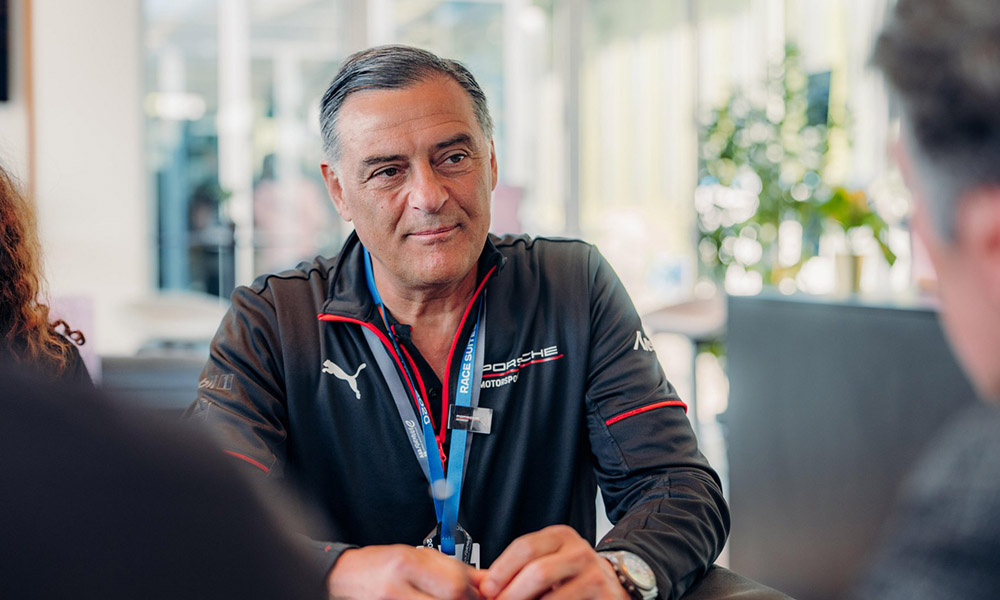
Porsche has confirmed that Dr Michael Steiner will step down from his position as Member of the Executive Board for Research and Development in May 2027, bringing an end to almost 25 years with the German manufacturer. The 62-year-old, who has overseen several major road-car and motorsport developments, will hand over his responsibilities to Mercedes-Benz executive Jörg Bartels.
Steiner has led Porsche’s research and development division since 2016 and has served as Deputy Chairman of the Executive Board since 2025. Throughout his tenure, he has played an important role in the manufacturer’s technological development, including its successful Porsche 919 Hybrid programme and the introduction of the Porsche 963.
The announcement, made on 30 October, comes as Porsche implements its new Sportwagenschmiede ’35 strategy, which Steiner helped develop. However, the manufacturer has not disclosed a specific reason for his departure.
Steiner prepares to leave Porsche after almost 25 years
Steiner joined Porsche in 2002 as Head of Innovations, Concepts and Computer-Aided Engineering (CAE), while also serving as Chief Representative at Porsche Engineering Group GmbH.
He subsequently became Head of the Panamera model line in 2005 before taking responsibility for complete vehicle development and quality in 2011.
Five years later, Porsche appointed him to its Executive Board for Research and Development, placing him at the forefront of the manufacturer’s technological development.
Furthermore, Steiner held the position of Head of Group Research and Development at Volkswagen Group between 2022 and 2025, overseeing major technology and architecture projects across the organisation.
In 2025, Porsche appointed him Deputy Chairman of the Executive Board, further recognising his contributions to the manufacturer.
Dr Wolfgang Porsche, Chairman of Porsche AG’s Supervisory Board, praised Steiner’s extensive technical knowledge and contributions to the company’s success.
“Michael Steiner embodies Weissach and its significance for Porsche like no one else. His name stands not only for numerous brand-defining innovations, but also for countless victories on the world’s legendary race tracks,”
“His comprehensive and deep understanding of technology was also instrumental in carrying the core of the Porsche brand into the era of electric mobility.
“Our heartfelt thank you goes to Dr Michael Steiner for his outstanding work. We wish him all the very best for the future.”
His departure will therefore mark the end of a significant chapter in Porsche’s development history, particularly following a decade of leadership across its research and development activities.
Steiner contributes to Porsche’s motorsport success
Beyond his responsibilities for Porsche’s production vehicles, Steiner has maintained a close connection to the manufacturer’s international motorsport programmes.
His tenure included the successful Porsche 919 Hybrid LMP1 project, which established the manufacturer as one of the leading competitors in the FIA World Endurance Championship (WEC).
Porsche secured three consecutive overall victories at the 24 Hours of Le Mans between 2015 and 2017, alongside three successive WEC Manufacturers’ and Drivers’ titles.
The manufacturer completed its third consecutive championship treble in 2017 before concluding the factory LMP1 programme.
Furthermore, Steiner supported Porsche’s subsequent expansion into electric motorsport, with the manufacturer entering the ABB FIA Formula E World Championship in the 2019/20 season.
The programme subsequently developed into another championship-winning operation, securing multiple Drivers’, Teams’ and Manufacturers’ titles.
Porsche’s success continued throughout the GEN3 era, with the manufacturer establishing the 99X Electric as one of the championship’s most successful cars.
Most recently, Porsche retained Pascal Wehrlein and Nico Müller for the 2026/27 Formula E season, maintaining continuity as the championship prepares to introduce its GEN4 machinery.
Steiner’s time on the executive board also encompassed the development and introduction of the Porsche 963, which brought the manufacturer back to the highest level of international prototype endurance racing.
The Porsche Penske Motorsport programme has competed in both the FIA WEC and IMSA WeatherTech SportsCar Championship, adding further victories and championship successes to Porsche’s extensive motorsport record.
The 963 also helped maintain Porsche’s presence at the front of international endurance racing, including its competitive performances during the 2026 WEC season.
Consequently, Steiner’s departure represents a significant change in Porsche’s technical leadership following a period that included multiple successful motorsport projects.
Porsche highlights transfer of racing technology to road cars
Steiner has also played an important role in connecting Porsche’s motorsport developments with its production vehicle programmes.
During his tenure, the manufacturer expanded its electrification strategy while continuing to develop high-performance combustion engines and hybrid powertrains.
He contributed to the development of the 991 and 992 generations of the Porsche 911, alongside the introduction of the Taycan, Porsche’s first fully electric production vehicle.
Furthermore, his leadership supported several technological innovations, including Porsche Active Ride and the T-Hybrid powertrain introduced in the 911 Carrera GTS and 911 Turbo S.
Porsche AG CEO Dr Michael Leiters highlighted Steiner’s ability to transfer racing technology into the manufacturer’s road cars.
“Time and again, Michael Steiner and his team have succeeded in transferring motorsport genes to our production vehicles. He is an engineer at heart, and I greatly value his technical expertise and personality.
“Most recently, we worked closely together on developing the strategy Sportwagenschmiede ’35.
“Michael Steiner and I prepared this transition together and will organize the handover to his successor in close coordination.
“I am already looking forward to working with Joerg Bartels. He brings extensive experience in vehicle development and transformation and has worked internationally.
“He will consistently drive forward the realignment of our research and development that is already underway.”
Leiters’ comments emphasised Steiner’s contribution to Porsche’s engineering philosophy, which has historically linked its production vehicles with technologies developed through motorsport.
Jörg Bartels to take over Porsche’s research and development division
Porsche has selected Jörg Bartels to succeed Steiner as Member of the Executive Board for Research and Development in May 2027.
The 52-year-old will join the German sports car manufacturer from Mercedes-Benz, bringing more than 26 years of experience in the automotive industry.
Bartels currently oversees the global development of Mercedes-Benz powertrain systems, having previously held several senior engineering and management positions.
Furthermore, he served as President and CEO of Beijing Benz Automotive Co. in China, gaining experience in international automotive manufacturing and development operations.
His responsibilities have included the development of individual vehicle components, complete powertrain systems and entire vehicle platforms.
Consequently, Porsche will gain an executive with considerable experience managing large engineering organisations and overseeing technological transitions.
Bartels will now prepare to take responsibility for the manufacturer’s research and development division as Porsche continues implementing its revised long-term strategy.
Porsche prepares for transition under Sportwagenschmiede ’35 strategy
Steiner’s departure comes shortly after Porsche introduced its Sportwagenschmiede ’35 strategy, which aims to strengthen the company’s sports car identity and improve its long-term competitiveness. The strategy focuses on developing new products, expanding technological capabilities and improving the manufacturer’s operational efficiency.
Furthermore, Porsche intends to strengthen its position within the high-performance and luxury automotive markets while continuing to invest in advanced powertrain technologies.
Steiner played an important role in developing the strategy alongside Leiters, making the upcoming leadership transition particularly significant.
Bartels will now oversee its implementation within the research and development division, taking responsibility for the manufacturer’s future engineering priorities.
Porsche has confirmed that Steiner and Leiters will coordinate the handover with his successor to maintain continuity during the transition.
However, the company has not announced any direct changes to its motorsport programmes as part of the leadership change.
Steiner’s departure marks end of significant Porsche chapter
Steiner will leave Porsche in May 2027 after almost 25 years with the manufacturer, including a decade on its Executive Board for Research and Development.
His tenure encompassed several important developments across Porsche’s production vehicles and international motorsport activities, from the successful 919 Hybrid programme to the introduction of the 963 and the growth of its Formula E operation.
Meanwhile, his contributions to hybrid technology, electrification and vehicle development helped shape Porsche’s transition towards new powertrain technologies.
With Bartels preparing to assume responsibility for research and development, the manufacturer will now focus on maintaining its engineering expertise while implementing its Sportwagenschmiede ’35 strategy.
Although Porsche has not disclosed the reason for Steiner’s departure, the upcoming transition will bring a new leader to one of the manufacturer’s most important technical divisions as it prepares for its next chapter.