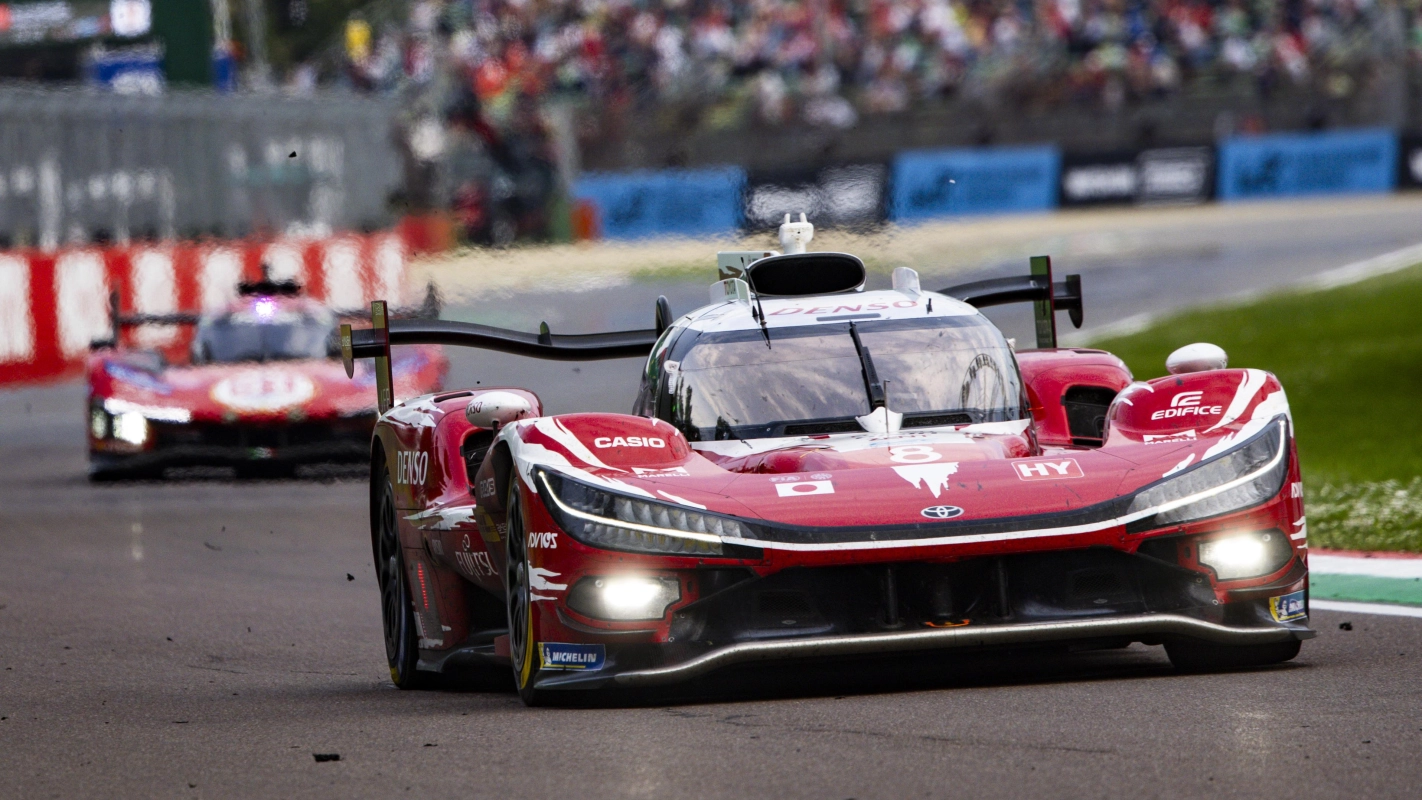
As reported by Sportscar365, Toyota and Peugeot have underlined the importance of retaining LMH-style hybrid systems as discussions continue over a single rules package for the 2030 FIA World Endurance Championship (WEC) season.
The current Hypercar era brings together two different technical routes. Toyota, Peugeot and Ferrari build and run their own front axle-mounted hybrid systems under LMH rules. By contrast, LMDh manufacturers use a mandated rear-mounted hybrid package supplied by Bosch, Xtrac and Fortescue Zero.
As the current Hypercar rules cycle heads towards its conclusion, rule-makers must decide how to align both approaches. However, Toyota and Peugeot have made clear that any future convergence must preserve meaningful manufacturer technology.
Toyota calls for stability, not revolution
Toyota Racing technical director David Floury believes the process will prove difficult because the FIA, ACO, IMSA and a growing list of manufacturers all need to find common ground. Ford and McLaren will also enter the equation as 2027 newcomers, which will add further complexity to the discussions.
Floury therefore urged decision-makers to protect the stability that helped attract so many brands to the championship.
“To please all parties, I don’t know,” said Floury. “There are many parties around the table. You have already three with the FIA, ACO and IMSA. On top of that, you have many manufacturers, and some new ones coming next year.
“I think it’s probably going to be challenging to please so many parties. So far, we have not really started any work on the topic, so it’s a bit early days. Normally, the plan is to have regulations for 2030 at the end of this year. But at the end of the day, I don’t think it requires us to revolutionize everything either. It’s a matter of finding improvements that are agreed on, finding the improvements that are needed from the current regulations, but probably not to make a revolution.
“Right now, the championship is strong and many manufacturers are involved. I think we need to keep some degree of stability and reflect carefully on what has enabled such a [large number of manufacturers] to be gathered.”
Toyota rejects a spec hybrid solution
Although Floury backed measured improvements, he strongly rejected the idea of moving Toyota towards a spec hybrid package similar to the one LMDh manufacturers currently use.
When asked whether Toyota would accept such a route, he gave a direct answer: “For sure not.”
He then explained why Toyota sees hybrid development as central to its racing programme rather than an optional technical feature.
“On our side, one of the main reasons why we go racing is also to learn from it and develop people. In the team, we have people who were in road car development, joined us for two, three, four seasons, and then they go back to road car development.
“Therefore, it is key that we can work on technology that are relevant for what we do in road cars. When you buy a product from someone else, then it doesn’t tick that box. It’s not something we want. I think the same is true for Ferrari.”
That stance places Toyota firmly on the side of technical freedom. Moreover, it highlights why LMH manufacturers value control over their hybrid systems: they can link race development directly to road car knowledge, staff development and brand engineering.
Peugeot links hybrid racing to its road car message
Peugeot has also stressed the importance of hybrid power as part of its WEC identity. The French manufacturer has already confirmed its 9X8 programme through 2029, and team principal Emmanuel Esnault says the future rules must reflect both the modern car market and each manufacturer’s philosophy.
“Hybrid is definitely part of the current landscape in the car industry now, so the question mark is not whether to have hybrid, but which way and how it is correctly balanced between ICE power and electric power for the good of the message we want to give, and also in terms of costs and development efforts,” said Esnault.
“It has to be linked to the philosophy of the manufacturer. Peugeot is a leader in hybrid cars so it has to make sense in terms of the proportion between ICE power and electric power. It has to have a link with the final product.”
As a result, Peugeot does not simply view hybrid power as a performance tool. Instead, it sees the technology as a bridge between the 9X8 race car and its wider road car strategy.
Battery freedom remains open to discussion
Peugeot chose the LMH route because it offered a broader technical challenge. The 9X8 uses a custom battery developed by Saft, a subsidiary of TotalEnergies, yet Esnault stopped short of declaring that Peugeot would refuse any future single-supplier battery approach.
He nevertheless made clear that the brand values the scope of the LMH concept.
“The choice of Peugeot was to take on the LMH challenge, which is the more difficult one, but it’s also a technical showcase for the brand,” said Esnault. “We are doing the complete [design], 360 degrees, from A to Z, and we are one of the few to do it.
“Due to the partnership we have with companies like TotalEnergies, if it’s not a single-make [battery], we have many opportunities to showcase what we can do. But I cannot say today yes or no. It’s something to be discussed.”
Therefore, Peugeot appears open to negotiation on specific components, but it still wants the 2030 regulations to preserve a strong technological showcase.
2030 rules must balance cost, relevance and identity
The WEC now faces a delicate challenge. On one hand, convergence must keep costs under control and maintain fairness between LMH and LMDh manufacturers. On the other hand, too much standardisation could weaken the technical freedom that attracted Toyota, Ferrari and Peugeot to the current rules.
Toyota has already rejected a spec hybrid solution, while Peugeot has tied hybrid racing directly to its brand message. Consequently, the 2030 rules debate will likely centre on compromise: enough common ground to unite the field, but enough engineering freedom to keep manufacturers invested.
For now, both brands have delivered a clear message. They want evolution, not revolution, and they want hybrid technology to remain central to endurance racing’s top class.