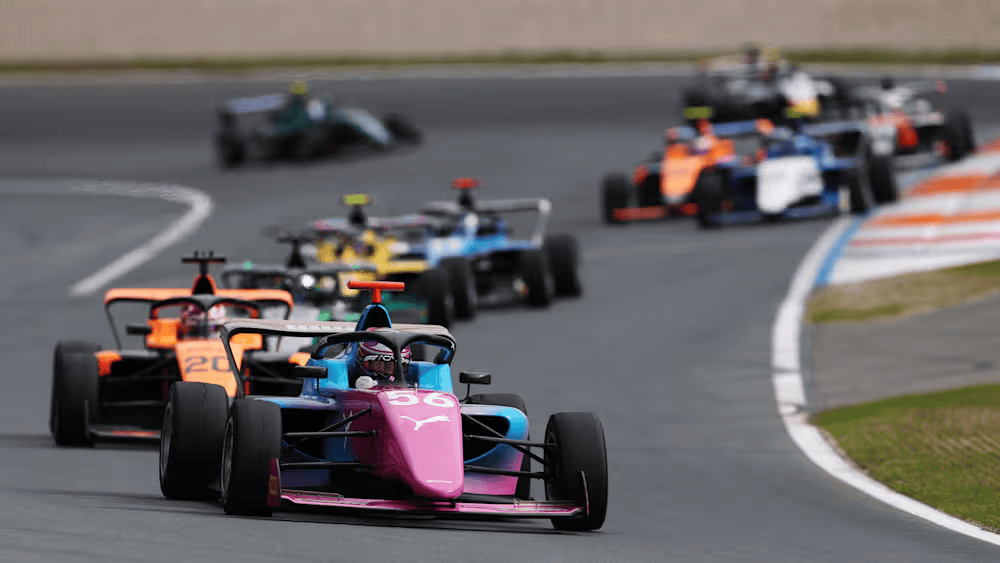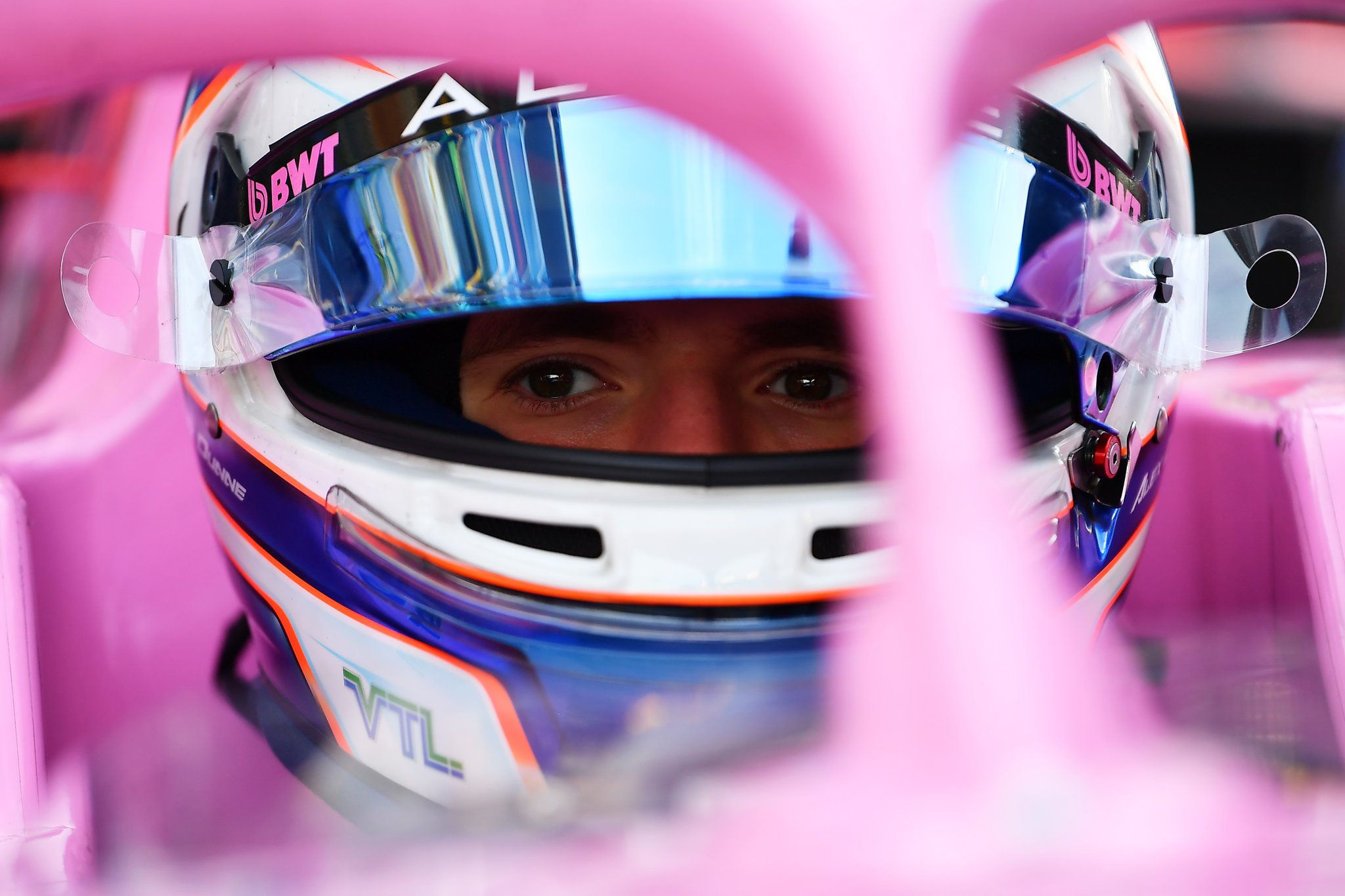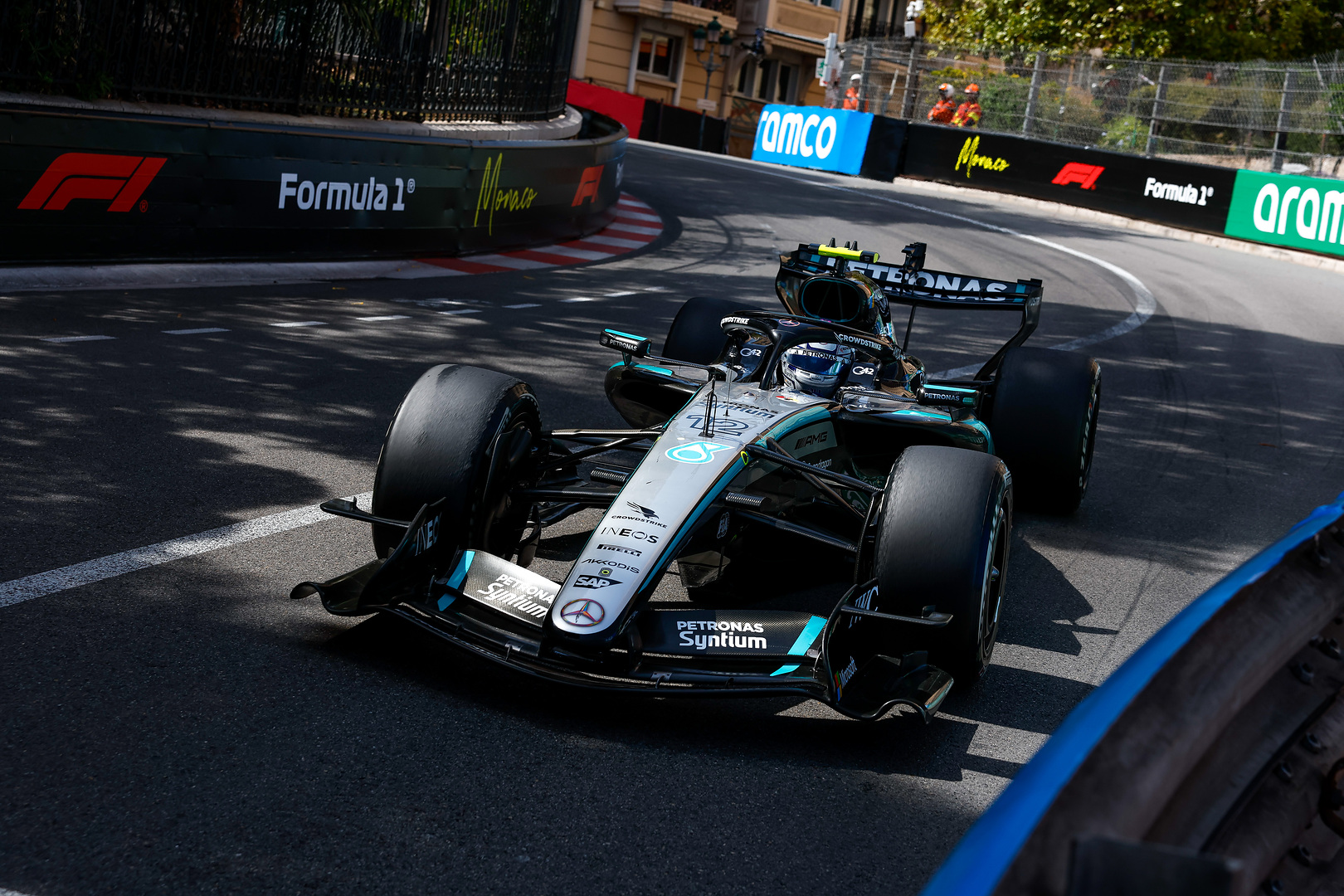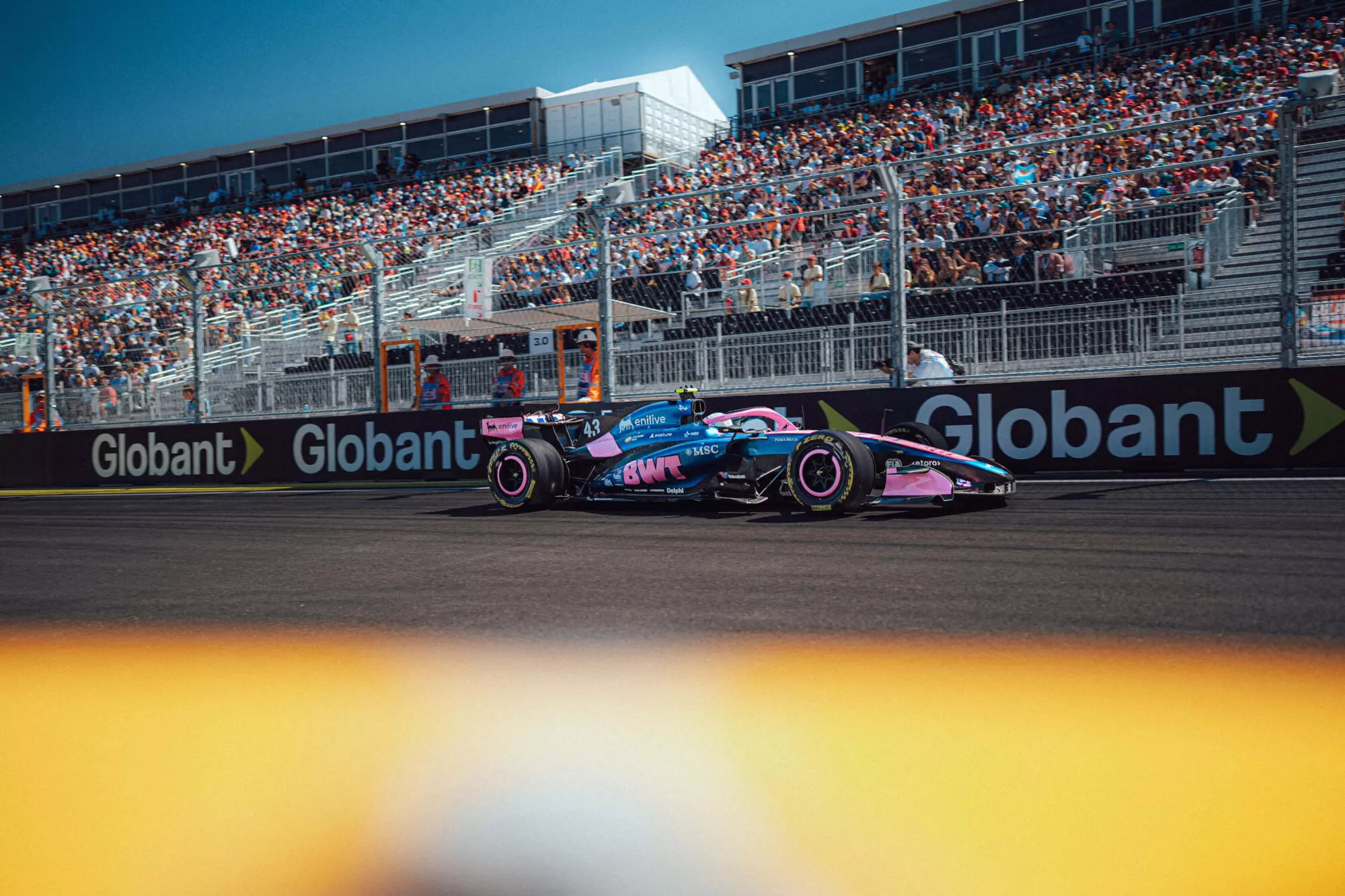
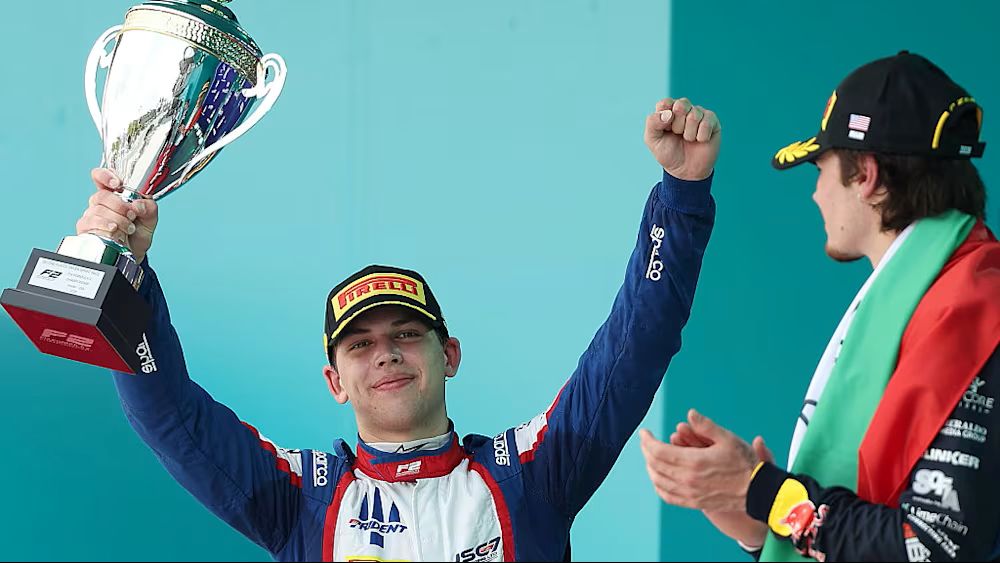
Laurens van Hoepen left the F2 Sprint Race at the Miami GP with both satisfaction and frustration after narrowly missing out on victory in one the championship’s most dramatic finishes of the season so far.
The Trident driver fought Campos Racing’s Nikola Tsolov throughout the closing stages of the first-ever F2 race at the Miami International Autodrome. Alex Dunne also joined the lead battle late on, which turned the final lap into a three-way contest for victory. Although Tsolov ultimately secured the win, van Hoepen delivered another strong statement for Trident. His second-place finish continued his podium run and gave the team another sign that its progress from last season has carried into race-winning contention. He discussed his performance and his thoughts on the Miami weekend so far during a post-Sprint Race press conference attending by Pit Debrief.
Van Hoepen reflects on F2’s North American debut in Miami
The FIA Formula 2 Championship’s first visit to Miami gave the field a new circuit, a different environment and a fresh racing challenge. The Miami International Autodrome quickly made a strong impression, with its layout creating several overtaking opportunities and its powerful DRS zones encouraging close fights down the straights.
Van Hoepen embraced that challenge. After finishing second in a dramatic race-long fight with Nikola Tsolov, the Trident driver admitted the circuit had exceeded his expectations.
“Yeah, I mean, to have the opportunity to race in Miami is amazing. The place around is very cool and then also the track was really fun to race. Yeah, more fun than I even expected.”
That positive first impression also came at an important stage of the season. After an almost two-month break, F2 has now resumed with a North American stretch that offers drivers another chance to build rhythm and momentum. Van Hoepen has already started looking ahead to the next challenge, and his simulator work for Montreal has only increased his anticipation.
“And then to also be able to go to Montreal in a couple of weeks is something that I’m really looking forward to. I mean, I’ve done the track already on the sim for a bit and it looks like it’s going to be amazing as well.”
However, Miami still offers another opportunity before the paddock can turn fully towards Canada. After his Sprint Race podium, van Hoepen is focused on carrying that momentum into Sunday’s Feature Race and turning Trident’s strong pace into another valuable result.
“So, yeah, looking forward to the race tomorrow and then the next race weekend in Montreal as well.”
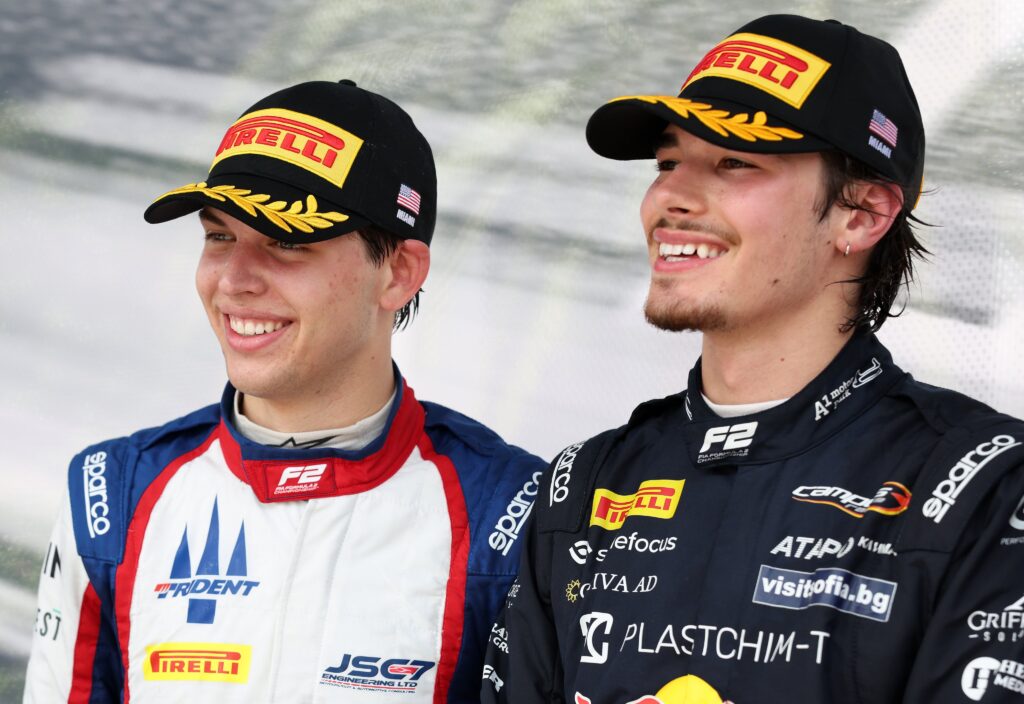
Van Hoepen reflects on the respectful rivalry that defined the fight for F2 Sprint Race victory at the 2026 Miami GP
The battle between van Hoepen and Tsolov defined the Miami Sprint Race. Tsolov led early, but van Hoepen stayed close enough to keep him under pressure and use the powerful DRS zones to attack.
Their familiarity also shaped the duel. Both drivers raced hard and pushed the limits under braking, yet they gave each other enough respect and space to avoid unnecessary contact. For van Hoepen, that balance made the fight especially enjoyable, even though he ultimately missed out on victory.
“Yeah, it was a super nice battle. Nikola and I, like he said, we know each other well and we kept it very respectful between the two of us. Although the racing was hard, but fair, which was nice, especially going into that last corner. It’s all coming down to that braking zone. It was on the limit, but good. In the end, to come away with P2 is still a good result. It’s just a shame not to win, especially after beating the last lap.”
His response captured the mixed feeling behind the result. Second place gave him valuable points and another podium for Trident, but the narrow margin still left him thinking about what more he could have done.
However, van Hoepen focused on the quality of the racing rather than only the disappointment. The late fight featured repeated attacks, defensive judgement and changing momentum, which made the Miami Sprint stand out.
“I mean, this is exactly what racing should be like. Late in the brakes, in the last corner, on the last lap, fighting with all the guys. It’s something that I really enjoy and one of the most fun parts of racing, of course. To me, it’s textbook how it should be.”
The final lap that demanded instinct and control
That “textbook” battle then came down to one final lap, where van Hoepen had to balance ambition with discipline. Tsolov remained just ahead, while Dunne closed from behind, turning every braking zone into a decisive moment for the podium order.
In that situation, van Hoepen said instinct took over. Rather than calculating whether to protect second place, he focused on beating the car in front and giving himself the best chance to cross the line first.
“Yeah, I mean, you’re just so busy with the fight itself that you’re not really thinking about the position you’re going to end up in. You just want to cross the line first, of course, but you’re just thinking about being in front of the other car. So that’s just not really something you think about.
But then you go into that last corner and think, ‘OK, I should brake on my marks, don’t look up, don’t go straight into him,’ or something like that, especially when he just came in front of me before the braking.”
That approach nearly delivered victory, but it also demanded precision. A late move into the final corner could have won the race, while a small misjudgement could have caused contact with Tsolov or left him exposed to Dunne.
Van Hoepen therefore had to attack decisively while still leaving enough margin to finish the race cleanly. Although Tsolov eventually came out ahead, the pair avoided contact in the decisive moment.
“So those are all things you take into consideration. But I think we did a good job to not touch each other and just keep it respectful through the last corner there.”
Miami heat adds another layer to the Sprint Race
Beyond the fight for victory, van Hoepen also had to manage the wider demands of the Miami Sprint. The hot conditions placed extra pressure on the tyres, so he could not simply attack Tsolov without considering degradation and temperature.
That created a difficult balance. Van Hoepen needed to stay close enough to fight for the win, while also keeping the car in the right operating window across the race distance. As a result, Miami became a physical and strategic challenge as much as a wheel-to-wheel one.
“I mean, the whole race itself was challenging. Of course, it’s super hot. You’ve got the tyres you kind of want to keep in a good window, but you also want to overtake and win the race, ultimately. So, I think the combination of all those things and all the different aspects of the race make it really difficult and also make it fun, in a way.”
That challenge suited van Hoepen’s approach. Instead of treating the heat and tyre management only as obstacles, he saw them as part of what made the race engaging.
The Sprint also gave Trident valuable information before Sunday’s Feature Race. With Miami new to the F2 calendar, every lap helped the team understand tyre behaviour, DRS effect and race pace ahead of the longer contest.
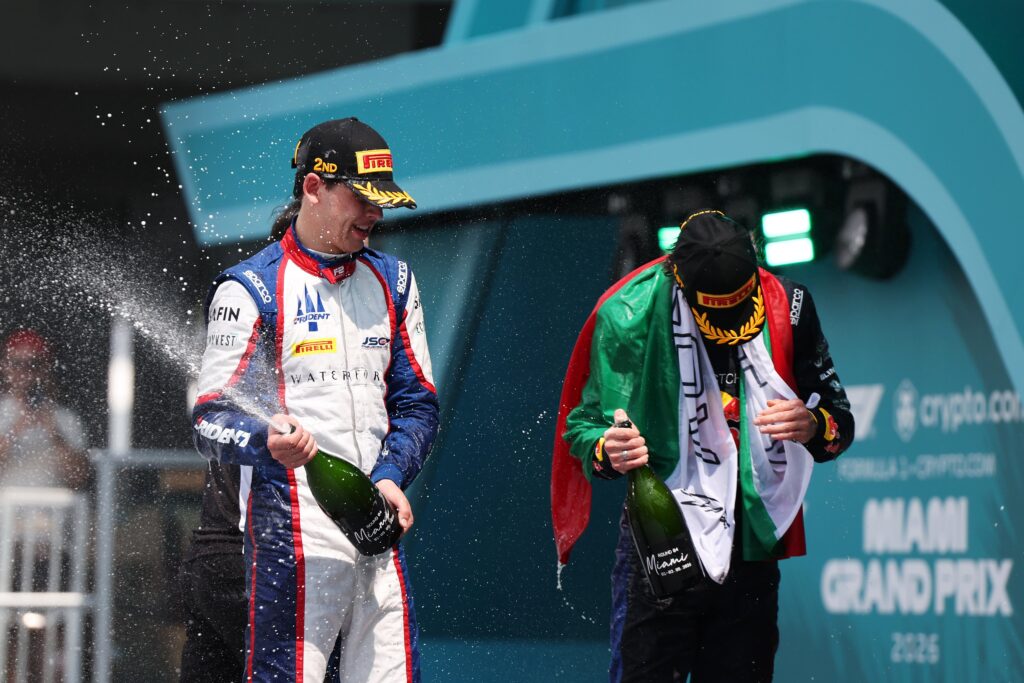
Van Hoepen reflects on how DRS created opportunity and danger in the F2 Sprint Race at the 2026 Miami GP
DRS played a major role in the shape of the race. It helped van Hoepen stay close to Tsolov, attack for the lead and remain involved in the victory fight until the final corner.
However, it also made the lead difficult to defend. Once a driver moved ahead, the car behind could often respond quickly, especially down the back straight. That turned the closing laps into a tactical contest as much as a pure pace battle.
Van Hoepen recognised the power of DRS early and tried to use it to build his race around tyre management, positioning and timing.
“Yeah, I noticed quite soon that the DRS was very powerful and I tried to use that to my advantage as much as possible. I tried to manage the tyres, stay in the DRS, try to keep everything a bit cooler and then go for the move. We can use this now and just fight in the end. That worked quite well. Maybe I should have played it a bit differently now looking at the result. It was just very fun to play it like that.”
Evolution expected in Sunday’s Feature Race
Still, Sunday’s Feature Race will bring a different challenge. The grid, stint lengths, tyre strategy and race circumstances will all change, so van Hoepen resisted making firm predictions about DRS management.
He also recognised that DRS can serve different purposes depending on track position. A driver can use it to attack, manage gaps, protect tyres by staying in range, or respond to pressure from behind.
In response to a question by Pit Debrief, van Hoepen said, “Yeah, I mean, like Nikola said, the DRS was really strong, but tomorrow is a different race. You’re going to be in a different position, so it’s difficult to tell right now how you should manage.”
Therefore, adaptation will matter more than a fixed plan. In the longer Feature Race, strategy can stretch the field and create different battles across the stints, meaning drivers must react to the opportunities the race gives them.
“I think it’s something that comes to you in the moment if you can use it to your advantage with managing the tyres a bit or if you can use it to really fly past someone. There are different options, of course, and it’s just something you’ll find out in the race tomorrow.”
Van Hoepen on keeping focus as pressure from Dunne increased during the F2 Sprint Race at the 2026 Miami GP
As van Hoepen continued to attack Tsolov, Dunne became an increasingly serious threat from behind. The Rodin Motorsport driver closed onto the lead battle in the final stages, which forced van Hoepen to act quickly rather than wait for the perfect opening.
That pressure changed the dynamic at the front. If van Hoepen delayed his move for too long, Dunne could have gained a chance to attack both drivers ahead. However, van Hoepen still kept his attention on victory rather than simply protecting second place.
“Well, you definitely saw a pink car coming close in the mirrors. I knew I had to go for the move at some point, some point soon. So then after I tried to straight away go for a move, it was a bit too optimistic, I would say. But in the end, you’re just focusing on the car ahead. The main target was to win, so we’re just looking forward and not too much worrying about the back.”
That attacking approach showed van Hoepen’s confidence in the car and in Trident’s race pace. Instead of settling for a safe podium, he kept chasing victory until the final corner.
Although Tsolov ultimately reclaimed the decisive advantage, van Hoepen’s willingness to keep attacking under pressure highlighted both his confidence and Trident’s growing strength at the front.
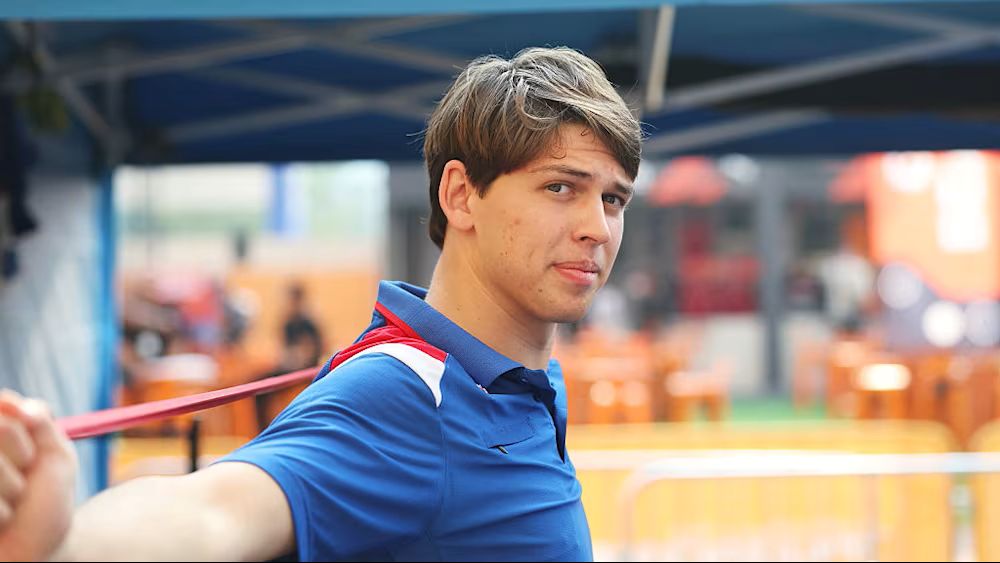
Trident’s turnaround gains momentum
Van Hoepen’s Miami podium continued Trident’s encouraging start to the campaign. After a difficult previous season, the team has clearly moved forward, and van Hoepen has now turned that progress into back-to-back podium finishes.
Asked by Pit Debrief about Trident’s turnaround and his own development, van Hoepen credited the team for giving him the tools to fight at the front. However, he also stressed that the improvement has come through collaboration rather than one single change.
“Yeah, I mean, Trident’s done a great job to help me be on the podium these two races. I mean, definitely a great improvement from last year.”
That progress has also grown from a stronger working relationship between driver and team. In F2, where track time remains limited and margins stay tight, clear communication can shape an entire weekend. Therefore, the Miami result reflected a wider process inside Trident.
“We’ve been working really well together. So, you know, we’re all close, we all start to know each other pretty well now, and we know what we’re thinking and what we should do. So, it’s all coming together. I mean, they’re just working really hard. I’m working really hard. We’re all working hard together.”
Still, van Hoepen does not believe Trident has reached its limit. He praised the team’s progress, but also acknowledged that further gains remain necessary if they want to turn regular podium contention into victories.
“So, I mean, it’s just coming together more and more, and we still have some improvements to make. But overall, it’s been great progress.”
That grounded outlook has also shaped his approach to the rest of the Miami weekend. Trident could take confidence from its Sprint Race pace, but the team still has to prepare for a Feature Race that could present a very different challenge.
Feature Race conditions could bring uncertainty
The Feature Race may introduce another variable, with rain potentially affecting the second race of the Miami weekend. For van Hoepen, that would create a fresh challenge, as he has not yet driven the F2 car in wet conditions.
However, he did not sound concerned. Instead, he took a flexible approach and stressed that Trident had already shown strong pace in the dry. If rain arrives, Miami could become unpredictable, but van Hoepen believes the fundamentals will remain the same: adapt to the conditions, make the right tyre choice and execute the race cleanly.
“Yeah, like Nikola said, I’ve also never driven the F2 car in the rain, but, I mean, it’s whatever. I mean, I would like to drive in the rain. I think here you’d have a lot of chaos though. But today we proved that the pace was also good in the dry, so it doesn’t change that much, apart from what tyres you fit.”
That confidence comes from performance rather than optimism alone. Trident showed competitive race pace in the Sprint, while van Hoepen gained a clearer understanding of how the car behaves around Miami. As a result, his focus remains on carrying that momentum into Sunday, regardless of the weather.
“So, I’m ready for everything, and I’m just looking forward to race tomorrow. That’s the main thing.”
Sprint Race data strengthens Sunday preparation
The Sprint Race result mattered for points, but it also gave van Hoepen and Trident crucial information before the Feature Race. At a new venue, clean running can prove especially valuable, as teams need data on tyre behaviour, balance changes and overtaking patterns.
Van Hoepen underlined the importance of completing the race distance. An early crash or retirement would have left the team with limited information and far less clarity heading into Sunday.
“Yeah, it’s super important to do all the laps, make sure you really execute the race well to know where you’re at and also to know what you can do to improve. Because if you have a crash in the beginning of the race, you have very little data for the race tomorrow.”
Because van Hoepen completed the race and fought at the front, Trident now has both a strong result and a clearer understanding of its car. The Sprint also allowed the team to assess how the car behaved in traffic and how effectively van Hoepen could attack or defend with DRS.
That information could prove especially useful if Sunday produces another close contest.
“So it’s really important to get all the running in as you can. And I think we did that pretty well today and we have a much better understanding for the car for tomorrow.”
Van Hoepen may have missed out on Sprint Race victory, but his Miami performance reinforced his growing confidence and Trident’s improving form. With another race still to come, he now has the chance to turn that pace, data and experience into an even stronger Sunday result.