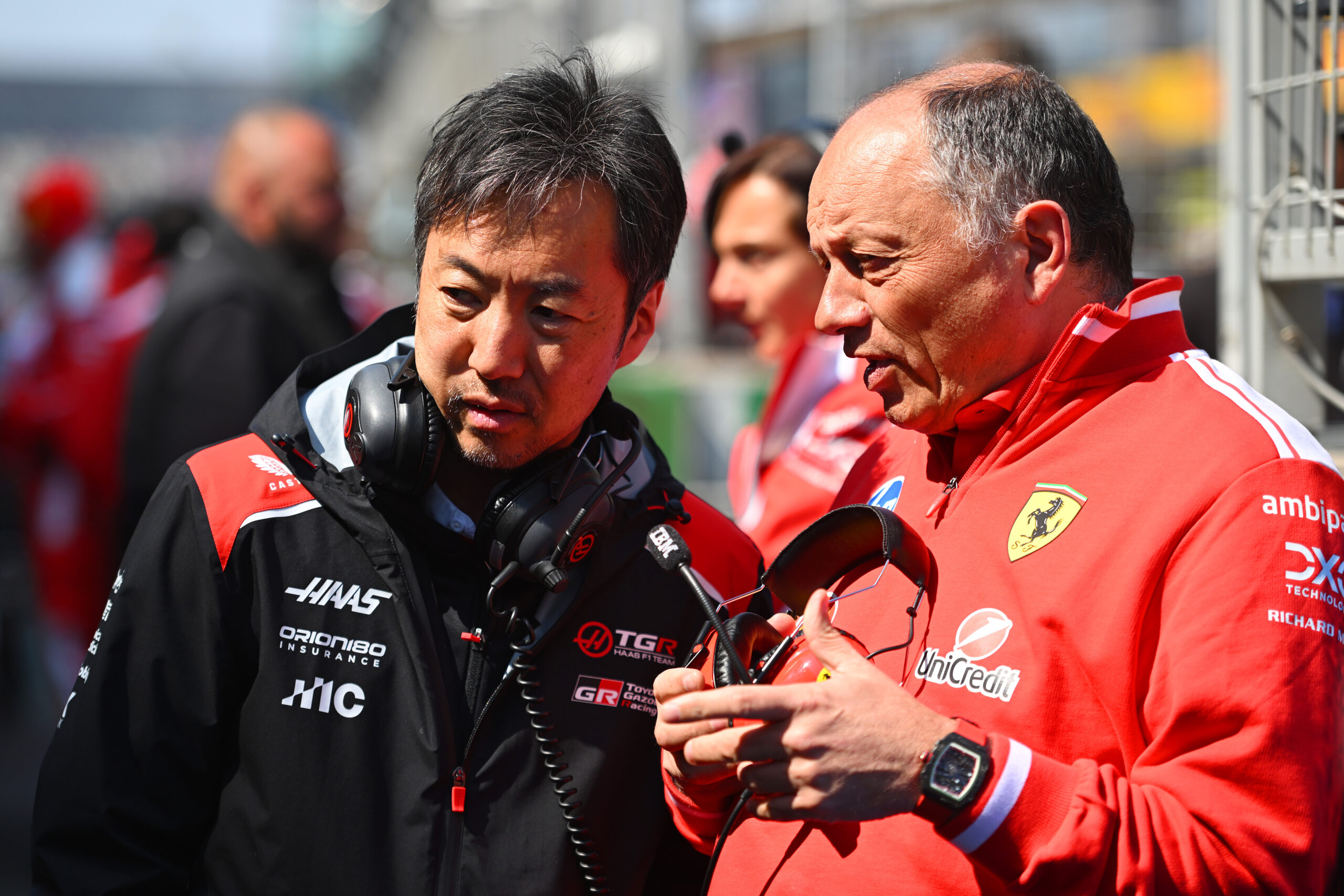
Haas F1 team principal Ayao Komatsu has explained why he’s heavily against what he called “knee-jerk” reactions and further changes to F1’s race start procedures in 2026.
With the removal of the MGU-H, teams lost a key component that helped the cars to get away pretty seamlessly most of the time by the end of last year. With this in mind, the FIA already implemented changes ahead of the second pre-season test in Bahrain, with the new “pre-start” procedure introduced in order to minimise some of the issues observed during the first week of testing.
But after a somewhat chaotic start to the 2026 F1 Australian GP despite the new procedures, there were several teams pushing for further changes surrounding the starting sequence in order to minimise the problems some were facing, with McLaren team principal Andrea Stella notoriously claiming changes were necessary on safety grounds — which is always a huge concern.
“All teams” had the same opportunity with the regulations
Before the season properly started, it was widely believed that Ferrari-powered cars would have a start line advantage due to a smaller-sized turbo, which would in theory take less time to spool up and get to the optimal start revs — and that proved to be absolutely right, with a Ferrari driver leading the first lap in all three race starts (Sprint included) that happened so far.
And that’s precisely why the team and its customers have moved to block any such changes that would benefit its rivals, who had the same chance of adapting to the new rules and didn’t do so.
That view is completely backed up by Haas F1 team principal Ayao Komatsu, as he explained why he thinks it is “way too early” in the 2026 season, and believes any such change would be a “knee-jerk” reaction:
“Again, for me, it’s way, way too early [to make any changes],” Komatsu said in a print media session at the 2026 Chinese F1 GP. “I mean, again, as teams, we have the same set of regulations, right? All the teams have the same set of regulations.
“So you cannot sort of do a knee-jerk reaction after [two] events where everybody is learning at such an amazing rate. And the formation lap [in Melbourne], we didn’t do a very good job, actually.
“We actually drained battery a lot more than we should have done because we weren’t aware of certain things. But then you review the data from Sunday, [and] the understanding we got from that one formation lap, I’m sure if we did it again, we’d do a much better job.”
F1 has to avoid “unintended consequences” from further changing the start procedure
Whilst some teams are still lobbying for change even after the 2026 F1 Chinese GP, Komatsu is adamant that any such move will almost certainly have some unintended consequences, which would only further complicate the matter and unfairly disadvantage those who adapted best to the rules, such as Haas and Ferrrai:
“But imagine then if we change the regulation formation lap now, moving the goalpost, right? What are we doing? I’m sure if you make those knee-jerk reactions, you’re going to have unintended consequences.”
Haas’ Komatsu cited the sudden change in straight line mode zone at the 2026 Australian GP on Saturday, which helped F1 teams that were suffering from chronic understeer at the long stretch between turns six and nine — but that would inherently have unintended consequences, such as increased plank wear and a revision of the car’s downforce levels at such a short notice.
“So that’s exactly what we need to avoid. Things like the straight-line mode fuss on Saturday morning [in Australia], that wasn’t discussed with the teams at all, right?
“So we as an F1 community got to work together and don’t have those knee-jerk reactions. But [it’s] actually good because we had a meeting with all the TPs and FIA just earlier on, including the formation lap topic.
“And then, of course, opinions divided. But what doesn’t change is everybody is learning quickly, right? So let’s not just rush into certain knee-jerk reaction because that’s the worst thing that can happen.
“[When] you change something, then engineers need to learn the new things, drivers need to learn the new things. ‘Oh, wow, then now there are these unintended consequences. Now we introduced a new problem, we need to change it again.'”
Komatsu: Haas is on the side of caution with 2026 F1 rules
Komatsu advised that teams and the regulators need to give it time before considering any immediate changes, and actually weighing up what is safety critical from team’s own personal vested interests in changing things up going forward:
“Observe, let the teams learn because we are learning fast, not just us, everyone. Give drivers some stability. Then they have a chance to get used to these new regulations as well.
“Then after several races, look at the global picture, not just formation laps.
“What do we need to improve, what is actually safety critical? What is affecting the show? Then take a decision from there.”
Further changes won’t prevent teams from having issues going forward
Komatsu warned that teams and drivers are learning at such a rapid rate, that there may well be some issues that haven’t even cropped up yet, that will appear in the next few events, and will make any such decision for changes to the formation lap procedures, automatically a more informed one:
“I cannot speak for other people, but we can make mistakes, right? We may experience something we didn’t experience [in the first two races], then we may mess up.
“So I cannot say that nobody is going to have an issue, but we are learning at such a rapid rate. Even doing burnouts, we now really understood how much it’s affecting certain things. But also sitting on the grid, doing the pre-start laps, that’s charging battery as well.”
Start line issues “nothing to do” with the battery
Whilst some drivers have reported to having low battery at the start of the first two races — notably the two Mercedes drivers and Max Verstappen in Melbourne — Komatsu believes most of the issues seen so far are down to the turbo not being spooled up enough — which is an inherent design feature of each car, and not an actual safety concern as some are making it out to be:
“And also in terms of, like, if you talk about safety, people [that] don’t get off the line. That’s got nothing to do with battery, as you know.
“You don’t deploy it until you get to the early part of the start. So that’s more to do with turbo engagement.
“Again, we’ve been practising that in the Bahrain testing, especially [the second week], with the blue lights, et cetera. So we’ve already changed that.
“Let’s just stabilise it. If everybody’s got known goalposts, in Formula 1 it’s amazing, everyone runs so quickly. So can we just stop moving goalposts every time we talk?,” he pleaded.
Haas’ Komatsu believes it’s “impossible” to make F1 rules that cater for every team in 2026
Whilst the main initiative behind the new pre-start procedure was to minimise any potential disadvantages for drivers lower down the field, who wouldn’t have enough time to properly spool up their turbos, Komatsu believes there’s no rules that would make everybody happy, as there are pros and cons either side of the starting grid, with Haas having already been in each of those situations in the 2026 F1 season:
“If you look at it on the opposite side, on a completely different dimension, but further down the grid, you have more time to prepare. So when the final car comes on the grid, then blue light starts going, right?
“If you’ve qualified in midfield or top ten, you even have more time before that. So there’s, you could say, advantage.
“So it’s impossible to make a rule that caters for all the situations, but that’s where all of us got to really think about as an F1 community, not because we are P1 or P22.
“How can we improve everything in terms of safety, in terms of a show, and where we drop it?”