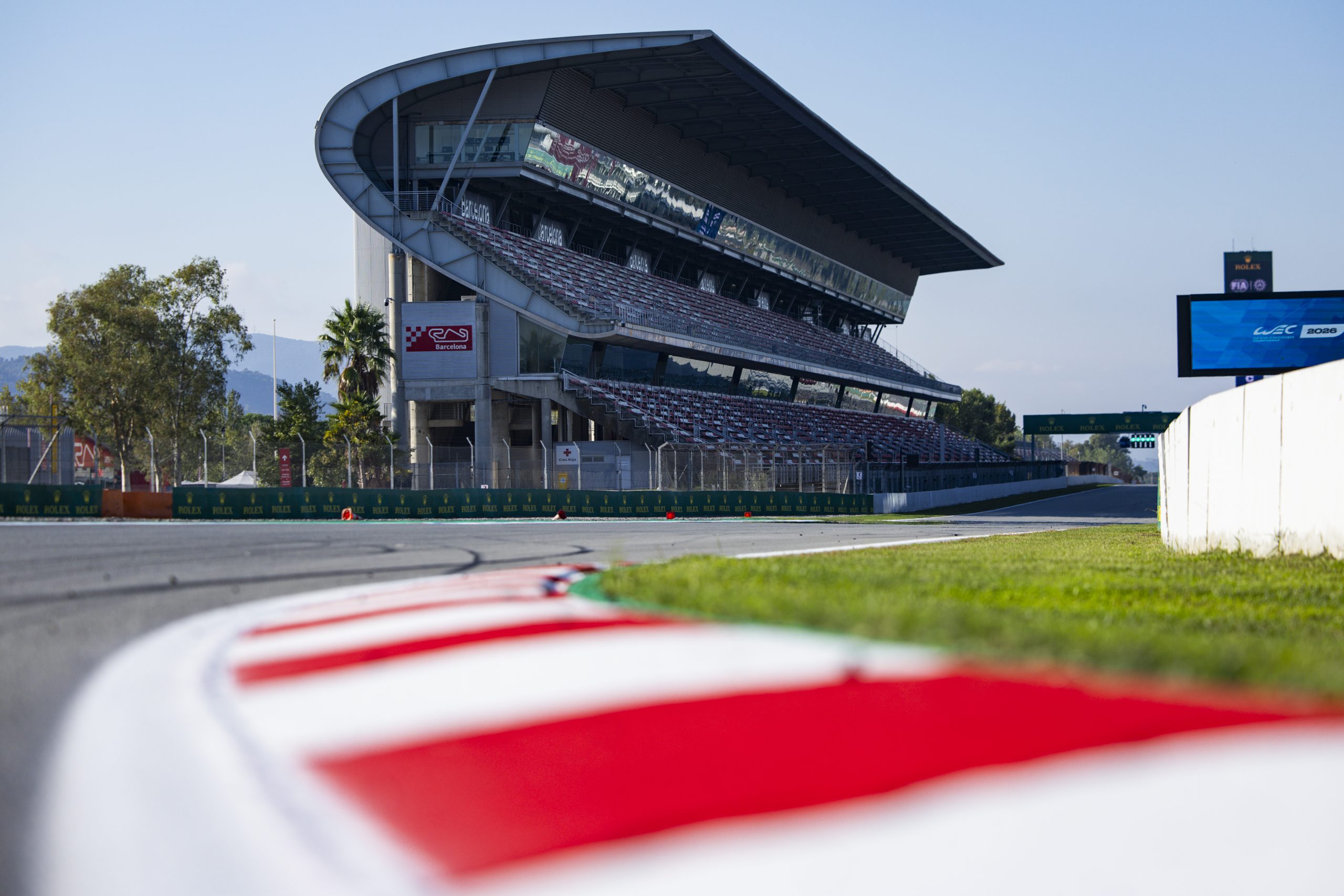
Michelin expects the inaugural FIA World Endurance Championship (WEC) 6 Hours of Barcelona to present its toughest tyre challenge of the 2026 season, with the Circuit de Barcelona-Catalunya placing exceptional demands on Hypercar machinery through its high-speed corners and sustained lateral loads.
The French manufacturer, which exclusively supplies tyres to the championship’s Hypercar category, anticipates that competitors will experience lateral forces exceeding 2g for almost a third of each lap. Those demands could encourage teams to adopt different replacement strategies for their left- and right-side tyres, potentially influencing the outcome of Sunday’s six-hour race.
Michelin will also introduce a new wet-weather tyre containing 57 per cent renewable or recycled raw materials, complementing its latest-generation Pilot Sport Endurance slicks. Teams will have access to the soft and medium compounds throughout the weekend, while the new wet tyre will provide an additional option if rain affects the penultimate round of the championship.
The 6 Hours of Barcelona presented by Visit Qatar takes place from 16–18 October, replacing the originally scheduled Qatar 1812km following changes to the championship calendar. Although the Spanish circuit previously hosted FIA WEC’s 2019 pre-season Prologue, the championship has never raced at the venue, adding another challenge as teams enter the final stages of the title battles.
Michelin introduces new sustainable wet-weather tyre
Michelin will use the Barcelona weekend to introduce the latest addition to its Pilot Sport Endurance range, unveiling a wet-weather tyre that incorporates 57 per cent renewable or recycled raw materials.
The new specification represents another step in the manufacturer’s efforts to improve the sustainability of its racing products while maintaining the performance and durability required at the highest level of endurance competition. It features distinctive blue sidewall markings, allowing teams and spectators to distinguish it from the existing range.
The tyre will complement Michelin’s latest-generation Pilot Sport Endurance slicks, which the manufacturer introduced for the 2026 season. Those tyres contain 50 per cent sustainable materials, with Barcelona’s Hypercar competitors choosing between soft and medium compounds in dry conditions.
Pierre Alves, Manager of Michelin’s endurance racing programmes, explained that the new wet-weather tyre also offers improvements in challenging track conditions, particularly when a drying circuit causes excessive heat to develop within the rubber.
“Our Hypercar partners will be able to fit this new tyre if it rains,” noted Alves. “In addition to delivering superior grip and performance in wet weather, it is also more resistant to the phenomenon known as blistering in drying conditions. It was signed off in 2025 after a private test we organised at Le Castellet in France, to which all of our Hypercar partners were invited.”
The development addresses an important challenge in endurance racing, where teams may need to remain on wet-weather tyres as a circuit gradually dries. By improving resistance to blistering, Michelin aims to provide drivers with more consistent performance during changing conditions while reducing the risk of tyre damage.
Barcelona presents exceptional lateral-load demands
The Circuit de Barcelona-Catalunya introduces a substantially different tyre challenge from several other venues on the FIA WEC calendar, particularly through its combination of sustained high-speed cornering and significant lateral loads.
The 4.657-kilometre circuit features 14 corners and runs clockwise, placing particular demands on the left-side tyres through its longer right-hand bends. Drivers must also manage heavy braking and acceleration zones, creating a demanding combination of lateral and longitudinal forces over a relatively short lap.
According to Michelin, Hypercars will experience lateral forces exceeding 2g for almost one-third of the circuit. Although other venues present more extreme straight-line speeds or individual braking demands, Barcelona’s sustained cornering loads make it particularly challenging for tyre durability.
Alves described the circuit as familiar territory for Michelin, although he acknowledged that the current generation of Hypercars differs considerably from the prototypes that competed there during previous endurance events.
“It’s a circuit we know,” explained Alves. “That said, our last visit at this level dates back to 2019, when FIA WEC organised its pre-season Prologue test here. Ten years before that, we won the 10,00km of Barcelona – a round of the 2009 Le Mans Series – with Aston Martin. The LMP1 prototypes of the day were very different to today’s Hypercars, though. Our engineers have therefore made extensive use of simulation technology to prepare for the coming weekend, while some of our partner teams tested in Barcelona over the summer.”
Those preparations will help Michelin and its partners evaluate the demands of the venue before Sunday’s race, although teams will still need to gather data during practice to understand how their cars interact with the current tyre range.
Left-side tyre management could influence race strategies
Michelin expects the substantial lateral loads at Barcelona to encourage teams to consider different tyre replacement strategies across their Hypercars.
While competitors frequently change all four tyres during endurance pit stops, the circuit’s asymmetrical demands could make it advantageous to replace the more heavily stressed left-side tyres while retaining the right-side set for another stint.
The approach could reduce the time spent stationary during a pit stop, although teams must balance that potential advantage against the performance loss associated with using older tyres. Each manufacturer will also need to consider its car’s weight distribution, aerodynamic characteristics and individual tyre wear patterns before selecting an appropriate strategy.
Alves believes Barcelona’s characteristics could make this approach particularly relevant during Sunday’s six-hour race.
“Tyres need to be capable of withstanding very high laterals loads, which exceed 2g for almost a third of the lap. From that point-of-view, it’s the hardest race of the year for us. The biggest demands are made of the left hand-side tyres, so expect strategies where teams double-stint the rights and single-stint the lefts.”
Such strategies could prove particularly important during closely contested periods, when even small differences in pit-stop duration may change the order between competing manufacturers.
However, the effectiveness of retaining older right-side tyres will depend on their remaining performance and the conditions encountered during each stint. Teams must also ensure that their drivers can maintain competitive lap times without accelerating degradation or compromising tyre safety.
Circuit places high energy demands on Hypercar tyres
Beyond its lateral loads, Barcelona presents significant energy-management challenges that distinguish it from several other FIA WEC venues.
Although the circuit does not feature the extreme straight-line speeds associated with Le Mans or Fuji, its flowing layout generates considerable energy through repeated cornering, braking and acceleration. Tyres must therefore withstand sustained mechanical demands while maintaining consistent grip across the six-hour race.
Alves identified Barcelona as the circuit with the highest tyre energy demands on the championship calendar, despite its relatively moderate average lap speeds.
“It’s also the track that makes the biggest energy demands. Average lap speeds are comparable with São Paulo and Bahrain, which is to say average for the championship. Also of note are the hard-braking zones into Turns One, Five and Ten.”
The braking areas create additional challenges because tyres must provide stability as drivers decelerate before transitioning into cornering and acceleration. Excessive temperatures or degradation could compromise performance through those sequences, particularly late in a stint.
Teams must therefore develop setups that balance outright speed with tyre preservation. Cars that perform strongly over a single qualifying lap may not necessarily maintain the same advantage during longer race runs, especially if their configurations place greater stress on the tyres.
Barcelona’s demanding characteristics could consequently reward manufacturers that manage tyre temperatures effectively while maintaining a consistent pace across multiple stints.
Soft and medium compounds offer strategic alternatives
Michelin will provide its soft and medium Pilot Sport Endurance slick compounds for the Barcelona weekend, giving Hypercar teams different options as they prepare their race strategies.
The softer compound should offer stronger initial grip and potentially faster warm-up, characteristics that could prove beneficial during qualifying or shorter stints. However, teams must assess whether it can maintain competitive performance under Barcelona’s sustained lateral loads, particularly as track temperatures increase.
The medium compound provides an alternative for longer stints, potentially allowing drivers to maintain more consistent performance as the race progresses. Nevertheless, the relationship between tyre degradation and outright pace will vary between manufacturers, making Friday’s practice sessions important for evaluating both options.
Michelin faced a different challenge at Fuji in September, where the championship’s longest straight placed considerable emphasis on vertical loads and tyre temperature management. The manufacturer’s preparations for the 6 Hours of Fuji highlighted the importance of balancing aerodynamic efficiency, warm-up performance and mechanical grip across the circuit’s three distinctive sectors.
Barcelona shifts that emphasis towards sustained cornering forces and managing the increased wear on the left-side tyres. Consequently, the strategies that proved effective in Japan may not translate directly to Spain, even though teams have access to the same soft and medium slick compounds.
The additional possibility of rain could further complicate tyre choices, particularly if teams need to determine when to switch between slicks and Michelin’s new wet-weather specification.
Sustainable tyre development remains central to Michelin’s WEC programme
The introduction of the new wet-weather tyre continues Michelin’s wider efforts to develop more sustainable racing products without compromising the performance demands of international endurance competition.
The manufacturer introduced its latest Pilot Sport Endurance slicks for 2026, incorporating 50 per cent renewable or recycled materials while improving performance characteristics compared with the previous generation. The new wet-weather tyre increases that proportion to 57 per cent, extending the approach across its Hypercar range.
Michelin has identified FIA WEC as an important environment for developing and evaluating new technologies, allowing it to assess tyre performance under the demanding conditions of international endurance racing.
The manufacturer’s long-term involvement in the championship is also secure. Earlier this year, the FIA and Automobile Club de l’Ouest confirmed that Michelin will remain the exclusive Hypercar tyre supplier through 2032.
The agreement extends Michelin’s existing commitment beyond 2029 and includes the introduction of the next generation of Hypercar regulations in 2030. It will therefore allow the company to continue developing its tyre technology as manufacturers prepare for another major technical transition.
Meanwhile, Goodyear will retain its position as the exclusive supplier to the LMGT3 category through the same period, maintaining the championship’s established division between its two tyre partners.
Barcelona will provide Michelin with another opportunity to evaluate its latest products under demanding race conditions, contributing to its broader development programme ahead of the coming seasons.
Tyre management could prove decisive in championship battles
The tyre challenges awaiting competitors at Barcelona arrive at a critical stage of the 2026 FIA WEC season, with only two rounds remaining and several manufacturers still competing for championship honours.
Toyota enters the weekend leading the Hypercar Manufacturers’ Championship with 169 points, holding a 23-point advantage over BMW following its victory at Fuji. Ferrari sits third with 115 points, leaving the Italian manufacturer facing an increasingly difficult task as it attempts to defend its title.
The Drivers’ Championship remains considerably closer, with the #8 Toyota crew of Sébastien Buemi, Brendon Hartley and Ryō Hirakawa leading on 89 points. Their teammates in the #7 Toyota, Mike Conway, Kamui Kobayashi and Nyck de Vries, follow ten points behind, while BMW’s René Rast and Robin Frijns remain in contention on 75.
Those narrow margins increase the importance of race strategy, particularly at a circuit where tyre degradation could produce significant differences in performance across longer stints.
Ferrari has already demonstrated promising pace during Friday’s opening practice session, with Robert Kubica topping the Hypercar classification in the #83 AF Corse 499P. The two factory Ferrari entries finished third and fourth, suggesting that the manufacturer could challenge Toyota and BMW during Sunday’s race.
However, practice performance offers only an early indication of the competitive order. With Michelin expecting particularly demanding tyre conditions, teams will need to balance qualifying pace against the durability required to remain competitive throughout six hours of racing.
The inaugural 6 Hours of Barcelona therefore presents an important opportunity for manufacturers to demonstrate not only outright speed but also their ability to manage the circuit’s unique technical demands.
Barcelona prepares for Michelin’s toughest tyre test of 2026
The 2026 6 Hours of Barcelona will take place on Sunday, 18 October, beginning at 12:00 local Central European Summer Time. The race will mark the championship’s first competitive appearance at the Circuit de Barcelona-Catalunya, introducing a new technical challenge during the penultimate round of the season.
Teams will continue gathering tyre data during Friday’s second practice session before completing their final preparations and qualifying programmes on Saturday. The sessions should provide further insight into the relative performance of Michelin’s soft and medium compounds, particularly as track conditions evolve throughout the weekend.
For Michelin, the race represents an opportunity to evaluate its latest-generation products at a circuit that places exceptional demands on tyre construction and durability. The introduction of the new wet-weather tyre adds another development to its sustainability programme, although its competitive debut will depend on whether rain affects the event.
Meanwhile, the possibility of using different tyre replacement strategies could introduce further variation between the Hypercar teams. Manufacturers capable of extending right-side tyre life while maintaining competitive pace may gain an important advantage during pit stops.
With Toyota, BMW and Ferrari competing for major championship honours, those strategic decisions could prove decisive in determining the outcome of the inaugural Barcelona race.
Michelin expects its toughest challenge of the season, but the demanding circuit may also provide one of the clearest demonstrations of how tyre management can influence success in modern Hypercar competition.