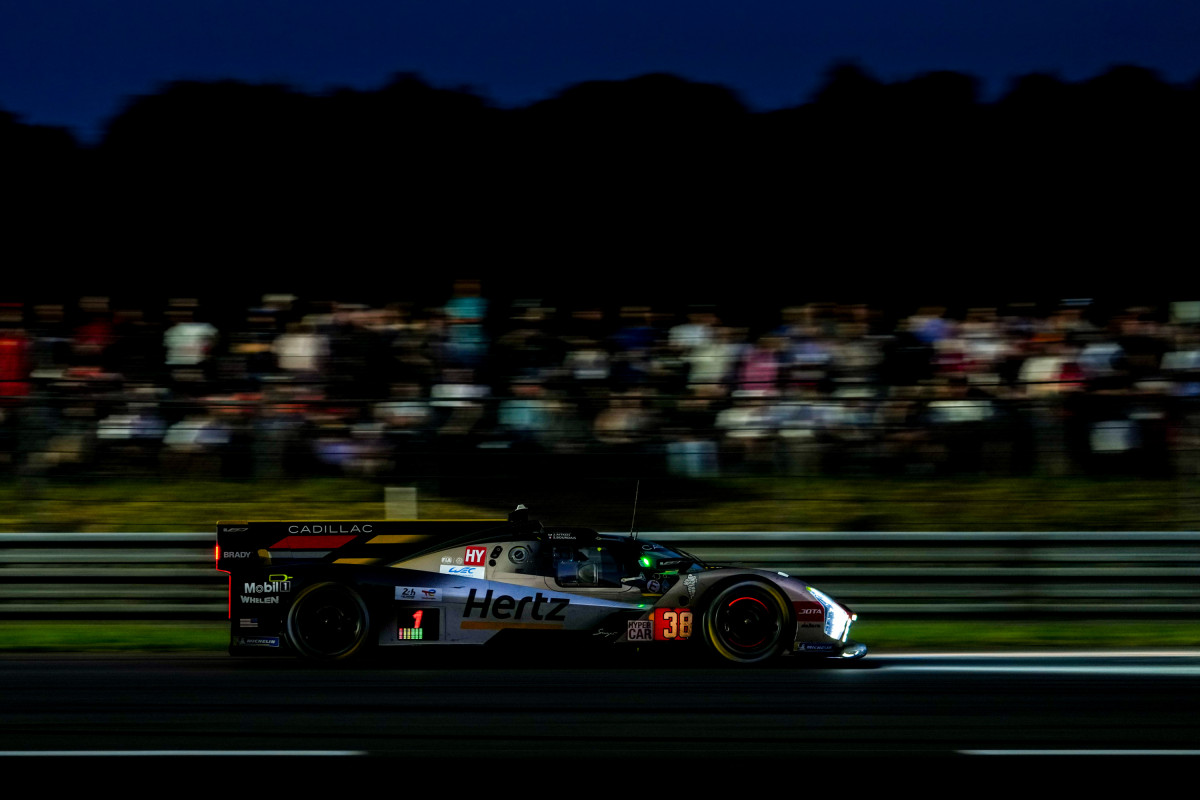
Sébastien Bourdais entered the second half of the 2026 24 Hours of Le Mans with the opportunity he had spent years believing might never return.
The #38 Hertz Team JOTA Cadillac V-Series.R had run at the front throughout the opening 12 hours. Jack Aitken moved the car into the lead during the sixth hour, while Bourdais and Earl Bamber maintained its challenge through a race shaped by close margins, changing tyre strategies and frequent lead changes.
However, shortly after the halfway point, a power-steering failure ended that momentum. Bourdais had already passed pit entry when the problem appeared, forcing him to complete almost an entire lap before Hertz Team JOTA could attempt repairs.
The car briefly returned to the track, but the team later retired it. For Bourdais, who has finished second overall at Le Mans three times, the failure removed another rare chance to claim victory at his home event.
Cadillac gives Bourdais another genuine opportunity at the 2026 24 Hours of Le Mans
Bourdais had previously reached the Le Mans podium with Peugeot, finishing second three times between 2007 and 2011. However, he had not returned to the race with such a strong chance of winning overall for several years.
The 2026 race changed that outlook. Cadillac brought an updated V-Series.R to Le Mans, while Hertz Team JOTA consistently placed both cars inside the leading fight.
Aitken’s move into first during the sixth hour confirmed the #38 car’s pace. Moreover, the crew remained competitive across different temperatures and strategic sequences, allowing all three drivers to contribute to a sustained victory challenge.
Bourdais, therefore, viewed the retirement as more painful because the team had created the opportunity through performance rather than circumstance.
“We obviously had an amazing car, it was fighting at the front the entire time,” he said. “My teammates did an amazing job, the team in general executed exactly the way we had to and we gave ourselves a chance and that’s all you can ask for at Le Mans. In 2020 I had pretty much given up ever getting this chance ever again and this year it was there.”
Small failure brings major consequences
The #38 crew had completed the first half without a decisive mistake. Its drivers delivered their stints, while the team managed strategy and pit work well enough to remain at the front.
Nevertheless, endurance racing can reduce hours of execution to the condition of one component. In this case, the steering failure abruptly changed the car from a victory contender into a retirement.
“This race has got its ways to humble everything and everyone. For maybe a two-dollar piece, it came to a crushing end.
“It’s a big blow. I’m 47 years old, I’m not going to get many of those opportunities but it’s racing. “Some races just decide to turn their back on some guys and smile on the others and it is what it is.
“You win much fewer than you lose in your racing career and that doesn’t make you a better or worse driver it’s just part of the journey and sometimes it’s incredibly cruel.”
Bourdais accepts the result but questions the manner of it
Bourdais has competed long enough to understand that Le Mans rarely rewards every strong performance. However, the nature of the retirement left little for the crew to analyse from a sporting perspective.
The #38 had not crashed out of contention or lost the race through a strategic error. Instead, the car stopped because of a technical problem after the drivers and team had executed their responsibilities.
That distinction shaped Bourdais’ reaction. He accepted the unpredictability of racing, but he also made clear that the crew had done enough to deserve the opportunity to continue fighting.
“I did my part, I had a solid stint in the car and so did everybody else. When the gods of racing decide it’s not your day, it’s not your day.
“We didn’t stuff the car in the fence or anything like that, it’s just a stupid failure that ruins everybody’s efforts.”
Steering failure during the 2026 24 Hours of Le Mans leaves Bourdais with a difficult lap
The timing of the problem added another challenge. The power steering failed as Bourdais passed the pit entrance, leaving no immediate route back to the garage. He therefore had to guide the Cadillac around almost the full Circuit de la Sarthe without normal steering assistance. That lap included several fast sections and heavy braking zones, while Bourdais also had to avoid worsening the damage or losing control.
He immediately understood that the failure had probably ended the car’s chance of victory. Even so, he still needed to complete the lap and return the car safely enough for Hertz Team JOTA to inspect it.
“On top of it, the power steering failed at pit in so I was already through so I was going to have to do the lap back to the pits bleeding lap time and trying not to crash because the steering wheel was just a rod,” he explained. “It was quite spicy to turn.”
The team attempted repairs and briefly sent the #38 back onto the circuit. However, the car returned to the garage before Hertz Team JOTA confirmed its retirement.
Sister Cadillac underlines scale of progress
Although the #38 did not finish, Cadillac’s wider Le Mans performance provided evidence that its latest development programme had worked. The manufacturer had already demonstrated one-lap speed at the Circuit de la Sarthe. One year earlier, Cadillac locked out the front row but failed to sustain that level across the race.
In 2026, the situation changed. Both Hertz Team JOTA cars remained competitive over long stints, while the #12 entry also fought at the front after the #38 retired.
Evo package validates Cadillac’s direction
Cadillac introduced its revised package with Le Mans performance as a major objective. However, development work can only establish the probability of progress before a car races against its rivals. Therefore, the 24-hour event offered the first complete test of whether the changes had improved pace, consistency and tyre use across a wide range of conditions.
Bourdais believes the answer was clear. While the retirement denied the #38 crew the result, the car’s competitiveness validated the work completed by Cadillac’s engineering and technical groups.
“For us, it’s a validation of all the efforts that have been made and all the developments and directions that were taken with the Evo kit,” added Bourdais.
“It seemed like we took a bigger step than most and that’s amazing because, when you redesign an Evo like that, you hope it’s going to be good enough and you hope you do everything right, but you’re never sure of the result. It’s testament to the development group and the entire technical group because they did get it right.”
Progress cannot replace the lost result
Cadillac left the first half of the race with proof that its updated Hypercar could compete for the lead over a full stint. Hertz Team JOTA also showed that it could place both entries in the fight through pace, strategy and execution.
However, those gains could not replace the result that Bourdais, Aitken and Bamber lost.
The #38 crew had created a genuine chance to win Le Mans before the power-steering failure removed it from contention. For Bourdais, the technical progress offered encouragement for Cadillac’s wider programme, but the retirement still represented another missed opportunity at the race he has yet to win overall.