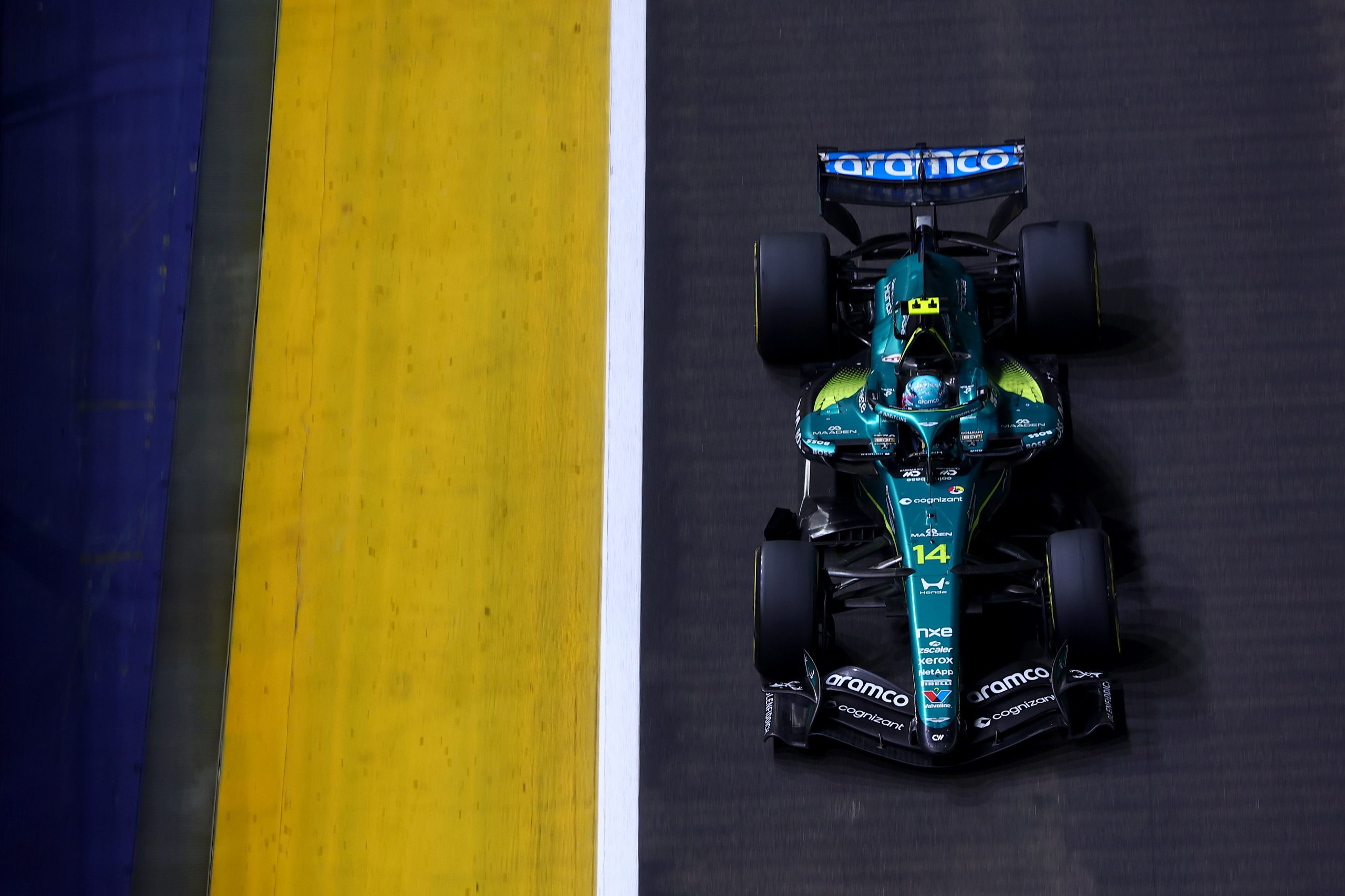
Following a difficult weekend at the 2026 F1 Singapore GP, Fernando Alonso pointed out his concerns regarding the reliability and performance of his Aston Martin‘s power unit.
The two-time world champion struggled throughout the night at Marina Bay Street Circuit, ultimately crossing the finish line down in 16th place, while his teammate Lance Stroll endured an even worse Sunday, failing to finish the race. He was only ahead of the Cadillacs at the flag of those who finished. Alex Albon was behind him before boxing to retire on the penultimate lap.
Alonso warns Aston Martin about the upcoming race weekends
Explaining that drivability and turbo lag problems had severely hurt his whole race in the 2026 F1 Singapore GP, Alonso stressed that the team urgently needs to figure out the real causes of these issues before heading into a relatively tougher part of the calendar.
Upcoming tracks’ slow and tight corners could make Aston Martin’s current problems and power delivery even worse. Add on top of that they are way down on top speed, they are likely to be right the back at circuits like Las Vegas and potentially Mexico.
“There is something on the power unit that is not performing as it should do on this weekend, and yeah, we need to understand why.
“Because obviously there are a couple of tough races coming. Mexico will be the next one with very slow speed corners, maybe Vegas and some other street circuits.
“So yeah, we need to get on top of the issues that drivability, turbo lag. There are a couple of things that are costing us a lot of lap time and we discovered on the hard way too this weekend.”
Deployment frustration at the 2026 F1 Singapore GP
The situation became even more complicated when it came to Aston Martin’s decision to change Alonso’s turbo before the 2026 F1 Singapore GP. Asked if the new turbo made things better, Alonso explained that his main headaches shifted toward energy management issues rather than the turbo itself, especially during neutralisations.
“I don’t know, I still have a lot of problems on the race. I think less on the turbo side but it was a lot of problems on deployment, especially after the Virtual Safety Car. I don’t think the car knew exactly where I was in the lap because I was deploying in different places that I didn’t need and I was not deploying on the straights. So that was highly frustrating, but yesterday turbo is broken, so I had to change it.”
Detailing Virtual Safety Car complications
Alonso admitted that they still need to investigate whether the track’s corners caused these troubles or if the team had actually taken a step backward in car drivability. Pointing out that recent races on similarly tricky circuits went smoothly, the two-time world champion presumed the issues were specific to the Marina Bay Street Circuit.
“I don’t know, we need to see because last weekend in Sepang we had no issues, even in Baku. Baku was very twisty and very slow the first two sectors and we didn’t have any issues. So it seems very specific on this track and I don’t have any answers yet.”
On street tracks, you need instant power and exact timing during a Virtual Safety Car. The Spaniard’s inability to harvest and deploy energy effectively created a double jeopardy here: missing a window to pass Sergio Pérez, whilst simultaneously becoming an easy target for Isack Hadjar. They had been right together when it went green.
“All the laps was difficult. But here on the Virtual in the first one I could have overtaken Pérez and I ended up not overtaking Checo but also losing the position with Hadjar and then in the last Virtual as well I lost like two seconds on the restart. So yeah, it was complicated that weekend in general.”
Straight-line deficit of Aston Martin
When running in clean air or on the soft compound, the car’s underlying pace showed the essence of competitiveness, according to Alonso. However, all that hard work was lost on the straights. Because the car lost tenths on every straight, passing or defending against other drivers became an impossible mission.
“Yeah, the car was okay, especially on the soft tyre. I think the first stint was very strong but we ended up behind Checo, well behind any car, and then we lose 200-300 metres every straight, so it’s a bit of an impossible task.”
Being realistic about the nature of the street tracks
Addressing comments from drivers like Lewis Hamilton and Max Verstappen regarding whether the circuit layout needs modifications to improve racing, Alonso remained realistic about the limitations of street tracks.
He reflected on past eras of Formula 1 to emphasise that overtaking has always been inherently difficult at such venues.
“I don’t think there is much that we can do, you know, there are street circuits that normally qualifying means 90% of the race and it has been like that from the times I remember Formula 1 from Senna, Prost, Michael, myself here 2010. I had like eight tenths deficit from the Red Bull, I made it on Saturday to be on pole and then I kept Sebastian behind for 62 laps.
“This is the nature of the of the track. I don’t think there is much we can do. I mean there’s still some overtakings, I think today. I don’t know, I was watching the screens but I saw Hamilton, losing a lot of places, so there were a couple of places to be overtaken.”