Balance of Performance, widely known as BoP, has become one of the most important systems in modern endurance racing. It shapes how the FIA World Endurance Championship and the 24 Hours of Le Mans manage competition between cars with different designs, engines, aerodynamics and technical philosophies.
In simple terms, BoP uses technical adjustments to keep cars within a similar performance window. In WEC, it applies to both Hypercar and LMGT3, with the FIA and the Automobile Club de l’Ouest using factors such as weight and power to prevent one concept from gaining an overwhelming advantage.
However, BoP does not guarantee equal results. It aims to balance each car’s performance potential, but it does not replace race execution, driver quality, tyre management, strategy, pit work or reliability. Those elements still decide who wins at Le Mans.
Why BoP exists
BoP exists because WEC and Le Mans allow very different cars to compete in the same categories.
In Hypercar, manufacturers can race under two technical approaches: Le Mans Hypercar and Le Mans Daytona h. LMH gives manufacturers greater design freedom, while LMDh uses more common components. Without balancing tools, one platform could gain an advantage simply because its rulebook gives it a different technical profile.
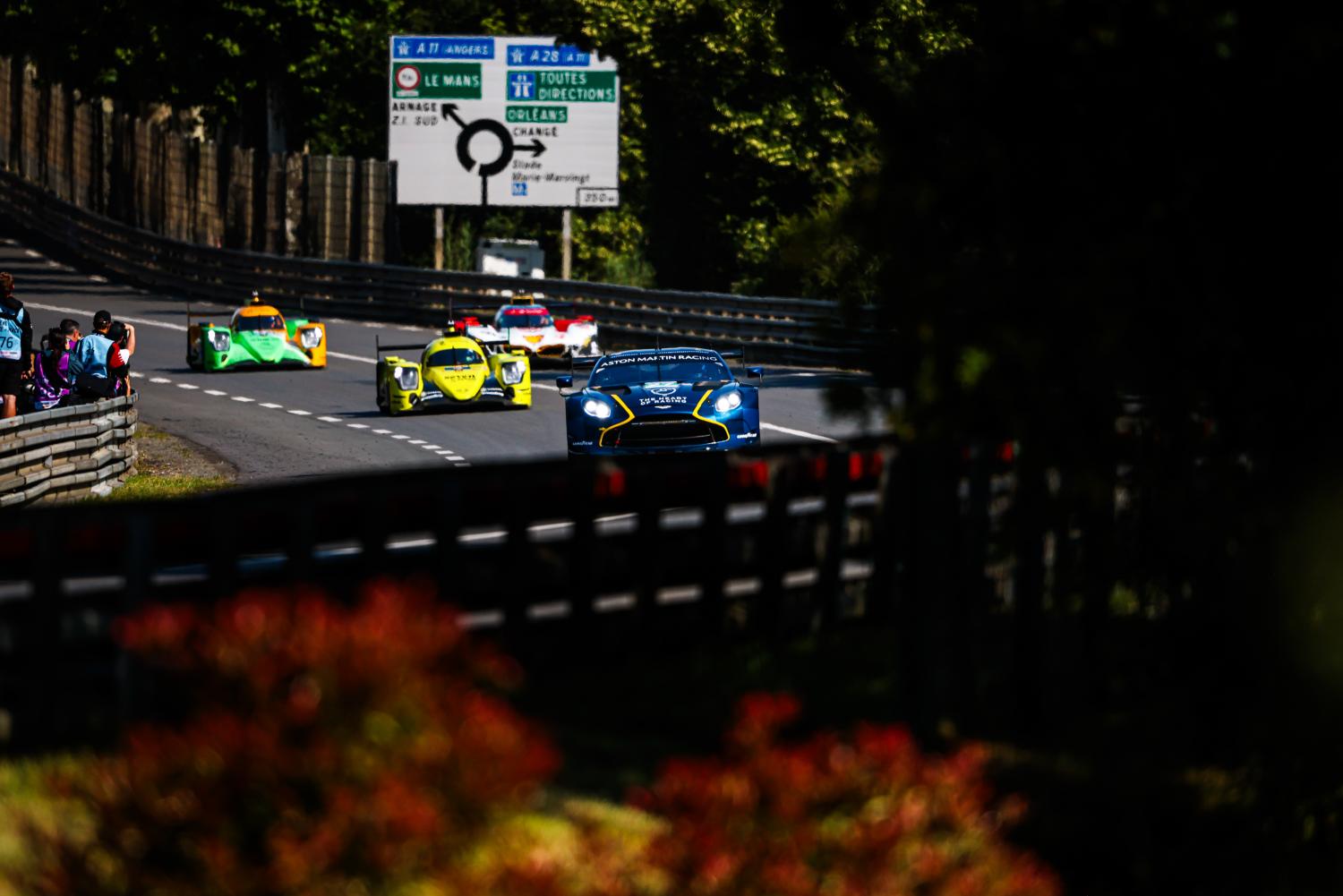
The same principle applies in LMGT3, where cars come from different road-car bases. A Ferrari 296, Porsche 911, BMW M4, Lexus RC F, Corvette Z06 and Aston Martin Vantage do not share the same engine layout, weight distribution, aerodynamics or dimensions. BoP allows those different concepts to race together without forcing every manufacturer to build the same type of car.
This also helps control costs. If manufacturers could chase unlimited performance gains, the category could become too expensive and discourage entries. By keeping cars within a defined window, BoP supports the large and varied grids that have become central to the modern WEC and Le Mans landscape.
How BoP works
BoP begins before the cars race. During homologation, the FIA and ACO inspect, measure and analyse each car, including its aerodynamic performance. In Hypercar, the permitted aerodynamic window is already narrow, so the cars should begin relatively close before further adjustments take place.
From there, officials use data gathered during testing and racing. Cars carry sensors, and governing bodies analyse performance indicators to understand how each manufacturer’s package behaves on track.
The main BoP tools include weight, power and energy-related parameters. In practice, a car may receive extra weight, less power, altered power delivery or other technical limits. These changes do not aim to punish success directly. Instead, they aim to stop underlying car concepts from becoming too strong relative to the field.
Hypercar BoP has three main layers
Hypercar BoP works through three main stages.
The first stage addresses homologation parameters. These are the technical characteristics measured when the car goes through official inspection and analysis.
The second stage is platform equivalence. This matters because LMH and LMDh cars operate under different rules. Officials compare the performance level of the best LMH-type car with the best LMDh-type car, then apply adjustments if one platform needs balancing against the other.
The third stage is manufacturer compensation. This uses race data to assess individual manufacturers. However, the FIA and ACO apply this carefully and only when the data is considered strong enough, usually after several races.
Together, these layers allow the category to manage both broad platform differences and manufacturer-specific performance gaps.
LMGT3 uses a simpler version of BoP
LMGT3 follows a similar process, but it does not need platform equivalence because all cars fall under the same broad GT3-based technical framework.
Instead, the system focuses on balancing the different manufacturer models. Officials can adjust weight, power and related parameters to keep the class competitive.
LMGT3 also uses a championship-based weight handicap at each race, except at the 24 Hours of Le Mans. This adds another layer to the class during the regular WEC season, but Le Mans receives its own treatment because of the race’s unique length, speed profile and importance.
Le Mans gets a specific BoP
Le Mans does not simply copy the BoP from the previous WEC round. The Circuit de la Sarthe has unique demands, especially because of its long straights, heavy braking zones and high-speed sections.
For the 24 Hours of Le Mans, officials can consider data from the previous year’s race. Therefore, the Le Mans BoP may differ from events such as Spa or Imola.
The Le Mans-specific approach matters because some cars may perform differently at La Sarthe than they do on conventional circuits. A car with strong straight-line efficiency, for example, may look more competitive on the Mulsanne Straight than it does at a twistier venue.
Power changes above 250kph matter at Le Mans
One important Le Mans-specific tool is power differentiation at low and high speed.
This allows officials to modulate power above 250kph, helping balance peak speeds without relying only on broad weight or power changes. That matters at Le Mans because the long full-throttle sections can magnify small differences in drag, deployment and straight-line efficiency.
In other words, two cars may look similar over a lap but reach that lap time in very different ways. One may gain on the straights, while another may recover time in the corners. Power differentiation helps manage those differences more precisely.
BoP does not decide everything
BoP often attracts attention because its figures can directly affect a car’s lap time. However, it remains only one part of performance.
A team still needs a strong setup, clean strategy, fast pit stops, effective tyre management and reliable execution. Drivers also need to manage traffic, avoid penalties and perform across changing track temperatures, weather conditions and fatigue.
This is especially true at Le Mans. Across 24 hours, a theoretically strong BoP cannot overcome poor reliability, slow stops, bad calls or driver mistakes. Equally, a car that looks slightly disadvantaged on paper can still fight if the team executes the race well.
Why WEC will keep BoP data confidential
For 2026, the FIA and ACO decided that WEC and Le Mans BoP tables would no longer be published publicly. The change aims to reduce speculation and misinterpretation around a system that depends on complex data and context.
Previously, fans and media could see figures such as weight, power and energy allocation. However, those numbers only tell part of the story. They do not include homologation data, internal performance traces, tyre behaviour, fuel usage, driver approach, track-specific conditions or how a car creates its lap time.
As a result, a simple headline figure can create a misleading picture. A car with more weight may also have other strengths. A car with less power may still generate better efficiency or cornering performance. Keeping the data confidential gives teams the necessary information while limiting public conclusions based on incomplete evidence.
No Hypercar success handicap for 2026
The FIA and ACO also moved away from introducing a Hypercar success handicap for 2026.
A success handicap would add extra performance limitations based on results or championship position. However, officials opted against adding another variable on top of BoP. The WEC calendar contains only eight races, so a success handicap could encourage teams to manage results or hold back rather than push fully at every event.
Instead, WEC will continue to rely on event-specific BoP adjustments. This approach allows the governing bodies to account for different circuit profiles without turning success itself into a direct penalty.
Why BoP remains controversial
BoP remains controversial because it sits between sporting fairness and technical freedom.
Manufacturers want a fair chance, but they also want their engineering work to matter. Fans want close racing, but they also want to believe results come from merit rather than adjustment. Teams want transparency, but full public data can create confusion when outsiders do not have the full technical picture.
That tension explains why BoP debates rarely disappear. A fast car may prompt claims that it received favourable treatment, while a struggling car may lead to accusations that it was restricted too heavily. In reality, the system tries to balance performance potential, not guarantee identical lap times or outcomes.
Why BoP is central to modern Le Mans
Modern Le Mans depends on variety. The Hypercar field includes different manufacturers, different design routes and different philosophies. LMGT3 brings road-derived cars with very different layouts into the same class.
BoP makes that variety possible. It allows Ferrari, Toyota, Porsche, Cadillac, Peugeot, BMW, Alpine, Lamborghini, Aston Martin and others to compete under one framework without forcing all of them into the same technical template.
The system will always invite debate. However, it has helped create deeper grids, closer racing and a more sustainable manufacturer landscape. At Le Mans, that matters because the race is at its best when different ideas fight for the same prize.
See the full schedule for the 2026 edition of the 24 Hours of Le Mans, and you can get live updates on race day from our blog.