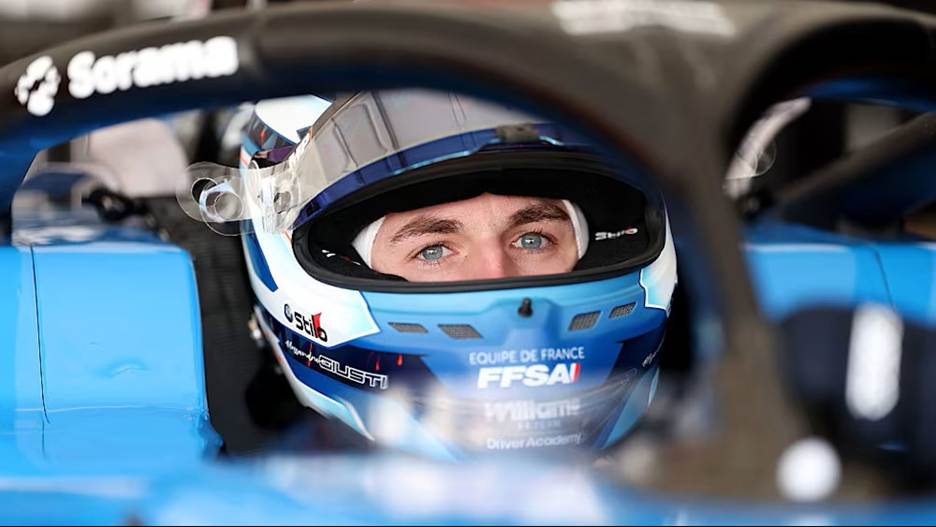
Alessandro Giusti enters the 2026 F3 season with clear ambition. After completing his rookie campaign, the MP Motorsport driver now wants to use that experience to challenge at the front and fight for the title.
His first year in F3 gave him a stronger understanding of the car, the tyres and the level of precision required across a race weekend. However, Giusti’s development did not start in single-seaters. His smooth driving style and natural tyre management first appeared in karting, before he carried those traits through F4, FREC and into F3.
In an interview with Formula 3, Giusti reflected on his driving style, his approach to tyre management, the challenge of qualifying, and the importance of adapting at each stage of the junior ladder.
Giusti on his smooth driving style and tyre management in 2026 F3 Championship
Giusti has always relied on a smooth approach behind the wheel. That style influences what he wants from the car, especially across a race stint. Rather than chasing an aggressive balance, he looks for stability and rotation that allow him to push without overworking the tyres.
“I have quite a smooth driving style so I want a stable car, and for it to have a good rotation for the race. That’s kind of it, I want good stability to push the corner. I’ve always been good since I’m a kid at managing my tyres. Unconsciously as well in go-kart when you don’t need to manage the tyres too much, I was always quite smooth with it, not damaging them too much. But in F3 it’s a big step compared to FREC and F4 to manage them. However I think I have done a good job.
That natural tyre management gives Giusti a useful foundation in F3. However, the step into F3 still demanded a more conscious approach. The tyres play a major role in both qualifying and race performance, so drivers must combine speed with control.
As a result, Giusti has had to refine a strength he already had. His smoothness helps him preserve the tyres, but F3 also requires him to manage them while racing closely against a large field.
Giusti discusses staying calm in traffic during F3 races in 2026
Race conditions add another layer to tyre management. In testing, drivers can focus on their own rhythm. In a race, however, they must manage the tyres while defending, attacking and reacting to the cars around them.
Giusti recognises that this makes the opening phase of a race especially difficult. Drivers need to stay composed while still protecting their tyres and positioning.
“It’s different at the start of the race when you have cars around, it’s always more difficult to manage than when you’re alone driving like at testing. So for sure you need to be calm and lucid, but that’s the difficulty.”
That calmness matters in F3 because the races often create intense pressure from the first lap. With so many cars on track, a driver must balance aggression with patience. Giusti’s ability to remain clear-headed therefore plays an important role in how he manages races.
Giust on why Qualifying remains one of F3’s toughest challenges
While race management requires patience, qualifying demands immediate execution. In F3, drivers often have only one real opportunity to extract the best from the tyres. That places huge pressure on the out-lap, track position and the push lap itself.
Giusti explained why qualifying in the category can become so difficult.
“In Formula 3, you tend to only get one lap out of the tyres. Sometimes if you’re lucky you get two, but also you have to get the tyres up to temperature for the start of the lap, that’s also why Quali in F3 is the toughest.
“You’ve also got 30 cars pushing, and you need to have quite a good gap. So on some tracks the guy ahead is catching the last car on the track. So it makes it quite hard.
The size of the grid adds another complication. Drivers need clean air, but everyone searches for the same space. Therefore, even a strong car and good pace can disappear if traffic ruins the lap.
However, Giusti does not see tyre warm-up as the main issue during race weekends. Track conditions usually help drivers bring the tyres into the right window.
“Actually to warm up the tyres on a race weekend is not an issue because you’ve got high track temps as Quali is normally at four in the afternoon on a race weekend. But the most important thing is to maximise the lap. You’ve got only got one push on the tyres, so don’t make mistakes and drive clean.”
That final point captures the essence of F3 qualifying. Drivers must deliver under pressure, avoid errors and make every corner count. For Giusti, improving in that area can prove decisive in a title challenge.

Adapting from karting to single-seaters
Giusti’s journey through the junior ladder has also forced him to adapt his driving style. The move from karting to F4 represented the biggest change because the techniques required in a kart did not directly transfer to a single-seater.
“When you step up to F4, it’s day and night compared to karting to be honest. You cannot take anything from the driving style, it’s way different. The only things you can take from it is just how you battle on track with the others, how you deal with the pressure, and with the stress. Other than that, not a lot.
Although karting still helped him develop racecraft and mental resilience, Giusti had to rebuild the technical side of his driving once he entered cars. From there, each step demanded further adjustment.
“I felt like F4 to FREC I had to change my driving style, but not as much. To F3 though is a big step, so I changed a bit on different aspects. But it’s still not like day and night like go-kart and F4.”
That progression shows how drivers must constantly evolve through the junior categories. F4, FREC and F3 all reward different habits, so Giusti has had to adapt without losing the smoothness that defines his style.
Giust views pre-season testing as a platform for a 2026 F3 title push
Testing now plays an important role in Giusti’s preparation. With only one pre-season test before Melbourne, drivers and teams must use that time carefully. For Giusti, it allows the team to assess winter developments while helping the driver rebuild rhythm in both race and qualifying trim.
“Pre-season testing is really important because, first of all, it’s the first test of the year, and it’s the only one before Melbourne, which is quite important. It’s always good to start on high, and there are things they have done over the winter, so it’s time to test all the things they do. It helps for us to get back on top of our race pace and Quali laps. It’s super useful.”
That preparation could prove crucial as Giusti targets a stronger second season in F3. His rookie year gave him experience, but 2026 offers the chance to turn those lessons into a sustained title challenge.
A driver refining his strengths for 2026
Giusti’s comments show a driver who understands where he must improve and which strengths he can carry forward. His smooth style and tyre management remain valuable assets, but Formula 3 demands more than natural ability. It requires precision in qualifying, calmness in traffic and constant adaptation.
As he enters 2026 with MP Motorsport, Giusti now has a clearer picture of what the category demands. If he can combine that experience with cleaner qualifying execution and strong race management, he can place himself firmly in the title fight.