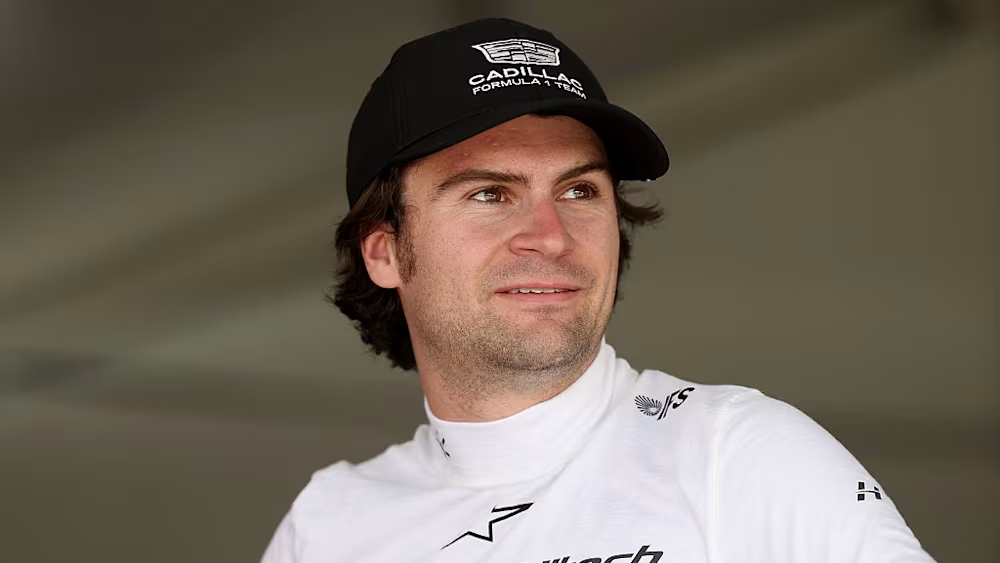
Ahead of the 2026 F2 round at Silverstone, Colton Herta described the first half of his campaign as disappointing and identified qualifying as the main area he must improve as he continues adapting to the championship together with his team Hitech.
The Hitech driver entered the season with extensive experience in IndyCar but has faced a steep learning curve on unfamiliar European circuits, sensitive tyres and a tightly contested F2 grid.
Speaking during a virtual media session ahead of the Silverstone round, which Pit Debrief attended, Herta discussed his difficult start to the campaign, the challenges of limited practice and the lessons he has learned since returning to European racing.
Herta gives honest assessment of first half of F2 season ahead of Silverstone
With Silverstone marking the halfway point of the F2 campaign, Pit Debrief asked Herta to assess his progress so far, identify the areas he wants to improve and outline what would constitute a successful run of races before the summer break.
Herta did not disguise his disappointment. Although he has come close to stronger results at points during the year, he believes his overall performances have fallen below the standards he set before entering the championship.
“Yeah, I wouldn’t grade my season so far very highly at all. It’s been disappointing from that side of things. I just need to continue to improve and make the small steps. Obviously, as a racing driver, I want to compete for wins and podiums.”
Qualifying improvement key to stronger results
In response to Pit Debrief’s question about the areas he wants to improve, Herta identified qualifying as the main factor preventing him and Hitech from converting their race pace into stronger results.
“We’ve been close, but for the most part, qualifying has been the Achilles heel of us at the moment. I think if we can sort that out, our race pace has been much better than our qualifying pace. That’s goal number one right now. I think if we improve that, we can build on it and hopefully wrap up the end of the season a lot stronger.”
At Silverstone, Herta’s assessment of his F2 campaign highlighted the difference between Hitech’s performance over one lap and its pace across a full race distance. He believes the team has often had enough speed to compete closer to the front during races, but qualifying has prevented him from fully exploiting that potential.
Improving his starting position would reduce the need for recovery drives and allow him to manage his tyres and strategy more effectively. Herta therefore sees qualifying progress as the clearest route towards podiums and victories during the remaining rounds.
Simulator work helps Herta overcome lack of track experience
Herta faces an additional challenge because many of his rivals already know the circuits on the F2 calendar from previous seasons or junior categories.
With only 45 minutes of practice before qualifying, there is little time to adapt, particularly at a high-speed circuit such as Silverstone. Herta must therefore complete much of his preparation before arriving, with simulator work playing a central role.
“Yeah, good question. I think most of it is obviously nowadays relying on the simulator. Hitech is very strong with their simulator programme.“
Although Herta raced in Europe earlier in his career, many years have passed since he regularly competed at several of the circuits. Changes to layouts, surfaces and curbs mean that his previous experience does not always provide a significant advantage.
“So yeah, obviously, I haven’t had a tonne of experience on the European tracks. And the experience that I have had, it’s been, you know, from a decade ago now. So a lot of the things have changed.”
Hitech sets clear driving targets for each circuit
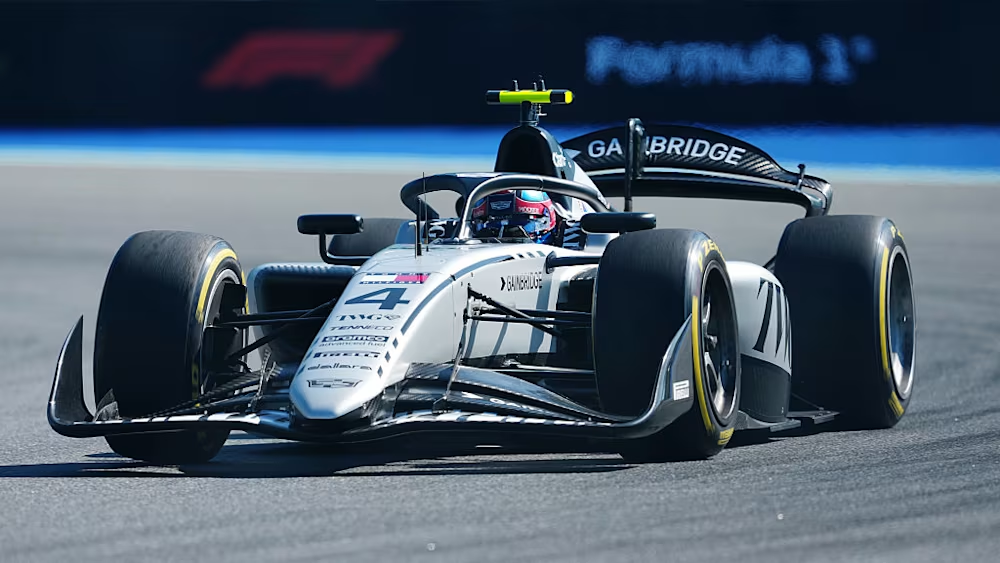
Rather than simply memorising each layout, Herta and Hitech focus on establishing specific driving targets. The team uses data and simulator sessions to identify how he should approach the corners and manage the characteristics of the F2 car.
“But the way that we’ve been trying to cut that down is really having a clear understanding of what the driving targets are for each track and how we approach that from inside the car. And then we try to replicate that in the simulator, and so on and so forth.
“And so, you know, I think the team has been really good and clear on getting me up to speed and what needs to happen and what the good things about this car are, what the bad things are, and how to treat it. But yeah, I mean, it’s a process. And so yeah, we’re still going through it.”
Herta views his adaptation as an ongoing process. Simulator preparation can shorten the learning curve, but it cannot fully recreate the grip levels, wind conditions and physical sensations experienced on the circuit. He must therefore use the limited practice session to confirm what he has learned before quickly committing to a qualifying set-up.
Sensitive F2 tyres contribute to qualifying struggles
While Herta has identified qualifying as his main weakness, he does not believe a single issue explains the deficit. Each circuit places different demands on the car and tyres, while changing temperatures and track conditions can affect their behaviour. Herta therefore rejected the idea that Hitech could solve its qualifying struggles with one simple adjustment.
Herta also acknowledged that aspects of his own driving can improve, although the exact limitations vary between rounds.
“Well, I think that it’s not extremely clear every time. So it’s not like one shoe fits all at the moment. So, you know, each track’s a little bit different. And obviously, how the tyres react, and how the car reacts is a little bit different. And the setups and packages that we bring are obviously different. But yeah, I think there’s a few things that are within my control to do better, and just kind of focussing on that.“
“But yeah, obviously, the tyres are a lot more sensitive, I guess we can say compared to what I’m used to. And any bad thing that you do to them, you kind of get hurt by it really quickly. So yeah, it’s a very, very different tyre. And to learn it has been, you know, just takes time. And so that’s part of it, but not the whole equation on what I need to work on.“
Herta has found the tyres less forgiving than those he previously used, with small mistakes quickly leading to a loss of grip. The tyres are therefore only one part of the challenge. Herta must also refine his driving and help Hitech find a more consistent set-up for each circuit, explaining why qualifying remains difficult despite progress in race simulations.
Miyata’s experience provides valuable support
Herta is one of 10 rookies on the F2 grid this season, creating a large group of drivers who must learn the championship’s procedures and technical demands while competing against more experienced rivals.
Second-year and third-year drivers often hold an advantage during the opening rounds because they already understand the tyres, race formats and circuits. They can begin a weekend refining their performance rather than learning the basics.
Herta believes Hitech has helped to reduce that deficit through its experience as a team. He has also benefited from working alongside Ritomo Miyata, whose previous seasons in F2 give him useful reference points when comparing data and discussing the car.
“So yeah, I think obviously doing a second year in anything is going to help you, especially in the beginning half of the season. But I think what helps me is I have Ritomo [Miyata], who’s been in the series for three years now. So he’s got a wealth of kind of knowledge, and he’s willing to share and help with me.“
A knowledgeable team-mate can provide information that data alone does not always reveal. Miyata can explain how the tyres usually develop across a weekend, how the car should feel in specific conditions and whether a problem relates to the set-up or the driver’s approach. That cooperation gives Herta a clearer benchmark as he continues to learn the car. It also allows Hitech to combine the feedback of a driver with extensive experience outside F2 and one who already understands the championship.
“So I think along with using the team, who obviously have the most experience in the series, but also Ritomo from the driving side has been helpful.“
Returning to work helps Herta move on from difficult results
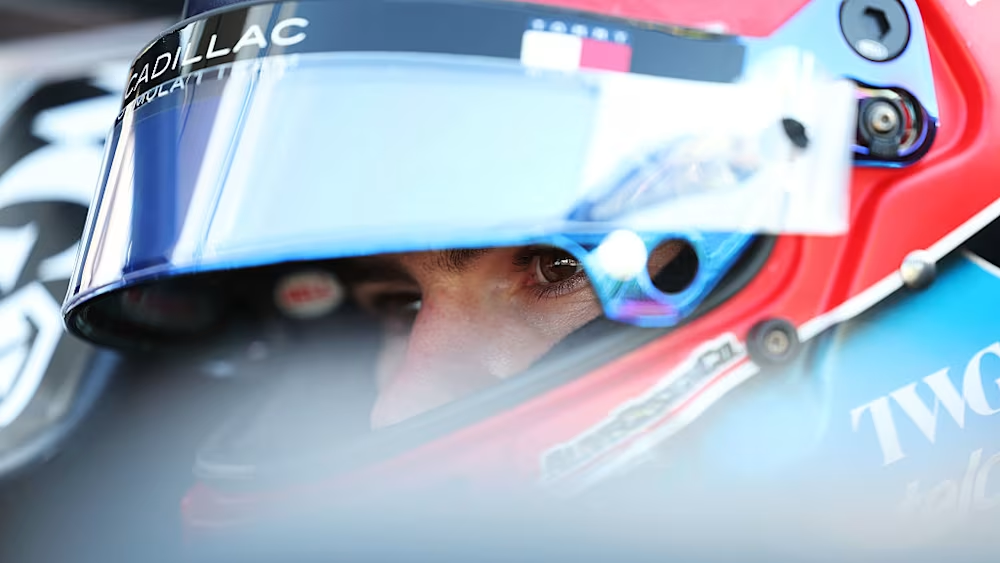
Herta’s challenging start to the season has also tested his ability to recover mentally from disappointing weekends. A poor result can prove particularly frustrating when a driver believes the underlying pace deserved more. However, Herta avoids dwelling on setbacks for too long and instead turns his attention towards the next race as quickly as possible.
“For me, it’s just to get back to work. After a weekend like that, the Monday typically sucks. And then, you know, back in the same Tuesday and starting event prep for this weekend. So anything that kind of gets me working and focussing on the next race is kind of the key.“
His approach relies on replacing frustration with preparation. Once Herta returns to the simulator and begins reviewing the next circuit, he gains a new set of objectives rather than continuing to focus on a result he can no longer change. That mindset could prove important during the second half of the season, when the compact calendar and limited time between events give drivers little opportunity to dwell on mistakes.
Herta relishing opportunity to race at Silverstone in F2
Despite his results falling short of his expectations, Herta has enjoyed the opportunity to compete at several of motorsport’s most recognisable circuits.
He has already raced at Indianapolis during his IndyCar career and added Monaco to his list earlier in the F2 season. Silverstone now provides another historic venue, with its high-speed layout offering a different challenge from the narrow streets of Monte Carlo. Herta believes the quality of the F2 calendar remains one of the championship’s main attractions.
“Yeah, it’s amazing. You know, the F2 calendar is pretty incredible, and we’ve gotten to go to some pretty cool places this year and will continue to. But yeah, it’s cool. I mean, they’re always very different than when you see them on the TV when you arrive for the first time and you get to walk the track or do your first laps. You kind of have this idea, this feeling about what it should be like or how it should feel. And it’s almost never how you imagine. “
Silverstone presents another unique F2 challenge for Herta
Television footage can show a circuit’s layout but rarely captures its elevation changes, surface details or sense of speed. Herta explained that walking or driving a famous track for the first time often challenges the expectations he formed before arriving.
Silverstone’s fast corners should provide another example. Sections such as Maggotts, Becketts and Chapel demand commitment and precision, while the exposed nature of the venue means changing wind conditions can quickly affect the car’s balance.
“So, yeah, I mean, I feel very lucky for the stuff that I’ve gotten to drive in my career and the races I’ve been able to do. And yeah, this would be a super cool weekend with another great track.“
The F2 weekend at Silverstone gives Herta an opportunity to combine his growing understanding of the car with the demands of one of the most challenging qualifying laps of the year. A stronger performance over one lap would represent an important step towards addressing the weakness he identified.
European circuits offer a series of smaller lessons
Herta has not identified one defining lesson from his return to European circuits. Instead, he has gradually built his knowledge through a collection of smaller observations at each venue. The differences include track surfaces, kerb designs, run-off areas and circuit lengths. Those details influence how aggressively a driver can attack a corner and how the car responds when it moves beyond the ideal racing line.
“I don’t think I can just choose one. You know, and it’s a lot of small things, stuff that I kind of pick up when I’m at the track about, you know, the surfaces or the curb profiles. I don’t think there’s one specific thing. The way that they build them and the runoff and the curving and the length, it’s quite different. So, but it’s nothing that I think is like outlandish or crazy to handle.”
Although none of the differences Herta has encountered in F2 has proved impossible to manage, they collectively add to his learning curve ahead of Silverstone. Drivers with recent experience at the circuits can rely on knowledge accumulated over several seasons, whereas Herta must gather much of that information during a restricted amount of track time.
His first half of the season has therefore required patience as well as speed. Herta remains dissatisfied with his results, but he has clearly identified qualifying as the priority and believes improvements there could transform the final part of his campaign. Silverstone will offer the next indication of whether Herta and Hitech can convert their stronger race pace into a more complete weekend.