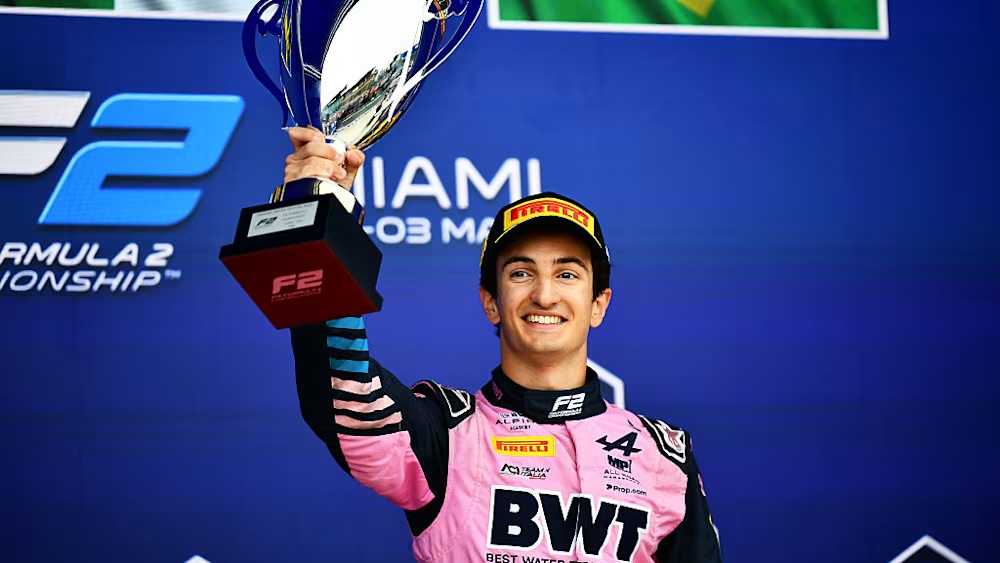
Gabriele Minì left Montreal as the new F2 championship leader after a strong and composed weekend at the Canadian GP.
The PREMA Racing driver finished on the podium in both races, adding a Feature Race podium to his Sprint Race result from Saturday. While the outright pace was not always there, Minì made the most of a chaotic Sunday race and capitalised when others around him hit trouble.
It marked an important weekend for the Italian, who delivered strong points on a circuit that was new to the F2 calendar. With the European rounds still to come, Minì said the lessons learned in Canada could prove useful later in the season.
A wild race focused on staying out of trouble
Speaking during the post F2 Feature Race press conference, with Pit Debrief in attendance, Minì admitted the race had been far from straightforward. The Italian said the pace “hasn’t been great”, resulting in his race turning into more about avoiding trouble than fighting aggressively. He made a strong start and and gained positions in the opening phase. However, once the race settled, he had to manage the car and focus on keeping it on track.
Minì praised PREMA for a strong pit stop, which helped him gain further ground. From there, he said the priority was once again to keep the race clean. Although he did not complete many overtakes, he still moved forward and secured another important result.
“I mean, it was very wild, to be honest. The pace hasn’t been great, so it was a lot about staying away from troubles. I did a very good start. I think I gained three or four positions there. And then after that, as I said, I was struggling a bit, so I just had to keep it on track, which is what we did.
“The team did a good job on the pit stop. We managed to gain a few places. And after that, to be honest, it was all about, you know, once again, keeping it clean. I didn’t do too many overtakes, but I ended up gaining positions. So that’s what mattered today. And as I said, even yesterday was a bit similar situation for me.”
Minì stays calm despite championship lead after F2 Canadian GP
After taking over the lead of the championship, Minì refused to look too far ahead. He pointed out that 11 race weekends and 22 races remained, with the season still only in May. The Italian said PREMA still needed to find more pace compared to its rivals. While he felt closer after the final Safety Car restart, he admitted the team had struggled more in the early stages.
Minì admitted it would not be easy to stay at the front of the standings, saying he preferred not to focus too much on the title fight and would instead take the season “lap by lap” and “race after race”, collecting points wherever possible.
“I mean, for sure, it’s going to be very challenging. We’ve got, I think, 11 weekends to go still. As I said, we need to still work a bit more to find some more pace from these guys here. Because clearly, we were not as quick as them. Probably at the end, after the last safety car restart, we were a bit closer. But at the beginning, we were struggling a bit more.
“So for sure, it’s not going to be easy. But as I already mentioned yesterday, it’s way too early, you know, 22 races to go. We are still in May. It’s way too long to think about that. As I said, I will focus lap by lap, race after race, trying to stay out of trouble and gain points whenever I can. And then we will see after the last run in December.”
Montreal support leaves an impression
The atmosphere in Montreal also stood out to Minì. F2 raced at the Canadian GP for the first time, and the crowd support impressed the Alpine junior. Minì said there were many fans outside the paddock during the Canadian GP, which was unusual for an F2 weekend. Many wanted photos or came to support their favourite drivers.
Minì also noted how full the grandstands were during the races, saying he had never seen the stands so packed for an F2 event and that it created a special atmosphere across the weekend.
“Yeah, I mean, I didn’t see that, but it’s always very cool. You know, there are so many fans out of the paddock, which is not very usual. Everyone, you know, wanting a picture or just supporting their favourite driver is amazing.
“You know, I think I’ve never seen the grandstand so full after a race, which is crazy. You know, even to see yesterday, I remember starting on pole, you could see all the grandstand full. And yeah, it’s a cool atmosphere.”
Setup changes help PREMA in wet conditions
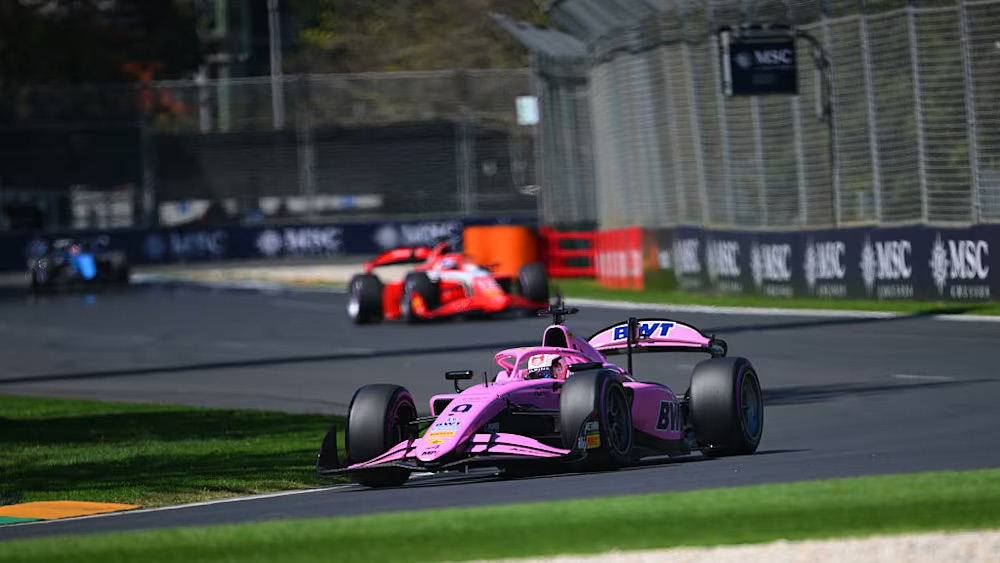
Minì said the setup had played an important role in his Feature Race podium at the F2 Canadian GP. PREMA made a major change compared to Saturday, which left the car better prepared for wet conditions. However, he felt the team had not fully maximised everything. While the pace was enough to reach the podium, it was still not as strong as he wanted.
The Italian explained that both Miami and Montreal had been difficult to judge because they were new circuits for the F2 field. That forced teams to test ideas, work closely together, and estimate a baseline setup. He believed those experiments would help later in the year, especially once the championship returned to more familiar European tracks.
“Yeah, I mean, as I mentioned yesterday, it was very important. We made a very big change compared to yesterday, and we were a bit more prepared for the wet conditions. I don’t think we maximised everything we possibly could, but in the end, we still managed to keep the pace and finish on the podium, even though it wasn’t as good as we wanted it to be.
“It’s also very important because we keep testing things for the European rounds. These two rounds, both Miami and Montreal, are a bit of a question mark, so you kind of have to try things, work well as a team, and guess the baseline setup. But in the European rounds, you have a better idea for sure, and testing new things that you wouldn’t normally try on a race weekend is always very useful.”
New circuits provide useful lessons
Minì said the process for learning a new track stayed largely the same. Drivers used the simulator, watched previous races, and worked through a detailed track book with their teams. He explained that there was rarely a completely unknown circuit because drivers could study it on television and in the simulator before arriving.
Minì also said he and Alex Dunne could use feedback from Alpine’s drivers to gain more information, but stressed that the final step still came down to the driver once on track. The challenge was to reach the limit quickly and understand how to maximise the setup, with Minì adding that this learning curve would help throughout the rest of the season.
“Yeah, I mean, we pretty much know all the tracks, but as you said, those two were pretty new to us. It’s always a bit of the same procedure, to be honest. You always go on the simulator. I mean, there isn’t really a new track for us because we always watch it on TV and drive it on the simulator.”
“Even all three of us, we always use the simulator together, so we knew this track from there. Then, of course, we prepare with our own team. We do the track book, so we can see a bit more. Of course, both Alex and I can get more information from the Alpine drivers’ feedback, so that’s always very useful.”
“But then it’s up to us how quickly we can get close to the limit and how easy it is, with the setup you have, to maximise it. So it’s a good learning curve that will help us throughout the season.”
Minì makes the most of a difficult weekend at F2 Canadian GP
Minì felt the result mattered not only because several drivers around him in the championship had difficult races, but also because PREMA did not have the pace to win. He said the team struggled more than expected, which made staying out of trouble even more important.
The Italian also warned against judging the championship picture too early, referencing Jak Crawford’s 2025 season, when he had no points before the third round but still went on to fight for the title later in the year. For Minì, the key was to maximise results on weekends where victory was not possible, something he felt PREMA had done in Montreal.
“I mean, I think it’s very important, but it’s not only because the main championship contenders, or the people who were in front in the championship at this point, had issues or were right behind. It’s also because we didn’t quite have the pace, I think, to win or to be on the podium. We were struggling a bit more. So, to be honest, we just stayed out of trouble, and we managed to do that. That’s the most important thing.
“So far, it’s too early to say whether one guy will be a championship contender or not. We saw it last year. I remember Jak Crawford was on zero points before the third round, and then he ended up being in the championship title fight. So it’s really early to say who’s going to be a contender or not. But, of course, if we can maximise the result when we don’t have the pace to win, then it’s always very good.”
Tyre temperatures made opening laps tricky for Minì
Minì said tyre temperature had been a major challenge at the start of the F2 Feature Race of the Canadian GP. The tyres were very cold, which made the opening phase difficult for everyone. He believed others struggled even more, as he gained three or four positions early on.
As the race went on, the tyres began to feel better, with Minì saying degradation was not a major issue for him despite PREMA lacking some overall pace. He noticed that other drivers were quicker at the start but faded later, showing how much the race depended on each car’s compromise between early pace and tyre management.
“It was very tricky at the beginning, especially temperature-wise. I was very, very low. I mean, everyone was very low because I ended up gaining three or four positions, so I guess the others were in even worse condition than me. Towards the middle of the race, to be honest, the tyre did not feel too bad for me. We were just missing a bit of pace, but we were not really degrading the tyres.”
“We could see some other drivers who were really quick at the beginning and a bit slower at the end, so it always depends on the compromise that you have with the car. It was the same thing for me: very quick at the beginning, but after a few laps, I really started degrading my tyres. So it’s always a compromise.”