
Following a haul of 18 points at the 2026 Austrian GP, Team Principal Andrea Stella shed more light on why McLaren are still lagging behind in comparison to Mercedes and whether they are surprised that power unit exploitation continues to be a factor eight rounds into the 2026 F1 season.
Although Stella came forward to clarify after the Japanese GP that Mercedes haven’t been withholding information on the optimisation of the power unit, he explained that McLaren’s primary limitation has been the shorter timeframe to work with and play catch-up.
As it stands, a sizeable gap in performance between engine manufacturers and customers still exists as teams continue to get to grips with the new technical regulations. While Mercedes drivers have won seven Grands Prix so far, Oscar Piastri and Lando Norris have only managed to secure four podiums in total.
Stella on the impact of drag and the power unit on McLaren’s deficit to Mercedes in 2026
Andrea Stella proclaimed on Saturday that the advantage the Brackley-based outfit holds over McLaren ranges between three and four tenths. Additionally, he revealed that they bleed 70 per cent of the lap time in the corners due to the lack of adequate downforce and 30 per cent on the straights on account of additional aerodynamic drag and suboptimal exploitation of the Mercedes power unit.
Speaking in a print media session after Sunday’s Austrian GP, Stella addressed the aforementioned claims and shared his insights on how much impact drag and power unit exploitation, respectively, have on McLaren’s deficit to Mercedes so far in the 2026 F1 season.
Admitting that the conclusion is difficult to arrive at, the Italian surmised that there are multiple factors that result in the speed difference on the track. He also explained that they typically reverse engineer their competitors to determine how much the drag and the power unit are individually affecting the lap times.
“Difficult question in terms of the reverse engineering.
“You know, like you see the outcome; the outcome is that there’s a few kph difference. But there could be multiple sources.
“And this is a typical problem when you reverse engineer competitors. You can effectively distinguish what’s the drag from what’s the power unit.”
What challenges McLaren faced in terms of PU exploitation at the start of the season
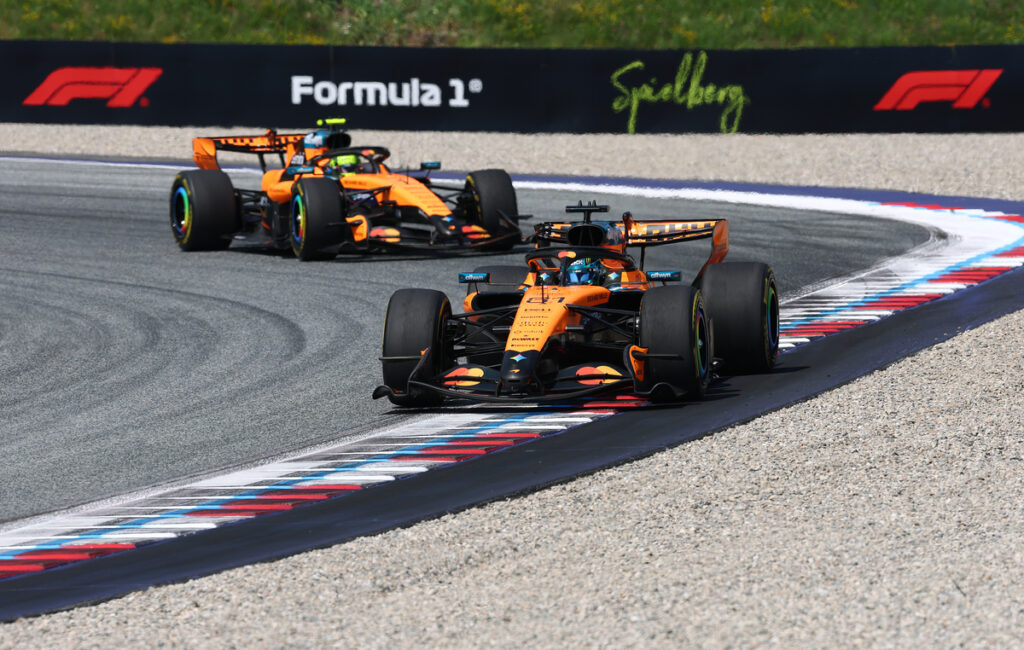
With regard to whether McLaren are surprised that power unit exploitation is still tricky to manage even after using the Mercedes engine for several months now, Andrea Stella called attention to how the scope for optimisation has broadened since the beginning of the 2026 F1 campaign.
The 55-year-old mentioned that concerns over power unit exploitation in the early rounds had mainly to do with the intricacies of deployment over a lap and how different driving styles corresponded to that. Additionally, he disclosed that their collaboration with Mercedes AMG High Performance Powertrains has been productive and that they are satisfied with their progress.
“I think when we were talking about exploitation at the start of the season, it was more in relation to the sensitivities to deployment. You know, deployment, very sensitive to driving style, very sensitive to how you distribute the deployment over the lap.
“From this point of view, there’s been good progress, good collaboration with HPP.”
The area of PU exploitation where McLaren have made progress
Expressing his gratitude to Mercedes HPP for their assistance in the development of better tools, Andrea Stella deduced that McLaren have made significant progress since the beginning of the 2026 F1 season as far as exploiting the power unit from an electrical energy deployment standpoint is concerned.
At the same time, the McLaren Team Principal remarked that ascertaining how much power each Internal Combustion Engine (ICE) generates is rather difficult since he expects all Mercedes power units to be the same.
“We now have better tools, thanks to the fact that HPP has helped the development of our tools, and we have a more effective collaboration.
“I think we are better in terms of exploiting the power unit from an electrical energy deployment. But there’s also the ICE power that we should consider, and like I say, I cannot talk about differences from a power unit point of view, because I’m just assuming that the power unit is the same.”
Stella on McLaren’s drag problem relative to Mercedes so far in 2026 F1 campaign
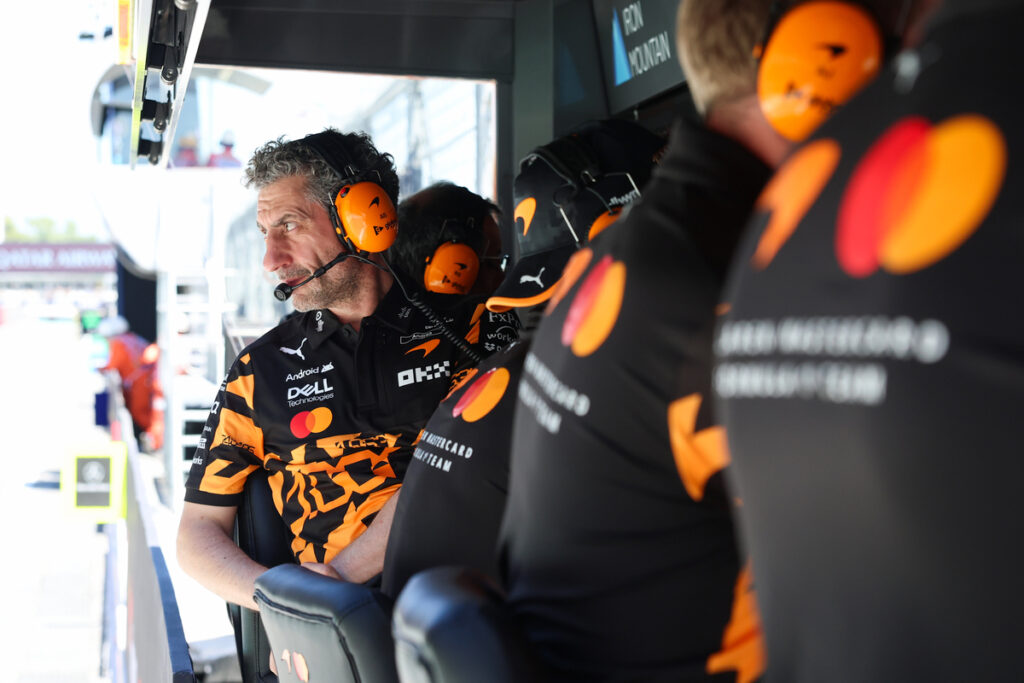
With respect to drag, Andrea Stella reckoned that the W17 produces less air resistance than the MCL40 due to the differences in the proportion of the chassis and the aerodynamic surfaces.
Maintaining that there might be other factors that contribute to the higher drag levels of their 2026 F1 challenger, Stella argued that eliminating all sources of additional drag is under McLaren’s purview and that they are sparing no effort to accomplish that while working side-by-side with Mercedes HPP.
“There may be differences from drag point of view. I think it’s fair to concede that Mercedes will have less drag than us. We have different ratios; this may have an effect.
“There may be some other sources. The only thing I know, and the only thing that is under our control, is that we need to minimise all the sources of drag on the MCL40, and this is what we are concentrating on, while we keep a very tight collaboration with HPP.”