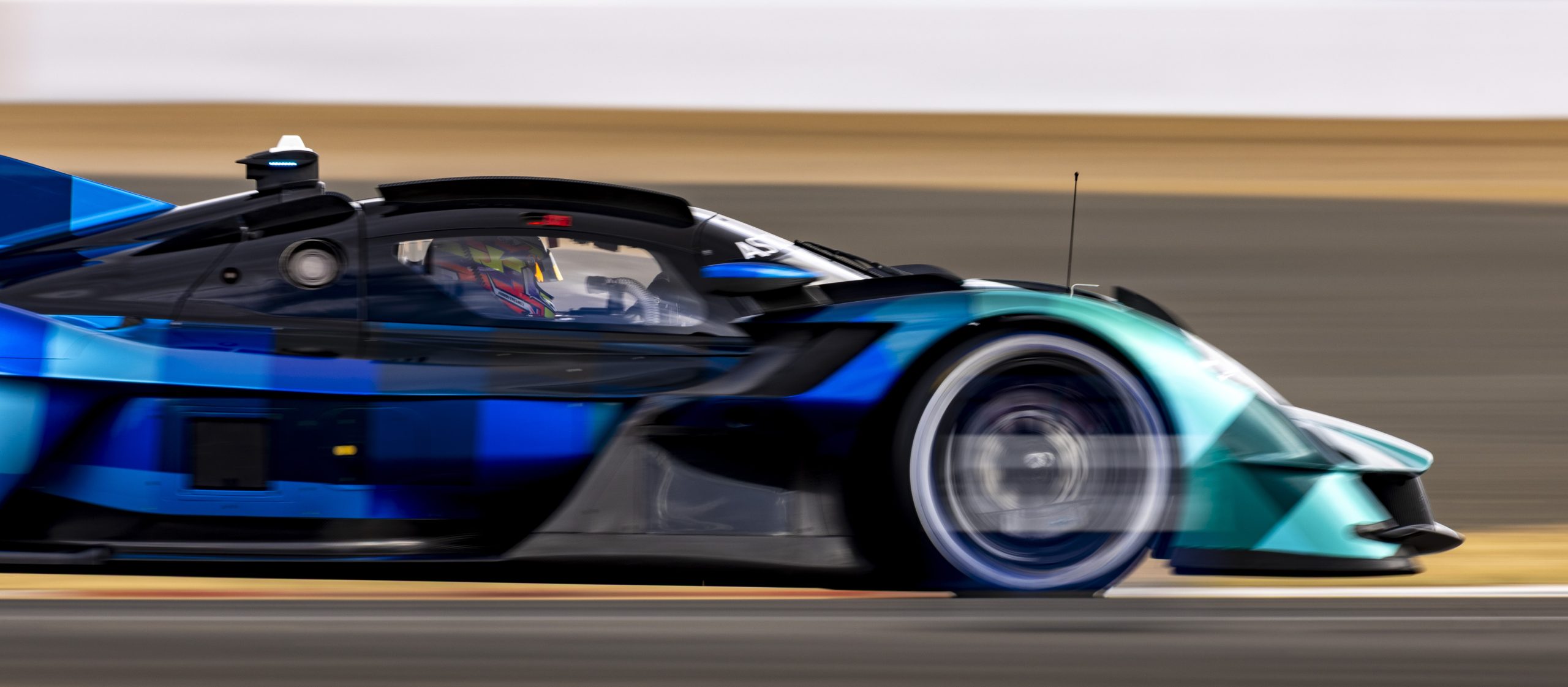
Aston Martin has taken the next step in the development of its Valkyrie Hypercar after completing an extensive test at Silverstone with a development version of the car.
Aston Martin THOR Team drivers Harry Tincknell and Ross Gunn shared the 6.5-litre V12-powered prototype as the manufacturer evaluated several technical developments and gathered data that could shape the Valkyrie’s future direction. After 18 months of competition across the FIA World Endurance Championship and IMSA WeatherTech SportsCar Championship, Aston Martin believes it now understands the car well enough to begin searching for further performance from its existing base.
The running also gave the British manufacturer valuable experience at Silverstone ahead of the circuit’s return to the FIA WEC calendar in April 2027, while development continues with another assault on the 24 Hours of Le Mans firmly in focus.
Silverstone test opens next stage of Valkyrie development
Aston Martin THOR Team used the test to explore several areas of the Valkyrie rather than focus on one individual upgrade. With the car now well into its second season of competition, the team can use the data accumulated across different circuits and conditions to assess where further gains may remain.
Team Principal Ian James described the Silverstone programme as an important moment for the Hypercar project as Aston Martin begins defining its next technical direction.
“This was a significant day for Valkyrie,” acknowledged Team Principal, Ian James. “Some of the developments we tried will fuel our thinking as we consider the technical direction we take next. We have been able to evaluate lots of areas on the car, so Silverstone proved an interesting place to challenge ideas. There’s more to come, and I think it gives us reasons to be excited.”
The session therefore represented the start of a broader development process rather than the unveiling of a finalised upgrade package. Aston Martin can now examine the information collected before deciding which concepts warrant further development.
Eighteen months of racing provides stronger foundation
The Valkyrie entered the Hypercar category against manufacturers that already possessed several years of experience with their respective programmes. Aston Martin consequently spent much of its opening phase learning the characteristics of a unique package that remains the only production-derived Hypercar competing at the top level.
However, Head of Endurance Motorsport Adam Carter believes the team has now reached a point where that experience allows it to search more deliberately for additional performance.
“We’ve been happy with Valkyrie’s performance characteristics in the first two seasons of competition,” added Aston Martin Head of Endurance Motorsport, Adam Carter. “We’ve repeatedly said we’ve entered an arena with a high level of formidable adversaries that are also several years further down the development track than us.
“We are beginning to explore new areas of performance that we may gain through developing the base car, now that we understand its characteristics that much better after 18 months of racing it. We’re right at the beginning of that journey, and this was a useful and informative start to the development process.”
Rather than abandoning the foundations of the Valkyrie concept, Aston Martin can now refine a platform that has increasingly demonstrated its potential in competition.
Recent results underline Valkyrie progress
That development work follows an encouraging run of results during the 2026 season. Tincknell and Tom Gamble have recorded four consecutive points finishes in the No. 007 Valkyrie, including fourth place at Spa-Francorchamps in May, where they narrowly missed the podium.
Aston Martin then achieved its first double top-10 FIA WEC finish at São Paulo, with the two Valkyries taking sixth and ninth. The results provided another indication that the programme has continued moving forward after the progress shown during the second half of its debut campaign.
The IMSA programme has followed a similarly positive trajectory. The Valkyrie has secured six top-10 finishes from seven races, while Gunn and Roman De Angelis have also taken second place on the road. Those performances have given Aston Martin a stronger competitive baseline from which to approach the next phase of development.
Silverstone running also prepares Aston Martin for home return
Silverstone offered another advantage beyond its role as a development venue. The circuit will return to the FIA WEC calendar from 23–25 April 2027, hosting the 6 Hours of Silverstone for the first time since 2019.
Its proximity to Aston Martin’s AMR Technology Campus also makes the event particularly significant for the British manufacturer. The race will mark the first opportunity for the Valkyrie to compete in the World Championship in front of a home crowd.
Carter welcomed Silverstone’s return and highlighted the significance of finally bringing the Hypercar to British fans in FIA WEC competition.
“We very much welcome Silverstone back to the calendar,” commented Carter. “It is not only the home of Aston Martin and British motorsport, but also the perfect opportunity for some of the best fans in the world to experience the raw and visceral joy that is the Aston Martin Valkyrie Hypercar. They have waited a long time to see Valkyrie competing at the highest level on British soil, and they deserve to be thoroughly entertained. We will do our best to contribute to that experience.”
Consequently, the development test also provided Aston Martin with an early opportunity to gather information at a circuit that will become directly relevant to its 2027 championship campaign.
Le Mans remains central to next phase
Beyond Silverstone, Aston Martin’s development work also feeds into its wider ambitions at the top level of endurance racing. The 95th running of the 24 Hours of Le Mans, scheduled for 9–13 June 2027, remains one of the defining targets for the Valkyrie programme.
Aston Martin has already shown that the car can score consistently and challenge closer to the front, but the Silverstone test signals a shift from simply understanding the package towards actively searching for the next level of performance.
The manufacturer still considers itself at the beginning of that process. However, with more race data, improving results and a clearer understanding of the Valkyrie’s characteristics, Aston Martin now has a stronger platform from which to develop.
As James suggested after the test, the current Valkyrie does not represent the end point of the programme. The work at Silverstone instead offered the first indication of what Aston Martin hopes will become its next competitive step.