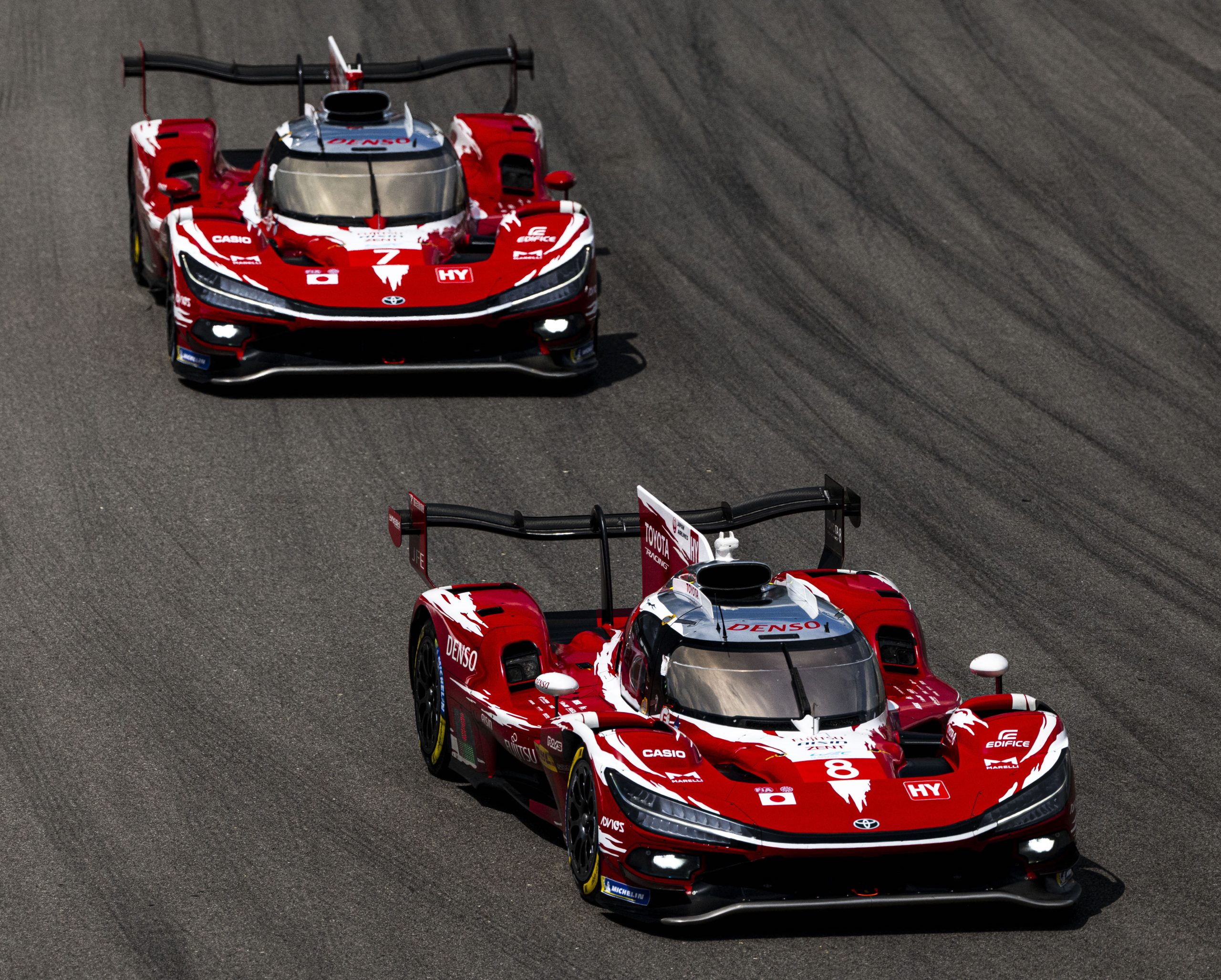
Toyota left the 2026 FIA World Endurance Championship (WEC) Lone Star Le Mans with mixed emotions after a late hydraulic failure denied the #7 TR010 Hybrid a likely victory at the Circuit of The Americas.
Nyck de Vries, Kamui Kobayashi and Mike Conway looked set to claim their second victory of the 2026 season after de Vries charged into the lead and built an advantage during the closing stages. However, a hydraulic problem affected the car’s power steering with barely ten minutes remaining and brought its race to a premature end.
The setback prevented Toyota from capitalising fully on a difficult race for its closest championship rivals, although the manufacturer still extended its advantage over BMW from five to nine points. Meanwhile, Sébastien Buemi recovered the sister #8 Toyota to sixth after a difficult sequence of strategy setbacks and a penalty, moving its crew to within 11 points of the Drivers’ Championship lead.
De Vries charges Toyota into contention
Toyota started the six-hour race from seventh and ninth on the grid but quickly brought both cars into the battle through contrasting strategies.
The #7 gained momentum following a mid-race Safety Car period, with de Vries moving aggressively through the field. He passed Aston Martin’s George Gamble and Alpine driver António Félix da Costa before engaging Cadillac’s Earl Bamber in a close fight for position.
De Vries eventually cleared Bamber and moved from fourth into the race lead, putting Toyota in position to convert its pace into a significant result.
He returned to the car for the final hour and immediately began producing a succession of fastest laps. With Kobayashi and Conway having already completed their stints, de Vries steadily increased the #7 crew’s advantage as the race approached its conclusion.
The situation changed dramatically when the Toyota developed a hydraulic issue that affected its power steering. With the race almost complete, de Vries could no longer continue and retired from a position that had appeared likely to deliver victory.
“Obviously, that was a very sad end to a great day,” reflected a crestfallen de Vries. “We really gave it our all and the team executed extremely well. We had a great car, with strong pace and we were in a perfect position going into the last few minutes. Unfortunately, this is a technical sport and that let us down this time.”
Kobayashi rues lost championship opportunity
The late failure proved particularly costly because Toyota had an opportunity to make a significant gain in both championship battles.
Kobayashi, Conway and de Vries entered COTA level with BMW drivers René Rast and Robin Frijns at the top of the Drivers’ Championship. With the BMW pairing also failing to score in Texas, victory would have given the Toyota trio a clear advantage with three rounds remaining.
Instead, both crews left COTA tied on points.
“It was very unfortunate,” echoed Kobayashi. “We had been strong all the way through. For almost six hours, we had a great race, but when you lose the hydraulics, there’s nothing you can do. It was a big opportunity for us to score a lot of points, so it’s tough to take, but this is endurance racing. We need to learn and improve so we can come back stronger for our home race.”
Although the result denied Toyota the maximum championship gain, BMW’s own scoreless race limited the damage. The #7 crew therefore remains firmly in contention as WEC heads to Toyota’s home round at Fuji Speedway.
Different strategy brings #8 into the fight
The sister #8 Toyota also demonstrated race-winning pace during different stages of the six-hour contest.
Buemi, Brendon Hartley and Ryō Hirakawa started from ninth and adopted an alternative approach during the first round of pit stops. Buemi used the resulting clean air to produce quick lap times and cycle through to the front of the field as the strategies developed.
Hartley later lost time in traffic while pursuing the eventual race-winning #50 Ferrari, before Hirakawa’s stint suffered another setback. Race Control handed him a drive-through penalty for speeding in the pit lane while the #8 occupied third place.
The penalty removed the Toyota from immediate podium contention, but an unfavourable Virtual Safety Car period caused even greater damage.
Virtual Safety Car compounds Toyota’s difficulties
The #8 had already stopped for fuel under normal racing conditions shortly before officials introduced the Virtual Safety Car.
Several rivals consequently made their own stops under the reduced-speed conditions and lost considerably less time, effectively gaining a cheaper pit stop. The timing dropped Toyota to 14th and left Buemi with a significant recovery task during the final stages.
The four-time WEC champion responded with an aggressive closing stint and worked his way back through the field to sixth at the finish. That recovery salvaged eight championship points and moved the #8 crew to 64 points, only 11 behind the Drivers’ Championship leaders.
Hartley nevertheless viewed the result as another missed opportunity after both Toyotas demonstrated the pace to challenge for the podium.
“It was a brutal finish for the team,” acknowledged Hartley. “We definitely had the pace to have two cars on the podium, so it hurt to give it away. Seb did a great last stint to bring our car back to sixth, but I’m massively disappointed for the team that car #7 had the issue when it was in a dominant position to take the victory.”
Buemi salvages valuable points from difficult race
Buemi’s final stint provided Toyota with its main consolation following the #7 retirement.
The Swiss driver turned what had become a heavily compromised race into a points-scoring finish, overtaking several competitors to recover from 14th to sixth.
Those points proved especially important in the Manufacturers’ Championship. Toyota arrived at COTA five points ahead of BMW and left with a nine-point advantage despite failing to convert its strongest opportunity into victory.
“It was a really sad day for us because the speed was there,” echoed Swiss star, Buemi. “We did the best we could in the end and salvaged a few points, but it’s really a big opportunity missed. The positive is that the car was very fast, but it’s always frustrating when you lose a good result like that. We’ll work hard and hopefully have a better race at Fuji.”
The recovery also strengthened the #8 crew’s position in the Drivers’ Championship. Buemi, Hartley and Hirakawa now sit fourth on 64 points, placing them firmly within reach of the two crews tied at the top on 75.
Toyota extends WEC lead despite COTA heartbreak
Despite the frustration surrounding the #7 retirement, Toyota still made a small championship gain in Texas.
The manufacturer increased its lead over BMW from five points to nine, while Ferrari’s victory brought the Italian marque significantly closer to the leading pair. With three rounds remaining, Toyota therefore maintains control of the Manufacturers’ standings but faces pressure from two rivals rather than one.
The Drivers’ Championship remains even tighter. Kobayashi, Conway and de Vries remain tied at the top with Rast and Frijns, while the #8 Toyota crew sits only 11 points behind.
COTA ultimately demonstrated both Toyota’s potential and the unpredictability that continues to shape the 2026 WEC season. Both TR010 Hybrids showed enough pace to fight near the front, but technical trouble, a penalty and poorly timed neutralisation periods prevented Toyota from translating that performance into the result it appeared capable of achieving.
The championship now heads to Fuji from 25-27 September, where Toyota will attempt to turn its COTA pace into a stronger result on home soil.