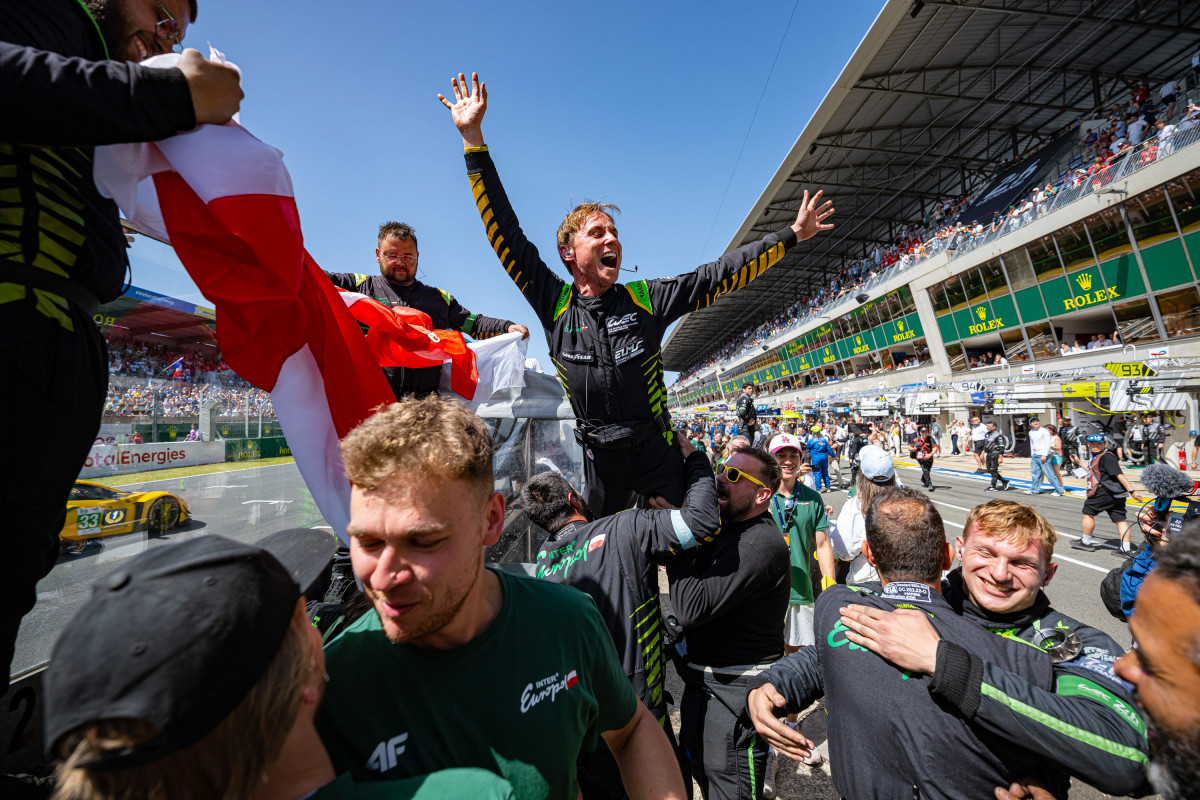
Inter Europol Competition arrived at the 2026 24 Hours of Le Mans with the chance to defend its LMP2 victory and strengthen an already impressive record at the Circuit de la Sarthe. By the end of the race, the Warsaw-based team had achieved far more than another class win. Jakub Śmiechowski, Tom Dillmann and Nick Yelloly guided the #43 Oreca 07-Gibson to victory, while Bijoy Garg, Reshad De Gerus and Nico Müller finished second in the sister #343 car.
The result gave Inter Europol its first LMP2 one-two at Le Mans and underlined the strength of its entire operation. However, the final classification did not show the full scale of the problems, pressure and risk that shaped the winning crew’s race.
Inter Europol builds on recent Le Mans success
Inter Europol entered the 94th edition of Le Mans as the defending LMP2 winner and with one of the strongest recent records in the class. The Polish team has now recorded three victories, two second-place finishes and five podiums across the past four years. During that period, it has not finished lower than second.
That consistency has not come from speed alone. Le Mans tests every part of a racing operation, from the drivers managing traffic and fatigue to the engineers and mechanics responding to mechanical problems and strategic changes. Once again, Inter Europol combined each of those elements effectively, even though the #43 crew endured a much more difficult race than the final result suggested.
Śmiechowski admitted that the team faced more problems than usual during the event.
“To be honest, this was one of the most difficult Le Mans races I’ve experienced in recent years. I don’t remember having so many issues during a race, but somehow this year luck was on our side and we managed to recover every time. We knew we had one of the fastest cars in the field, so once we got to the front I wasn’t surprised that we were able to build a gap. Nick and Tom did a fantastic job as always, but I feel like today was something really exceptional from everyone involved.”
Problems fail to stop the #43 crew
The #43 did not control the race from the beginning. Instead, Śmiechowski, Dillmann and Yelloly had to recover from repeated setbacks before they could use the full pace of the Oreca 07-Gibson. Each interruption threatened to weaken their victory challenge, but the team limited the damage and remained within reach of the leaders.
Once the #43 moved to the front, the crew began to build a gap through consistent lap times and controlled driving. However, the pressure did not disappear. Duqueine Team and Forestier Racing by Panis remained close enough to threaten during the closing hours, which forced Inter Europol to choose between protecting the car and continuing to attack.
The team chose aggression. Dillmann and Yelloly decided that a conservative approach would leave them vulnerable, so they pushed harder and accepted the risks that came with it.
Dillmann and Yelloly attack in the closing hours
As the race approached its final stages, Dillmann and Yelloly increased their pace to respond to their rivals. They attacked the kerbs and pushed the car towards its limits, even though that approach increased the chance of damage or retirement.
Dillmann explained that the crew viewed the decision as necessary rather than optional.
“A few hours before the finish, Nick and I decided to to mount all the kerbs, to go all-out. We had to respond. It was either win or retire, and it we got the win,”
The strategy allowed Inter Europol to maintain its advantage. Dillmann delivered the required pace during the decisive phase of the race, while Yelloly supported the team’s approach and trusted his teammate to complete the final stints.
The #43 eventually crossed the line first in LMP2, securing a second consecutive class victory for the same driver line-up.
Dillmann dedicates victory to his father
The result carried deep personal meaning for Dillmann following the death of his father in September. The French driver wore his father’s yellow colours on his helmet throughout the event and carried that tribute to victory in one of endurance racing’s most demanding contests.
“I wore my father’s yellow colours on my helmet, as a tribute to him. I’m very proud to have won the greatest race ever with his colours.”
The #43 Oreca also featured a new yellow livery inspired by Poland’s rapeseed fields. As a result, the car’s appearance connected the team’s national identity with Dillmann’s personal tribute and gave the victory further emotional significance.
Yelloly praises Dillmann’s decisive performance
Yelloly completed the same Inter Europol line-up that had won the LMP2 class one year earlier. He recognised the rarity of returning to Le Mans with the same team and teammates before successfully defending the victory.
“[We had] the same team, the same line-up as last year. To do it back to back is pretty special, it’s something I’ll remember for the rest of my life.”
The future Ford Hypercar driver also highlighted Dillmann’s contribution during the closing stages, when Inter Europol needed both speed and composure to stay ahead.
“In my opinion, Tom Dillman was the man of today. He was absolutely flying and I was more than happy to leave him in at the end of the race and let him do his business.”
Dillmann justified that confidence by maintaining the pace needed to defend the lead. Although every member of the crew contributed to the result, his final stints played a decisive role in securing the win.
Sister #343 car completes Inter Europol one-two
The #43 victory represented only half of Inter Europol’s achievement. Garg, De Gerus and Müller brought the #343 Oreca home in second place, completing the team’s first LMP2 one-two at Le Mans.
Their result demonstrated the strength of the entire Inter Europol operation. The team did not rely on one fast car or a single successful strategy. Instead, both crews remained competitive throughout the event and occupied the first two positions at the finish.
The result also rewarded team manager Wojciech Śmiechowski, along with the engineers, mechanics and strategists who prepared and operated both entries during the race.
Inter Europol enters a new Le Mans era
Inter Europol has gradually transformed itself from an LMP2 challenger into the class benchmark at Le Mans. One victory can result from perfect timing or a rival’s misfortune, but repeated wins and podium finishes require sustained performance across several years.
The Polish team has now shown that level of consistency. The #43 crew overcame repeated problems, attacked when the race demanded more pace and successfully defended the LMP2 crown. At the same time, the #343 crew converted the team’s wider strength into a historic one-two.
Inter Europol did not simply win the 2026 24 Hours of Le Mans. It produced a result that confirmed its control of the LMP2 class and marked the beginning of a new chapter in the team’s history.