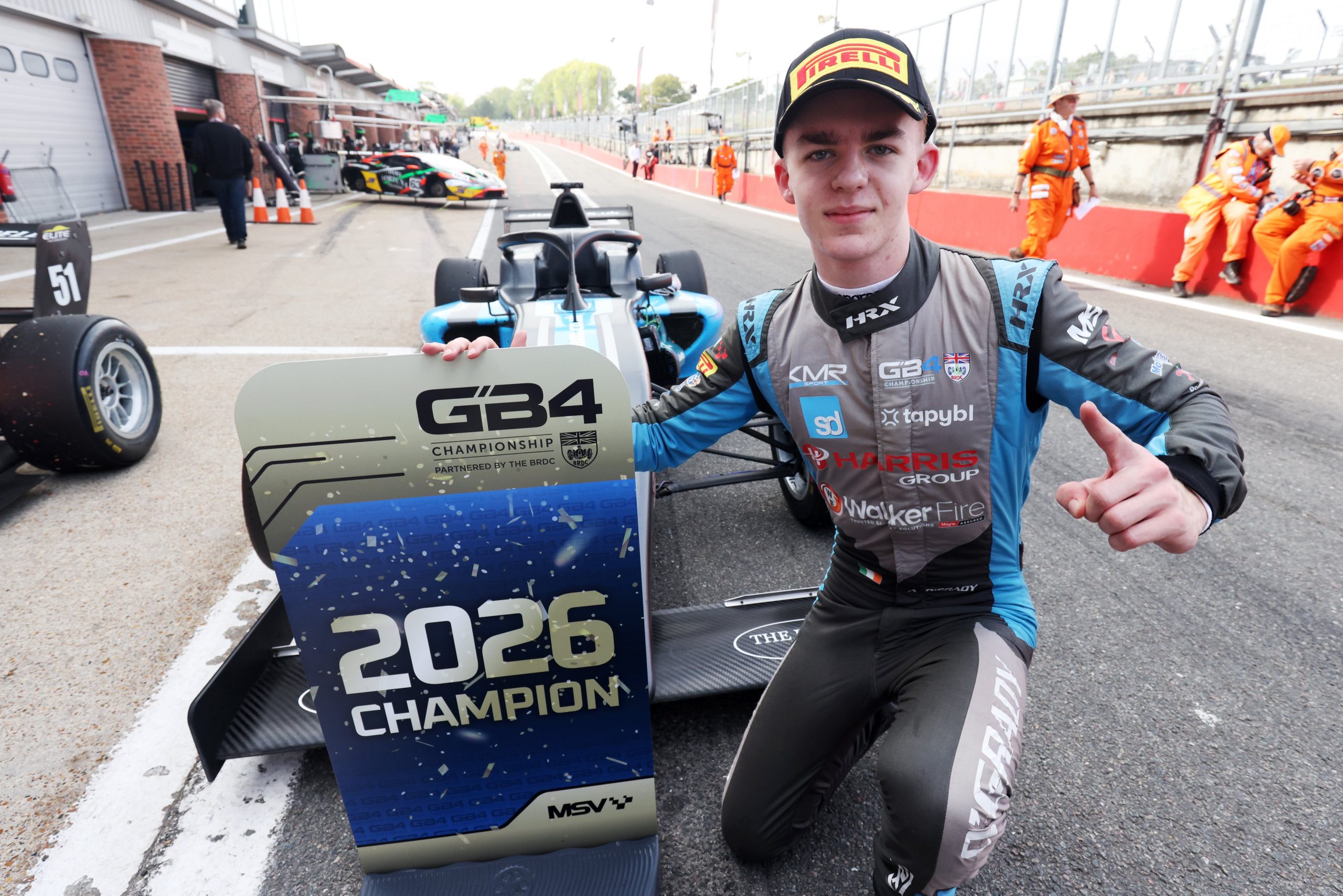
Alex O’Grady did not win the most races or claim the most pole positions during the 2026 GB4 season. What the KMR Sport driver did better than anyone else was keep scoring.
Across 21 races, O’Grady finished every contest, recorded 20 top-10 finishes and rarely allowed a difficult result to become a damaging weekend. That consistency eventually carried him to the Drivers’ Championship on 445 points, 33 clear of Elite Motorsport’s Fred Green.
The Irishman combined that reliability with three victories, nine podiums, four fastest laps and two poles. His strongest weekend came at Snetterton, where consecutive wins transformed a 25-point championship advantage into a commanding lead, but his title was built just as much through fourth, fifth and sixth places accumulated elsewhere.
By the time Green launched his late-season recovery, O’Grady had already created enough of a cushion to manage the final rounds. Second place in Brands Hatch Race 2 ultimately completed a championship campaign that rewarded patience as much as outright pace.
A second season built on lessons from 2025
O’Grady entered 2026 with the advantage of experience after remaining with KMR Sport for a second GB4 campaign. His rookie year had already included a maiden single-seater victory, but both driver and team had endured difficult weekends while learning the championship’s newer machinery.
Ahead of his return, O’Grady made clear that the objective had shifted from simply proving he could win races to fighting for the championship. Staying with KMR Sport gave him continuity at a stage when he needed refinement rather than another reset.
That difference became visible immediately. Silverstone had caused significant problems during his first season, but O’Grady returned in 2026 showing much stronger pace throughout Testing, Qualifying and the races. He later described the opening weekend as evidence of the progress both he and KMR Sport had made since the previous year.
His second campaign therefore began with a much stronger foundation. Green may have emerged as the early championship leader, but O’Grady immediately placed himself close enough to ensure the Elite Motorsport rookie could not disappear at the front.
Silverstone: A stronger beginning than 12 months earlier
The opening Silverstone round immediately demonstrated how different O’Grady’s second season could become.
Green capitalised on Luke Hilton’s post-Qualifying disqualification to inherit both poles and won the two conventional-grid races, establishing himself as the early benchmark. O’Grady did not match those victories, but regular scoring placed him fourth in the championship after Round 1 on 56 points.
Only 14 separated him from Green, while Enzo Hallman and Jason Smyth occupied the positions between them. For O’Grady, the significance came from avoiding the poor opening that had complicated his 2025 season.
He had qualified near the front, taken a podium and immediately placed himself within striking distance of the championship lead. Rather than needing to recover from the outset, he could begin applying pressure.
That proved particularly important because Green’s opening form showed no sign of disappearing when the championship moved to Oulton Park.
Oulton Park: First victory brings O’Grady into the fight
Oulton Park produced the first genuine head-to-head battle between O’Grady and Green.
Green narrowly beat the KMR Sport driver to Race 1 pole before the pair fought throughout the opening lap. O’Grady remained within one second for almost the entire contest and set the fastest lap, but Green held on to take his third win of the season by 0.785s.
O’Grady responded the following morning. After securing his first GB4 pole of 2026, he controlled Race 2 from the start and managed an early Safety Car restart before pulling clear. His 2.612s victory became the first major answer to Green’s dominant opening run.
The standings after Oulton Park left Green on 140 points and O’Grady on 127. Hallman remained only five further behind.
O’Grady had not yet taken control of the championship, but his first victory ensured Green’s early advantage had already fallen to 13 points.
Donington Park: Taking the lead without a victory
The first Donington Park weekend became an important illustration of how O’Grady would eventually win the championship.
He initially appeared to have secured the strongest Qualifying position, but widespread track-limits penalties reshuffled both grids. O’Grady consequently had to recover through the field rather than convert front-row starts into victories.
He climbed from 10th to sixth in Race 1 while Green recovered from 18th to 10th. Race 2 then produced the decisive championship swing when Green’s contest ended on the opening lap at Goddards. O’Grady avoided the incidents around him and charged from 14th to fourth.
Another fourth place followed in the reverse-grid finale. The results were not spectacular in isolation, but they added 57 points while Green endured a more damaging round.
O’Grady therefore left the first Donington Park round as championship leader on 184 points, 11 clear of Green and 16 ahead of Hallman.
He had taken first place in the standings without winning a race that weekend. That became an early example of how valuable his ability to continually score would prove.
Silverstone: Building the advantage through consistency
The championship returned to Silverstone with O’Grady defending the lead for the first time.
The weekend produced wins for Hilton, Thomas Ingram Hill and Connor Willis rather than either of the leading title rivals. Green also lost an important opportunity when contact with Ingram Hill on the opening lap of Race 1 dropped both out of contention.
O’Grady again avoided the major trouble. He finished second in the opener after Conor Grant received a track-limits penalty and continued accumulating points through the remaining races.
By the end of the weekend, his championship total had reached 247. Green remained second on 222, increasing O’Grady’s advantage from 11 to 25 points.
The round contained no victory for KMR Sport, but it strengthened the position that mattered most. O’Grady’s season was increasingly becoming less about matching every high point from Green and more about ensuring his own low points never became costly enough to surrender control.
That approach set up the weekend that ultimately transformed the championship.
Snetterton: The championship-changing weekend
Snetterton provided O’Grady’s strongest performance of the season and the largest swing in the title fight.
Green started Race 1 from pole and led the opening six laps with O’Grady directly behind. A mechanical problem then slowed the Elite Motorsport driver, handing O’Grady an opportunity he immediately converted. He took the lead and secured his second victory of the season, while Green failed to score.
The championship advantage instantly increased from 25 to 60 points.
Race 2 mattered even more because O’Grady did not need misfortune for his rival. Starting from pole with Green alongside, he resisted sustained pressure and beat his closest championship challenger directly by less than half a second.
Those two victories gave O’Grady the maximum 70 points available from the conventional-grid races and earned him the Omologato One to Watch Award.
Snetterton leaves O’Grady 70 points clear
The reverse-grid finale prevented O’Grady from completing a perfect weekend, but even that race ultimately strengthened his championship position.
He took evasive action during early incidents and eventually finished 12th. Green encountered further trouble and retired, meaning the KMR Sport driver still increased his advantage despite scoring relatively few points himself.
O’Grady therefore left Snetterton on 321 points with Green on 251. The 70-point championship lead represented the largest margin between them all season.
The weekend also demonstrated that O’Grady’s championship was about more than benefiting from others’ mistakes. Green’s Race 1 problem provided an opportunity, but Race 2 required O’Grady to defeat him directly. He also set the fastest race lap of the weekend and collected his second Sunoco Fastest Driver award of the season.
For the first time, O’Grady no longer needed to think solely about building a championship advantage. He now had a large enough margin to begin protecting one.
Donington Park: Green fights back
The second Donington Park visit finally brought Green the response he needed.
Yani Stevenheydens claimed both poles on his GB4 debut, but Green moved into the lead at the start of Race 1 and controlled the contest after a Safety Car interruption. O’Grady followed him home in second, limiting the championship damage despite losing six points.
Stevenheydens won Race 2, with Green second and O’Grady sixth. The reverse-grid finale then placed the two championship protagonists together near the lower end of the top 10, with Green finishing ninth and O’Grady 10th.
O’Grady added 52 points across the weekend, his smallest haul since the opening round, while Green cut 21 from the championship deficit.
Even so, the KMR Sport driver left Donington on 373 points and still held a 49-point advantage heading to Brands Hatch.
Green had restored some pressure, but Snetterton had given O’Grady enough protection to absorb the setback.
Brands Hatch: Five drivers still mathematically alive
Despite O’Grady’s sizeable advantage, five drivers entered Brands Hatch with a mathematical chance of becoming champion.
Green sat second on 324 points, with Dayton Coulthard on 290, Hallman on 281 and Ingram Hill on 277. A maximum of 102 remained available, although O’Grady’s 49-point cushion meant he controlled the permutations.
Testing also provided encouragement. O’Grady had shown strong pace around the Grand Prix circuit and entered the weekend confident KMR Sport could fight at the front rather than simply defend.
Green nevertheless produced an emphatic response in Qualifying by taking both poles. His performance ensured O’Grady would need to manage another weekend where his principal rival possessed the stronger outright pace.
Race 1 followed that pattern. Green won from pole, but O’Grady passed Ingram Hill at the start and finished second. The six-point swing reduced his advantage to 43 but eliminated Coulthard, Hallman and Ingram Hill from the championship.
One race later, O’Grady could settle everything with a podium.
Race 2: Managing the pressure
O’Grady started the decisive race third and again knew he did not need to beat Green. He simply needed to finish on the podium.
The pressure increased before the start when an oil spill on the formation lap delayed proceedings while marshals dressed the circuit. Once racing began, O’Grady immediately passed Ingram Hill into Paddock Hill Bend and moved into second.
Green pulled clear at the front, but O’Grady resisted the temptation to follow. Instead, he concentrated on keeping the car on track while managing Ingram Hill behind and navigating the dust that remained from the oil treatment.
O’Grady later admitted the race felt far less comfortable from inside the cockpit than the result suggested. However, he held second to the chequered flag and secured the championship with one race remaining.
O’Grady said, “I feel amazing! It was such a difficult race, just always thinking about what happens if I drop it around the back or something.”
Relief replaces championship pressure
The final laps encapsulated the pressure O’Grady had spent the season trying to avoid. Green remained far ahead, while Ingram Hill stayed close enough to punish any mistake.
O’Grady nevertheless managed the situation and crossed the line knowing the championship could no longer be taken from him.
O’Grady explained, “It was really nerve-wracking that whole race, but I settled into it and kept it calm and I wasn’t too worried about Fred [Green] driving away, I mean he was just going for it. I just drove around and could see the time going down and I was hoping that nothing would break.”
The result settled the championship before Race 3. O’Grady could finally approach the reverse-grid finale without thinking about permutations, points gaps or what Green was doing elsewhere on the circuit.
His eighth-place finish completed the season on 445 points. Green ended on 412, leaving the final margin at 33.
The advantage had been larger earlier in the campaign, but O’Grady had successfully protected enough of it to withstand Green’s exceptional late-season pace.
Consistency becomes the foundation of the title
O’Grady’s final statistics explain why his approach proved so effective.
He won three races compared with Green’s six and took two poles compared with his rival’s seven. On pure headline results, Green often produced the higher peaks.
O’Grady countered those peaks by almost eliminating damaging weekends. He was one of only two drivers to finish every race and recorded 20 top-10 results from 21 starts. Nine podiums and four fastest laps added larger scores when opportunities appeared.
That philosophy occasionally required accepting a lower finishing position rather than risking everything for another place.
O’Grady said, “There’s races where I think, yeah, I could have finished P5 instead of P6. But I mean, that’s the same reason why I was so consistent, because I wasn’t always going for it.”
The approach proved especially valuable when Green encountered the incidents and mechanical problems that created the decisive swings at Donington, Silverstone and Snetterton.
O’Grady rarely needed to manufacture an opportunity because he was usually still there when one appeared.
Development from year one proves decisive
KMR Sport team principal Mills saw O’Grady’s championship as the product of two seasons of development rather than a sudden breakthrough.
The Irishman already possessed enough speed to win during his rookie year, but his second campaign brought greater judgement over when to attack and when to protect the available result.
Mills said, “But as a driver for Alex, he knows when to push and when not to push. He knows when to take the points and when he needs to be faster and take a little bit more risk. And I think in his second year with us, that’s something he’s got much better at.”
That change separated O’Grady’s 2026 campaign from his first season. He remained aggressive enough to defeat Green directly at Oulton Park and Snetterton, but he no longer needed to treat every position as worth the same level of risk.
By Brands Hatch, that development allowed him to watch Green disappear into the distance without feeling compelled to respond. The championship required second place, and O’Grady took second place.
An “almost perfect year”
O’Grady ultimately described the campaign as an “almost perfect year”, an assessment that reflected how little he felt had been left on the table.
There were races where another position may have been available, and weekends where Green or another rival possessed greater outright pace. Yet O’Grady rarely left a circuit feeling he had surrendered a damaging quantity of points through his own decisions.
That reliability meant his championship progression remained remarkably steady. He moved from fourth after Silverstone to second after Oulton Park, took the lead at Donington and never relinquished it. His advantage increased from 11 points to 25 before Snetterton pushed it to 70. Green reduced that margin through the final two rounds, but never enough to regain control.
O’Grady therefore finished the year with fewer wins and poles than his main rival but with the trophy that mattered most.
His 2026 title was not built around dominating every weekend. It came from understanding that championships reward the difficult fourth places and sixth places alongside the victories.
By combining that discipline with enough outright pace to win when the opportunity mattered most, O’Grady turned his second GB4 season into the championship campaign he and KMR Sport had spent two years building towards.