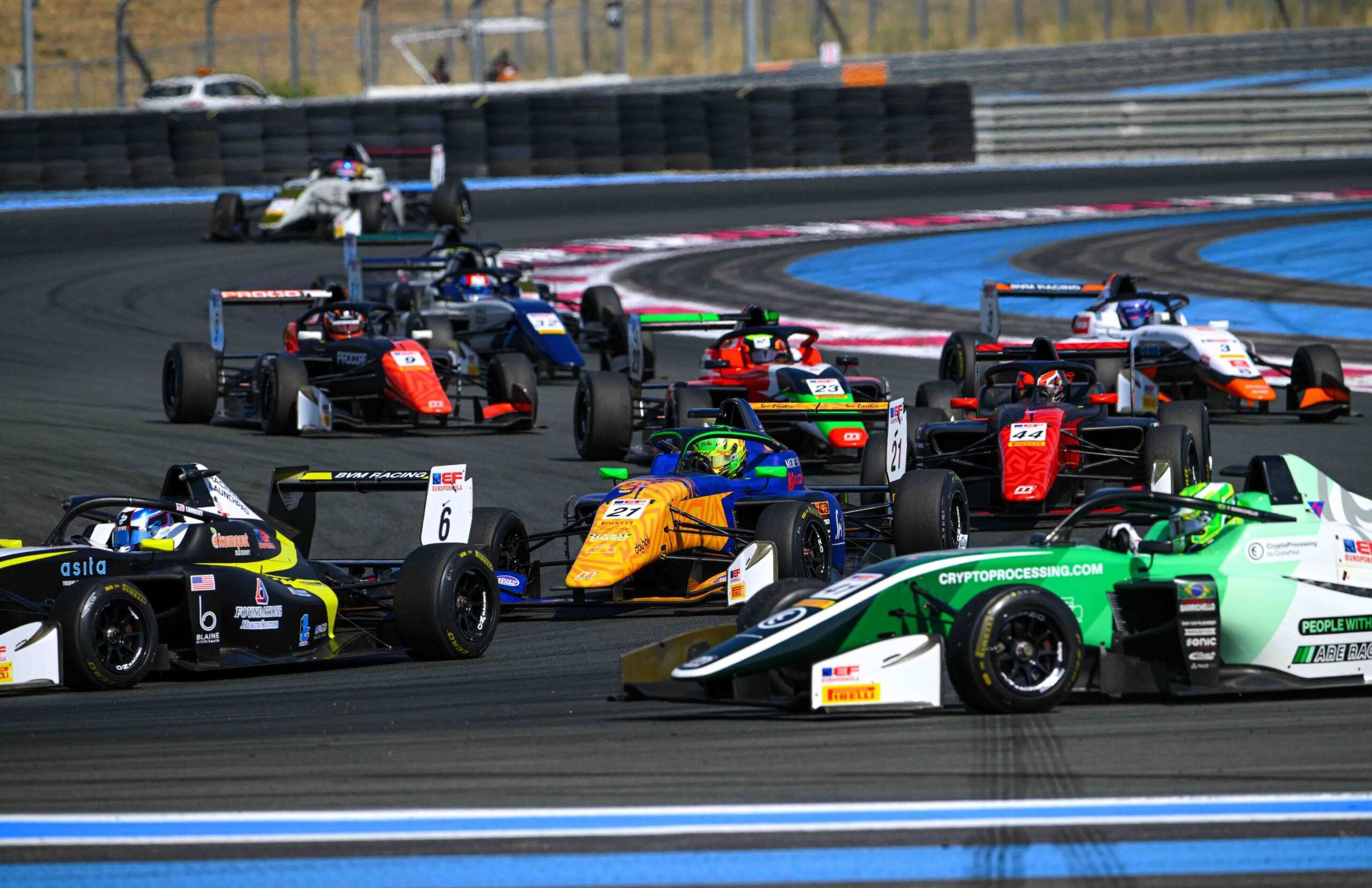
Euroformula Open returns for its 13th season in its current guise, bringing fresh energy, new drivers and subtle changes across the grid. Although the championship traces its roots back 26 years, it continues to evolve, and the 2026 campaign promises another competitive chapter.
This season retains the Dallara 324 chassis paired with a TOM’S-prepared Toyota engine, marking the second year of the spec-engine era. As a result, the series remains technically aligned with Super Formula Lights, ensuring consistency and performance parity across the field.
With several leading drivers from 2025 moving up the single-seater ladder, a new generation now steps forward. Consequently, the 2026 season could become one of the most unpredictable in recent years.
What is Euroformula Open?
Euroformula Open is a European single-seater championship designed to develop young drivers and prepare them for higher levels of motorsport. It operates with equal machinery, meaning driver ability, racecraft and team execution play decisive roles.
While the series has undergone several rebrands—from Spanish Formula 3 to European F3 Open—it has built a reputation as a key stepping stone towards FIA Formula 3 and beyond.
Moreover, its alignment with other global junior categories ensures that drivers gain relevant technical experience as they progress up the ladder.
A look back at 2025
The 2025 season delivered one of the closest title fights in recent history. Tymek Kucharczyk secured the championship in dramatic fashion at Monza, winning the penultimate race by just 0.001 seconds. That result gave him enough of an advantage to seal the title before the final race.
He ultimately finished only 17 points ahead of runner-up Yevan David, marking the tightest championship margin since 2015.
However, the competitive landscape has shifted. Kucharczyk now competes in Indy NXT, while David, Michael Shin and José Garfias have all progressed to FIA Formula 3. Therefore, the fight for the 2026 crown remains wide open.
The 2026 Euroformula Open calendar
For 2026, the championship introduces notable calendar adjustments while retaining its European focus. The Red Bull Ring drops off the schedule for the first time since 2018, and Misano joins as a new venue.
Meanwhile, Portimão continues to host the season opener, and Barcelona’s finale moves one week later in October.
2026 Race Calendar
- Round 1: Algarve International Circuit (17–19 April)
- Round 2: Spa-Francorchamps (15–17 May)
- Round 3: Misano World Circuit (5–7 June)
- Round 4: Hungaroring (3–5 July)
- Round 5: Paul Ricard (17–19 July)
- Round 6: Hockenheimring (11–13 September)
- Round 7: Monza (25–27 September)
- Round 8: Barcelona-Catalunya (23–25 October)
Each circuit offers distinct challenges, from high-speed straights to technical corners. Consequently, drivers must demonstrate versatility throughout the season.
Where to watch
Fans can follow every round live on the Euroformula Open YouTube channel. In addition, the series provides alternative broadcast options via its official website.
Live timing remains available online, ensuring that audiences can stay updated throughout each session.
The machinery: stability and performance
The 2026 season continues with the Dallara 324 chassis, paired with a TOM’S-developed Toyota engine. This combination ensures a balance between performance, reliability and cost control.
The package aligns closely with Super Formula Lights, allowing drivers to gain experience with machinery relevant to higher categories.
Key features of the current package include:
- A modern chassis designed for safety and aerodynamic efficiency
- A spec Toyota engine delivering consistent performance across all teams
- Technical regulations focused on cost control and competitive balance
As a result, the emphasis remains firmly on driver skill rather than technical advantage.
2026 Euroformula Open weekend format
The race format for the 2026 season remains unchanged, ensuring continuity while still delivering plenty of on-track action. Each race weekend begins with two Free Practice sessions on Friday, allowing drivers to fine-tune their setups and gather data.
Then, Saturday brings Qualifying, which sets the grid for Race 1, followed by the first race of the weekend. On Sunday, the intensity increases with two further races, creating a demanding schedule that tests both driver skill and team strategy.
Importantly, the grid-setting system continues to add variation. Race 2 uses the results from Race 1 but reverses the top six finishers, while Race 3 returns to qualifying results, again with a top-six reversal. Consequently, drivers must combine outright pace with strong racecraft and overtaking ability.
Weekend Structure:
- Friday: Two Free Practice sessions
- Saturday: Qualifying + Race 1
- Sunday: Race 2 and Race 3
Grid Formation:
- Race 1: Based on qualifying results
- Race 2: Based on Race 1 results, top six reversed
- Race 3: Based on qualifying results, top six reversed
Points System:
- 25 points for a win, down to 1 point for 10th place
- +1 point for pole position (qualifying fastest)
- +1 point for fastest lap in each race
The FIA-standard points system remains in place, rewarding consistency across all three races. Bonus points for pole position and fastest laps further encourage competitive performances throughout the weekend. Additionally, the rule requiring drivers to drop their worst three results ensures that a single poor weekend does not define a championship campaign.
Meanwhile, the rookie and teams’ championships continue unchanged. The structure rewards top rookie performers and ensures that teams rely on their strongest two drivers for points, maintaining fairness across the grid.
Championship Rules:
- Each driver drops their worst three results
- Consistency remains crucial across the season
Rookie Championship: Top five score: 10–8–6–4–3
Teams’ Championship: Top two drivers per team score points
2026 Euroformula Open teams and drivers: a new-look grid
The 2026 grid features three teams and 11 drivers for the opening round. Although smaller than previous seasons, the field remains competitive and diverse. It is expected that this will change throughout the season.
Notably, Nielsen Racing—rebranded as Northstar Racing—does not appear at Portimão despite pre-season plans. Similarly, G Motorsport delays its debut, reducing the overall grid size.
Nevertheless, the available line-up combines returning drivers with promising rookies, setting the stage for close racing.
Team Motopark
Team Motopark enters the 2026 season as the dominant force, and their line-up reflects both depth and potential. By combining experienced returnees with ambitious rookies, the team positions itself strongly once again.
- Wiktor Dobrzański (R) – The Polish rookie steps up after campaigns in Eurocup-4 Spanish Winter Championship and Eurocup-3. He continues to develop consistency and aims to break into the points regularly.
- Everett Stack – The highest-placed returning driver from 2025, Stack finished sixth overall with multiple podiums. He now targets race wins and a genuine title challenge.
- Lorenzo Castillo (R) – The Mexican rookie arrives from Eurocup-3, where he showed gradual improvement. He will look to translate that progress into stronger results.
- Enzo Yeh – The Taiwanese driver returns after an encouraging debut, which included a fourth-place finish and a fastest lap. He aims to build on that momentum.
- Jesse Carrasquedo Jr – One of the most experienced drivers on the grid, Carrasquedo Jr brings strong Eurocup-3 results and FIA F3 appearances, making him a key contender.
- Diego de la Torre – Entering his second season, the Mexican driver looks to improve on his 2025 podium finish and establish himself further up the order.
- Jan Koller (R) – The Czech rookie joins after a partial Italian F4 campaign. He continues his development as he adapts to higher-level competition.
BVM Racing
BVM Racing heads into 2026 with momentum after securing their first drivers’ title in 2025. The Italian team has consistently challenged Motopark and aims to go one step further this season. BVM Racing builds on its 2025 success with a balanced trio of drivers. The team combines experience with emerging talent as it looks to challenge for both titles.
- Javier Herrera (R) – The 16-year-old Mexican impressed in F4 CEZ with multiple wins and podiums. He enters as an exciting rookie with strong potential.
- Divy Nandan – The Indian driver transitions from GB3 and Indian F4. He brings valuable race experience and aims to secure consistent finishes.
- Alessandro Famularo – Returning after a partial 2025 campaign, Famularo showed promise with a fourth-place finish. He now seeks regular podium contention.
- Alceu Feldmann Neto (Round 2) – The Brazilian joined BVM Racing for the second round at Spa-Francorchamps, expanding the team to four cars. Feldmann also competes in Eurocup-3 and used his one-off Euroformula appearance to gain experience in the faster Dallara 324.
- Ricardo Baptista (R) (Round 3) – Baptista joined BVM Racing at Misano after previously making his Euroformula debut in 2025. The Brazilian also competes in GB3 and arrived with extensive Formula 4 experience, including a victory in the 2025 Brazilian F4 season.
- Celo Hahn (R) (Round 4) – The 17-year-old Brazilian steps up from Brazilian Formula 4 for his first international appearance. He joins BVM Racing at the Hungaroring, continuing his family’s Euroformula connection.
Neri Autosport
Neri Autosport brings a new dimension to the grid as the first French team in the championship’s modern era.
The team enters with a single driver, Aaron Ferrazzano, who impressed in junior categories after stepping up from karting. Although operating as a privateer, the team could still influence the midfield battle.
Drivex
Drivex returned to the Euroformula Open grid at Spa-Francorchamps with a two-car line-up featuring Filippo Fiorentino and Gino Trappa.
Filippo Fiorentino (R) (Round 2) – The Brazilian joined Drivex for its return at Spa while also racing for the team in Eurocup-3. Fiorentino stepped up after several seasons in Formula 4 and scored points during his Euroformula appearance.
Gino Trappa (R) (Round 2) – The Argentine returned to Euroformula with Drivex after making a one-off appearance in 2025. The reigning F4 CEZ champion immediately impressed at Spa, securing an overall podium and the Rookie Trophy victory.
Both drivers contested only the second round, with Drivex absent from the subsequent events at Misano and the Hungaroring.
A season of opportunity
Euroformula Open enters 2026 in a period of transition. With established frontrunners moving on, new talents now have the opportunity to step into the spotlight.
The revised calendar, stable regulations and competitive grid all point towards an unpredictable season. Furthermore, the mix of experienced drivers and rookies ensures that every round could deliver surprises.
Ultimately, the 2026 campaign promises intense battles and emerging stars, reinforcing Euroformula Open’s role as a vital proving ground in single-seater racing.