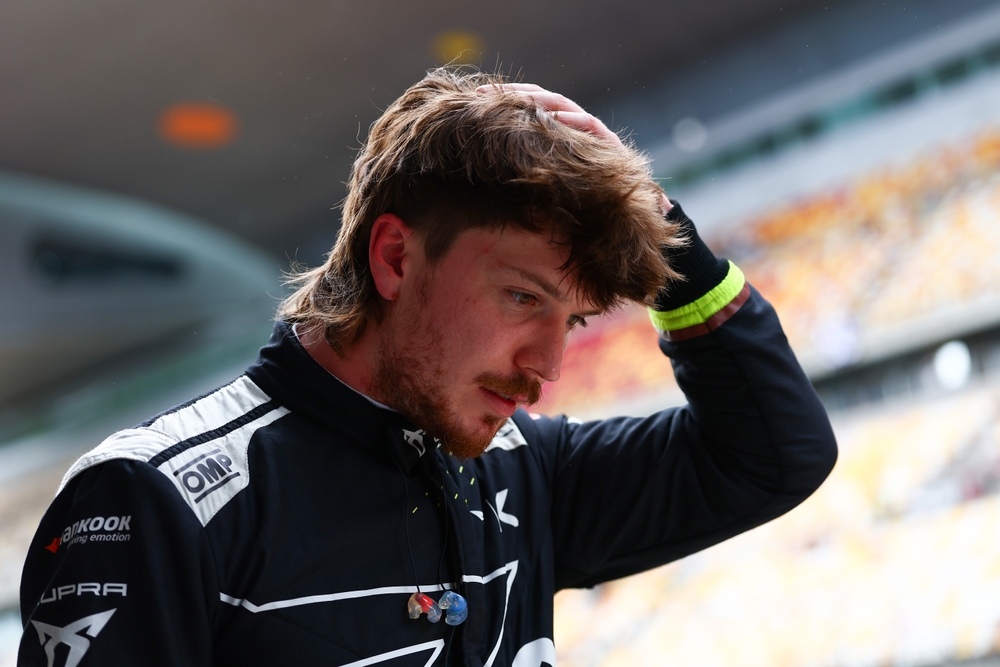
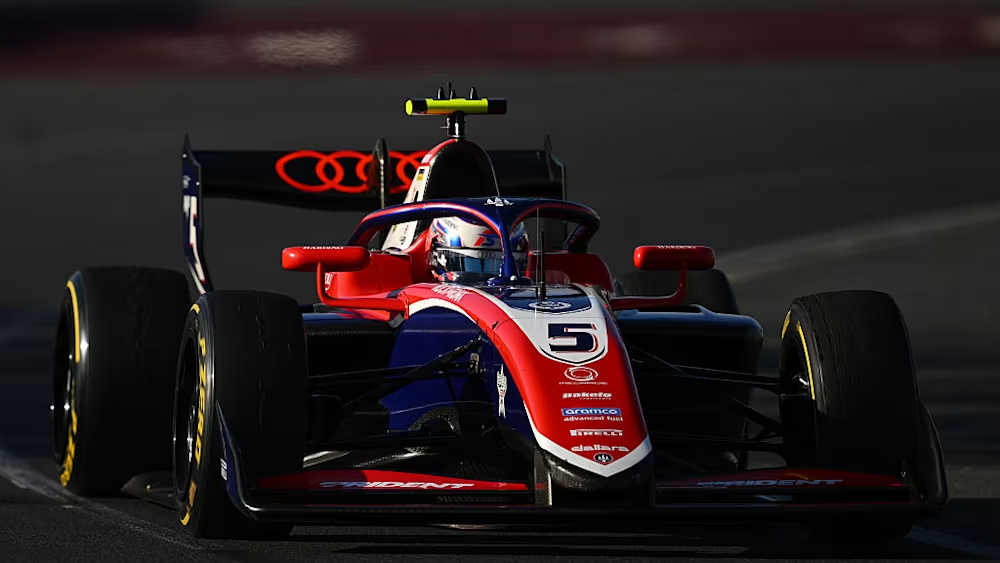
Freddie Slater delivered a strong Qualifying performance on the streets of Monte Carlo, finishing second in Group B and securing P3 on the grid for the 2026 F3 Feature Race at the Monaco GP
The TRIDENT driver became the first in his group to break the 1:25 barrier, setting a 1:24.986 to take provisional pole. However, a subsequent push lap ended prematurely after he clipped the wall at Turn 7, forcing him to abandon the attempt.
Despite the setback, Slater’s earlier effort remained good enough for second in Group B, behind pole-sitter Théophile Naël, whose outstanding 1:24.471 lap proved untouchable.
As a result, Slater will start Sunday’s Feature Race from P3, alongside Naël and Brando Badoer on the front two rows.
Speaking during a media session attended by Pit Debrief, Slater reflected on his Qualifying performance, the unique demands of Monaco, and his plans for the remainder of the weekend.
Slater pleased with reset after Turn 7 moment
Slater admitted that clipping the wall at Turn 7 came at a difficult stage of the session, but he was satisfied with the way he regrouped and immediately returned to competitive pace.
The British driver explained that he used the following cooldown lap to reset mentally before launching another strong effort. While it ultimately was not enough to challenge Naël for pole position, Slater felt he extracted almost everything available from the car.
Around Monaco, he added, the smallest margins often make the difference, with drivers constantly pushing close to the barriers in pursuit of lap time.
“Yeah, obviously, for me, clipping the wall in T7 wasn’t optimal, especially at that time. But I think I did a really good job of resetting, if I’m honest, because then the next lap I came out and was green or purple or something like this. So I think I did a really good job of resetting in that cooldown lap and yeah, unfortunately, it wasn’t quite enough but we knew we had to kind of get every little bit out of it that we could. And pole position was going to be separated by a few millimetres, you know, so I think you’re always going to see very close moments, and yeah, it happens to both of us.”
F3 Sprint Race in Monaco set to offer valuable learning for Slater after Qualifying
Although Slater will start Sunday’s Feature Race from near the front, the reverse-grid format means he will begin Saturday’s Sprint Race outside the points-paying positions.
When asked by Pit Debrief whether the Sprint would be an opportunity to attack or simply survive, Slater emphasised the importance of gathering information ahead of the Feature Race.
With this weekend marking his first experience of a race-distance run around Monaco, he believes the Sprint will provide crucial insight into tyre degradation and race behaviour around the tight street circuit.
“Yeah, pretty similar to what these guys said, just kind of get their knowledge on the tyre degradation which is pretty much the same approach in every sprint race of the year. Obviously, first time for me as well, doing kind of a long run race here so it’s going to be very valuable for myself to kind of get a bit of information on what the tyres do.”
Macau experience helped, but Monaco brings a different test
Slater also drew comparisons between Monaco and Macau, another iconic street circuit where he has previous experience.
While Macau helped build his confidence on temporary street tracks, he explained that the two venues require different approaches. Whereas Macau often revolves around managing interruptions and red flags, Monaco places a greater emphasis on traffic management due to its shorter layout and high car density.
Even so, Slater adapted quickly to the challenge, finishing second in Free Practice on his first appearance at the Principality.
“I’d say the approach in terms of Macau and Monaco are quite different. I think it just, in Macau, gave me obviously confidence and kind of just practise, I guess, the experience of driving on street tracks, but for me, around here, with such a small circuit with so many cars, especially in free practise, just to get that rhythm with so many cars on track was very difficult compared to Macau.
“Macau was more of a red flag thing and here was more of a traffic thing, so I think it’s just the different approaches of the two tracks. But I think you saw in FP we were straight into P2 for the first time in Monaco. I think it was pretty positive and yeah, I always enjoy a street track as well. I think it’s great to drive and it’s nice to take risks.”
Slater says every millimetre counts in 2026 F3 Qualifying in Monaco
With Formula 3’s Monaco Qualifying format split into two groups, Slater stressed the importance of being immediately on the pace.
For a driver making his Monaco debut, there was little room for a gradual build-up. Instead, competitors needed to commit fully from the outset, running close to the walls and accepting the risks that come with chasing the ultimate lap time.
Given the difficulty of overtaking around Monaco, maximising every possible gain in Qualifying becomes even more critical.
“Yeah, I knew obviously for my first time here it was very important to be on it straight away, and I think at the end of the day you take the full risk and you saw that. So I think, yeah, you leave no margin out there, you try and drive as close as you can to the walls, and every millimetre counts. And at the end of the day, the one that maximises that the most is normally the one on pole, so I think, yeah, it’s pretty clear what you have to do.”
Split Qualifying could be worth trying in F1
Slater was also asked whether Formula 1 should consider adopting split-group Qualifying at Monaco, following recent comments from Carlos Sainz supporting the concept.
While open to the idea, Slater cautioned that it would not eliminate every issue. Factors such as track evolution, weather conditions, and group allocation could still influence the final result.
At the same time, he believes traffic can be effectively managed when drivers, teams, and race engineers work together and show mutual respect on track.
“I think obviously with F1 and even Formula 3, it’s very difficult. With the separated groups, it’s also sometimes a bit of luck because, you know, the weather can come into play, and one group can be faster just because the track is faster. So I think it’s obviously very difficult with traffic, no matter if it’s Formula 1 or Formula 3, so it may be something to try at some point to see if it works.”
“It’s always good to try something different, but it’s not a definite answer if it would definitely work. And I think as long as everyone was kind of respecting each other, which I think the F3 drivers did quite a good job at this qualifying when you watched it, I think everybody can get an ultimate lap at the end of the day. So I think when the respect is there between all the drivers and the teams and the radio communication is good, there seems not to be a massive problem.”
Limited practice forces F3 drivers to adapt quickly
Slater concluded by discussing the challenge posed by Formula 3’s limited practice schedule. With just 45 minutes of Free Practice and only a handful of meaningful push laps available, drivers must adapt quickly and deliver performance almost immediately.
Having stepped up from FRECA, where drivers typically have more time to build pace and fine-tune setups throughout a race weekend, Slater acknowledged that the Formula 3 format requires a very different mindset. Nevertheless, he enjoys the challenge of operating at the limit from the outset.
“Yeah, I think obviously 45 minutes is not a very long time, and especially yesterday was six pushes worth, so it wasn’t actually a lot at the end. So I think it’s more for teams, they would probably like more practise sessions to develop the car more, but for us it’s our job as F3 drivers to get in in 45 minutes, we have to be on the pace.”
“So I think it’s a pretty standard procedure, to be honest, something that’s completely different obviously for me this year coming from FRECA, where you have a lot more time to kind of develop yourself throughout the weekend. And yeah, it’s been a completely different kind of approach that I’ve had to adapt to, and but also it’s enjoyable to go out there and have to push the limits straight away.”