ACO President Pierre Fillon has left the door open for a hydrogen-powered Garage 56 entry at the 24 Hours of Le Mans before the H2 Hypercar regulations arrive in 2030, as reported by Sportscar365.
The ACO announced its updated hydrogen roadmap during its annual Le Mans press conference. Under the plan, hydrogen-powered cars will compete for overall honours alongside conventional Hypercars under the next generation of converged technical regulations.
The revised timeline delays the planned introduction of hydrogen machinery by a further two years after organisers previously targeted 2028.
Switch to liquid hydrogen delays H2 Hypercar plans
Fillon explained that the decision to move away from gaseous hydrogen fuel-cell technology and towards liquid hydrogen created additional development demands.
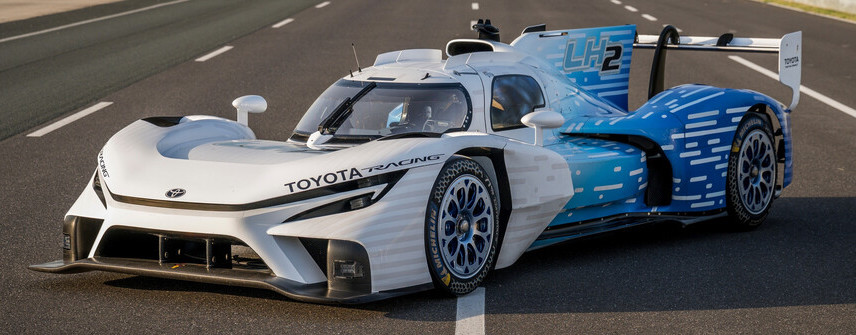
Toyota demonstrated that approach with its TR LH2 Racing Prototype at Le Mans. Kazuki Nakajima completed laps of the Circuit de la Sarthe on two occasions during the race weekend.
Fillon said manufacturers could still pursue a Garage 56 programme before the full regulations take effect.
“The plan was still 2028,” said Fillon. “As you know, there was a big change. We started with the fuel cell gaseous H2. Now it’s ICE and liquid H2, so it takes more time than we expected.
“The roadmap I presented today is 2030. [Before] that we can have some Garage 56 [entries], but we will see. That, you have to speak with the manufacturers.”
Garage 56 allows an innovative car to compete outside the standard sporting classification. Therefore, the platform could give a manufacturer the opportunity to develop hydrogen technology at Le Mans before the H2 Hypercar category formally launches.
H2 Hypercars will carry additional weight
The proposed 2030 regulations set a minimum weight of 1,200 kg for hydrogen-powered Hypercars. By comparison, conventional Hypercars currently run to a 1,040 kg minimum. The regulations will also require hydrogen cars to use larger, specially designed tyres to manage the additional weight.
ACO competition director Thierry Bouvet explained the technical direction behind the proposed formula.
“The biggest difference will be the weight because there are some constraints in the technology, some unknowns also,” explained Bouvet. “The idea is to have two-wheel drive ICE or fuel cell, because both are allowed, and storage based on liquid hydrogen.”
The regulations will permit manufacturers to choose either an internal combustion engine or a fuel-cell powertrain. However, both concepts will use liquid hydrogen storage and two-wheel drive.
Equivalence of Technology to balance performance
The ACO and FIA plan to reintroduce Equivalence of Technology measures to balance conventional and hydrogen Hypercars. FIA Chief Technical and Safety Officer Xavier Mestelan-Pinon said the regulators aim to bring the two concepts as close together as possible in performance.
“If the [H2] car will be bigger, of course they could have more power, but it needs to be refined,” he said.
Mestelan-Pinon also expressed confidence that the governing bodies will complete the regulations, although manufacturers must ultimately commit to building the cars.
“We are confident we will have hydrogen regulations.
“This is a question for the manufacturers. But if we are working on it, it means there is something behind [it], because we don’t want to waste our time.”
Meanwhile, ACO Deputy Competition Director Bruno Famin stressed that both the regulators and manufacturers still need to expand their understanding of hydrogen-powered prototypes.
“There’s still a lot to learn on both sides, the manufacturers and regulators, about hydrogen Hypercar. The more we will know, the more [accurate] it will be in defining the EoT.”
Le Mans pit upgrades will support hydrogen refuelling
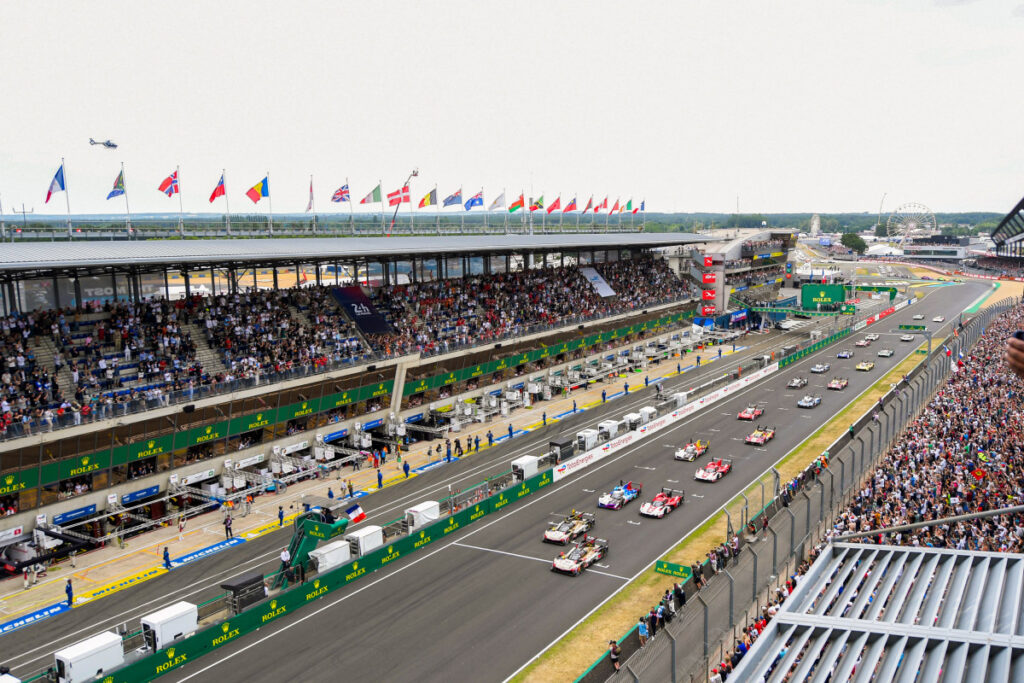
The ACO will also incorporate hydrogen infrastructure into its planned redevelopment of the Le Mans pit complex. The organisation revealed renders of the proposed upgrades during race week. However, Fillon expects the full project to continue until 2030 or 2031 because the ACO plans to complete the work during the winter months.
That approach will allow the circuit to continue hosting MotoGP, the 24 Heures Motos, the 24 Hours of Le Mans and Le Mans Classic without disrupting the sporting calendar.
“It’s a big job and challenging in terms of preparation and planning,” he said. “What we don’t want is to compromise the sporting season. You have MotoGP, the 24 hours of motorcycle, of course Le Mans and Le Mans Classic. So the idea is to realise the works during the winter. Of course it will not only be one winter.”
Fillon expects the initial work to begin in approximately nine to 12 months.
“When you realise some big works like that, the most important is the planning and the preparation,” he said. “When you have started the work, you can’t change anything. The most important [part] of our job is to prepare exactly what what we want to do.
“It takes time and we need at least nine to 12 months to see exactly what the plan is.”
Expanded pit complex to increase Le Mans grid
The redevelopment will also increase the size of the Le Mans field. Fillon told French-language media outlets, including Endurance-Info, that the upgraded pit complex will add two garages. As a result, the race could expand to a 64-car grid once the project reaches completion.
The additional capacity will support the ACO’s future technical plans while also creating space for hydrogen-powered entries.
Although the ACO has moved the full H2 Hypercar debut to 2030, a Garage 56 project could introduce the technology earlier. However, manufacturers must now decide whether they want to take that opportunity.