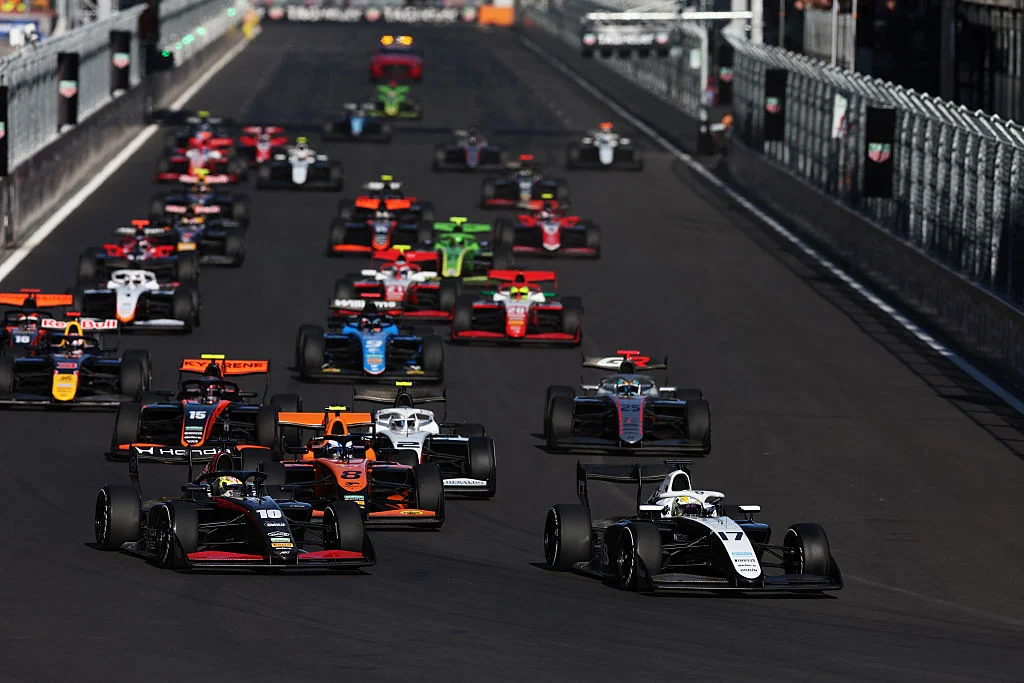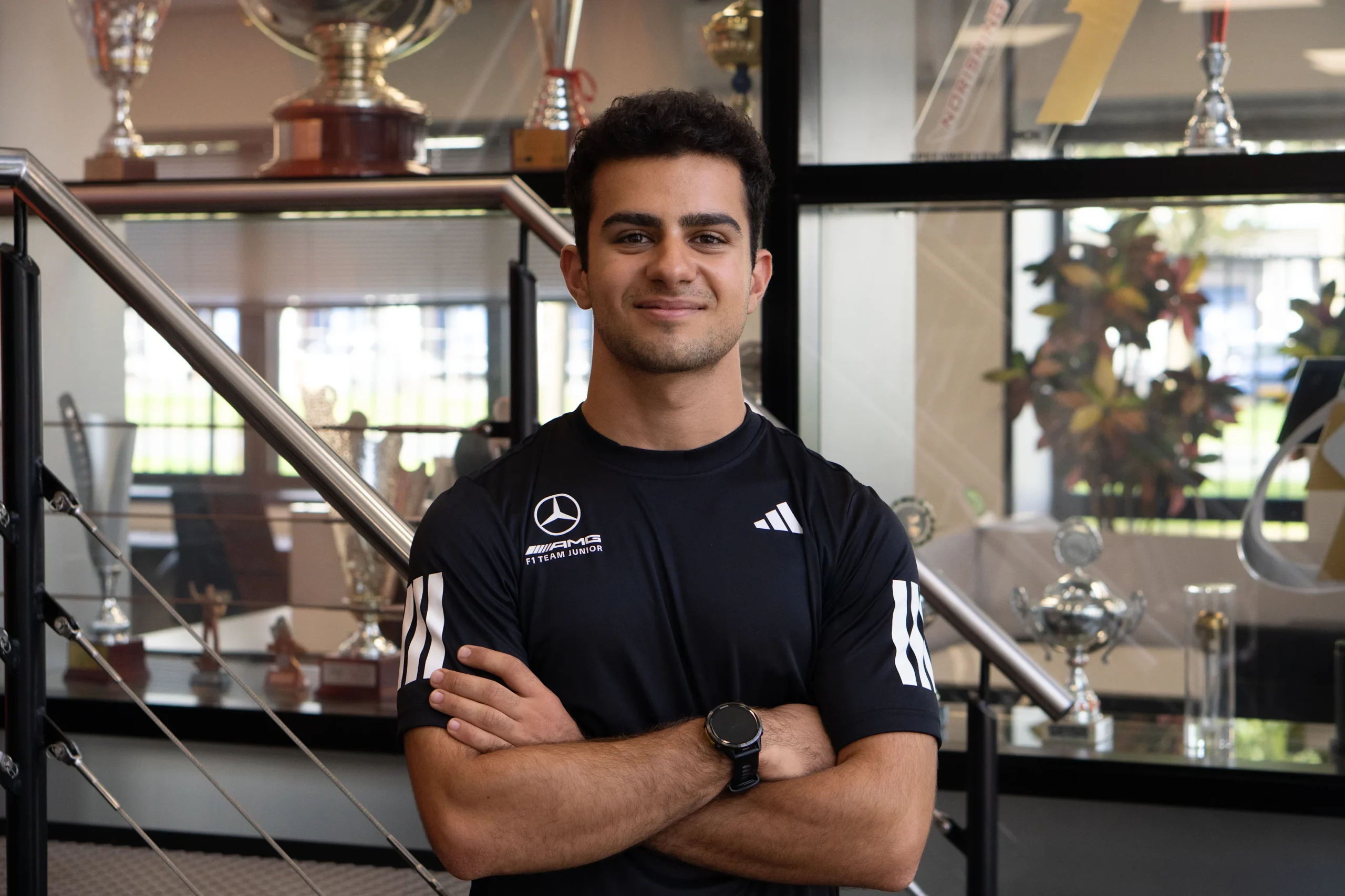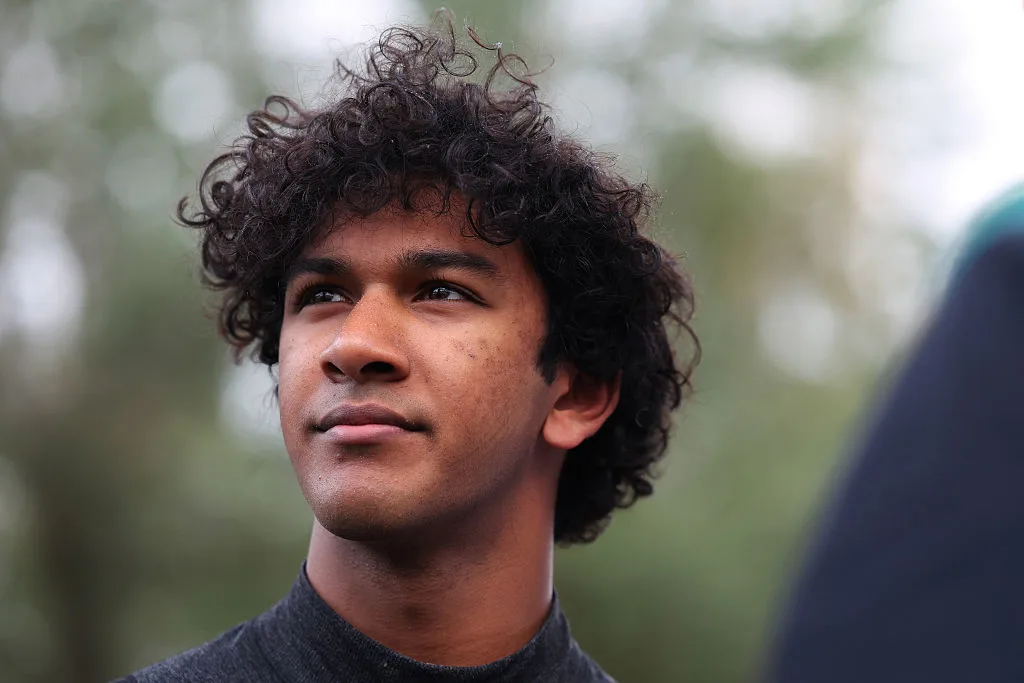
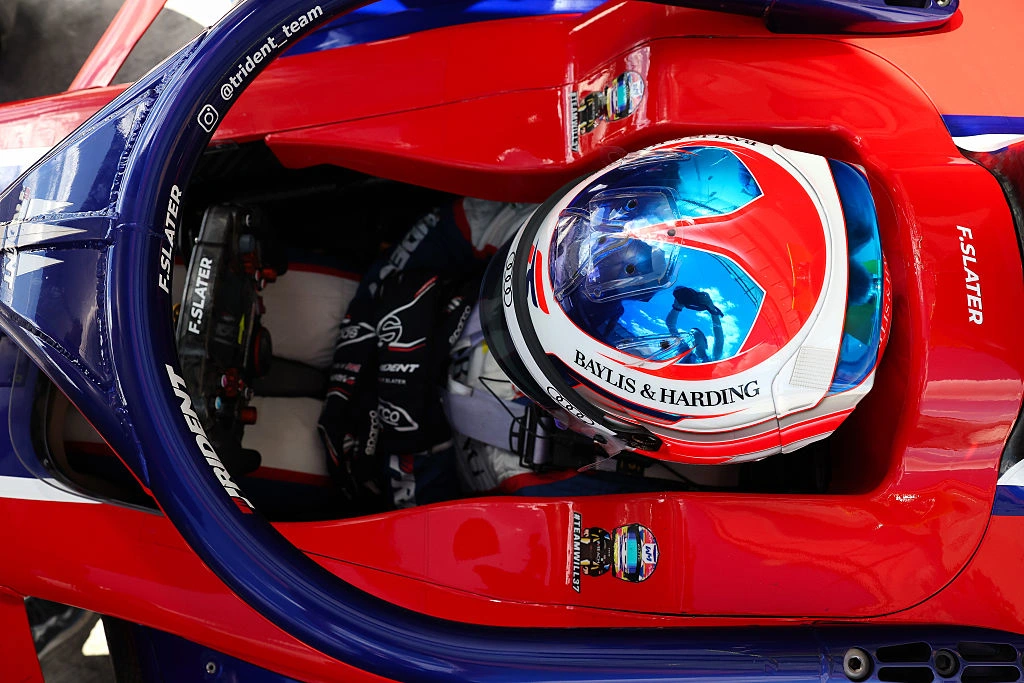
Freddie Slater will arrive at Monza as the leader of the 2026 FIA F3 Drivers’ Championship, but the eight-point advantage he holds over Ugo Ugochukwu tells only part of the story.
After seven rounds, Slater sits on 130 points to Ugochukwu’s 122. Behind them, Théophile Naël is third on 75, Ernesto Rivera has climbed to fourth on 72, while Brando Badoer completes the top five with 71. The gap from second to third is already 47 points, suggesting that the Championship has developed into a relatively clear fight between Slater and Ugochukwu. However, the unusual structure of the final round at Madrid means the mathematics remain far more open than the standings initially suggest.
There are still 106 points available to an individual driver across Monza and Madrid. The addition of a second Feature Race and another Qualifying session at MADRING means 67 points will be available during the finale alone, compared with the normal maximum of 39 at Monza. Consequently, 16 drivers remain mathematically capable of becoming the 2026 FIA Formula 3 Champion.
That does not mean F3 has a 16-driver title fight.
The much more relevant question is how many of those drivers can realistically score at the rate required to catch Slater, particularly if the Championship leader continues to accumulate points at anything close to the level he has managed through the opening seven rounds. On that basis, the field becomes considerably smaller.
The mathematics gives F3 16 contenders. The current points gap gives it five drivers with a plausible route into Madrid. The season-long performance data points overwhelmingly towards two.
The 2026 F3 Drivers’ Championship at a glance
The scale of the gap between Slater and Ugochukwu compared with the rest of the field becomes clearer when their scoring rates are examined.
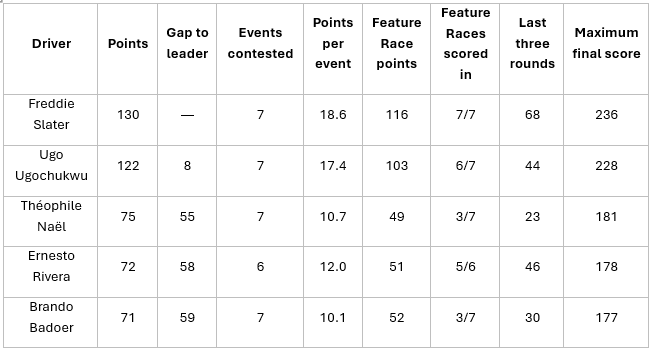
Rivera’s six events rather than seven are significant. The Campos Racing driver missed Melbourne while recovering from injury, with Patrick Heuzenroeder deputising for him at the opening round. Rivera has therefore averaged 12 points per weekend actually contested, comfortably ahead of Naël and Badoer and behind only the two Championship leaders.
That makes Rivera’s 58-point deficit more nuanced than it initially appears. He has had one fewer weekend in which to accumulate points and has become markedly stronger as the season has developed.
Nevertheless, the principal statistical divide remains difficult to ignore. Slater and Ugochukwu are averaging 18.6 and 17.4 points per event respectively. Nobody else is above 12.
The two leaders have not simply been quicker on isolated weekends. They have accumulated points at a fundamentally different rate.
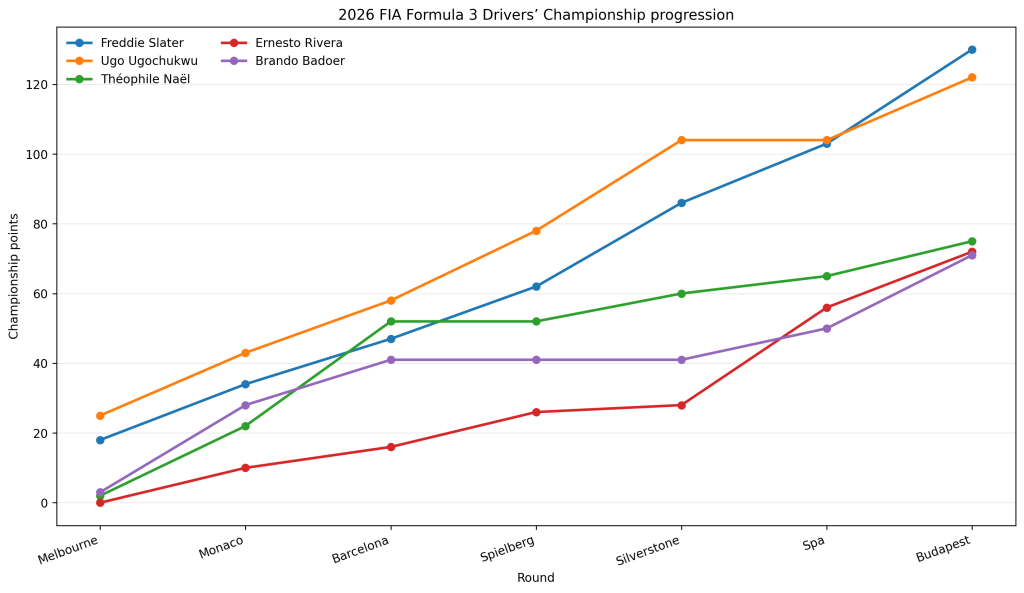
Figure 1: 2026 Championship progression
How 106 remaining points change the 2026 F3 Driver’s Championship title equation
The expanded Madrid finale is the reason so many drivers remain mathematically involved.
Under the standard F3 points system, a driver can score 10 points for winning the Sprint Race and another point for fastest lap if eligible. The Feature Race carries 25 points for victory, two for pole position and another one for fastest lap, creating a theoretical maximum return of 28.
A conventional weekend therefore carries a maximum of 39 points.
Madrid will retain the Sprint Race but feature two separate Qualifying sessions and two Feature Races. Each Qualifying session awards two points for pole, while both Feature Races carry the standard allocation. The theoretical Madrid maximum is therefore 11 points from the Sprint plus 28 from each Feature Race: 67 in total.
Combined with Monza, that gives:
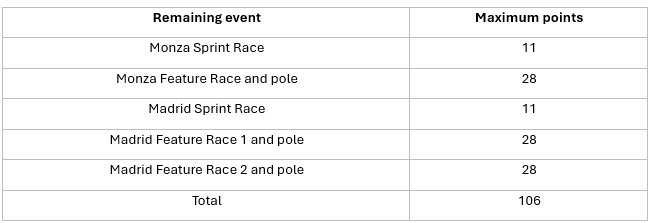
The threshold for mathematical elimination is therefore unusually low.
Slater currently has 130 points. Any driver capable of reaching at least 131 remains able, in theory, to surpass the Championship leader if Slater scores nothing else. That leaves everybody on 25 points or more mathematically alive. James Wharton and Enzo Deligny, both on 28, are the lowest-ranked surviving contenders. Louis Sharp is the first eliminated driver on 21 because even a perfect 106-point return would take him only to 127.
The actuality of the mathematics
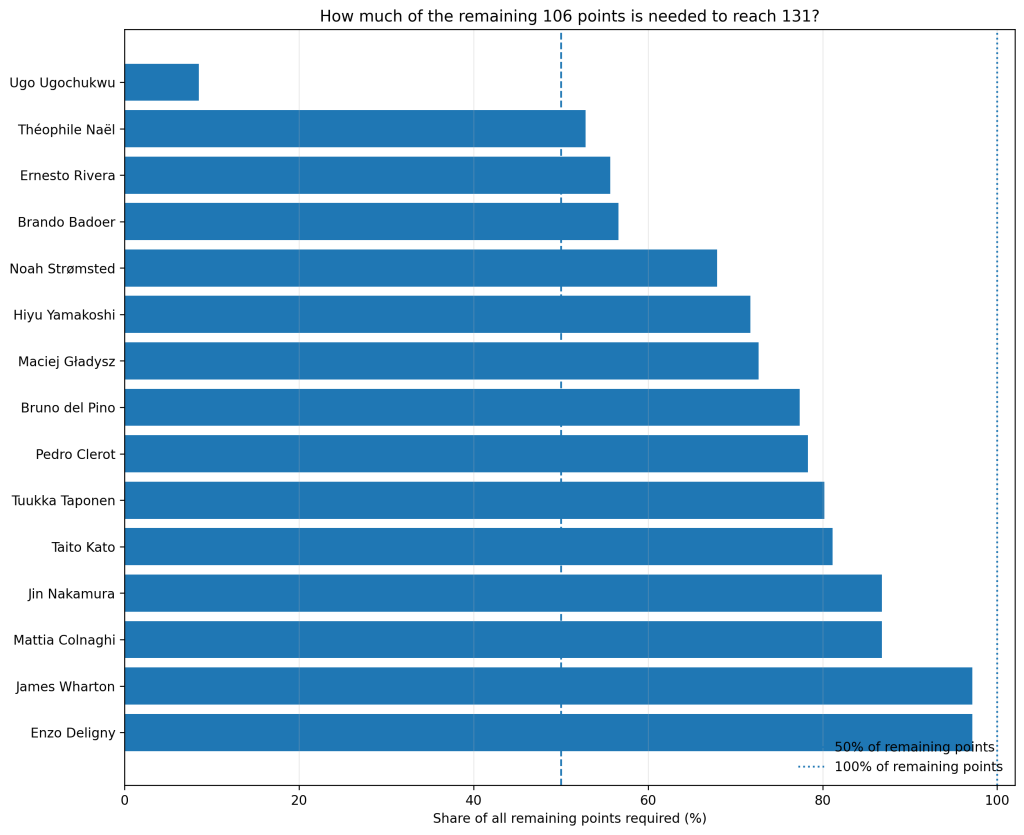
However, the amount of those 106 points that each contender would need merely to surpass Slater’s existing score illustrates how rapidly the mathematics become unrealistic.
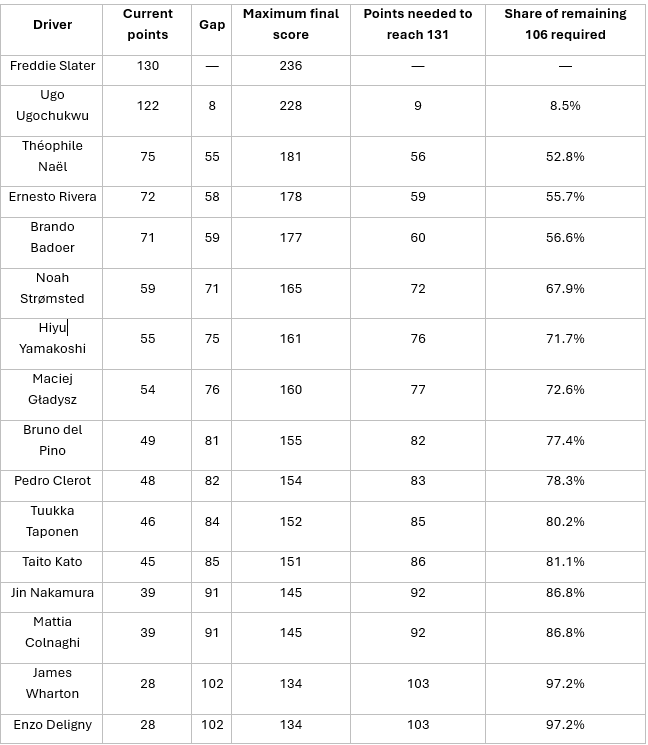
The most important caveat is that these figures assume Slater does not score another point.
Naël does not simply need 56 of the final 106 to win the Championship. He needs 56 just to move beyond the number Slater already has before Monza begins. Rivera needs 59. Badoer needs 60. Wharton and Deligny need 103 of 106 — 97.2% of every available point — merely to reach 131.
That is why the difference between being mathematically alive and being a genuine title contender is so substantial.
Figure 2: Share of the remaining points required just to reach 131
The 67-point Madrid window creates a more useful dividing line
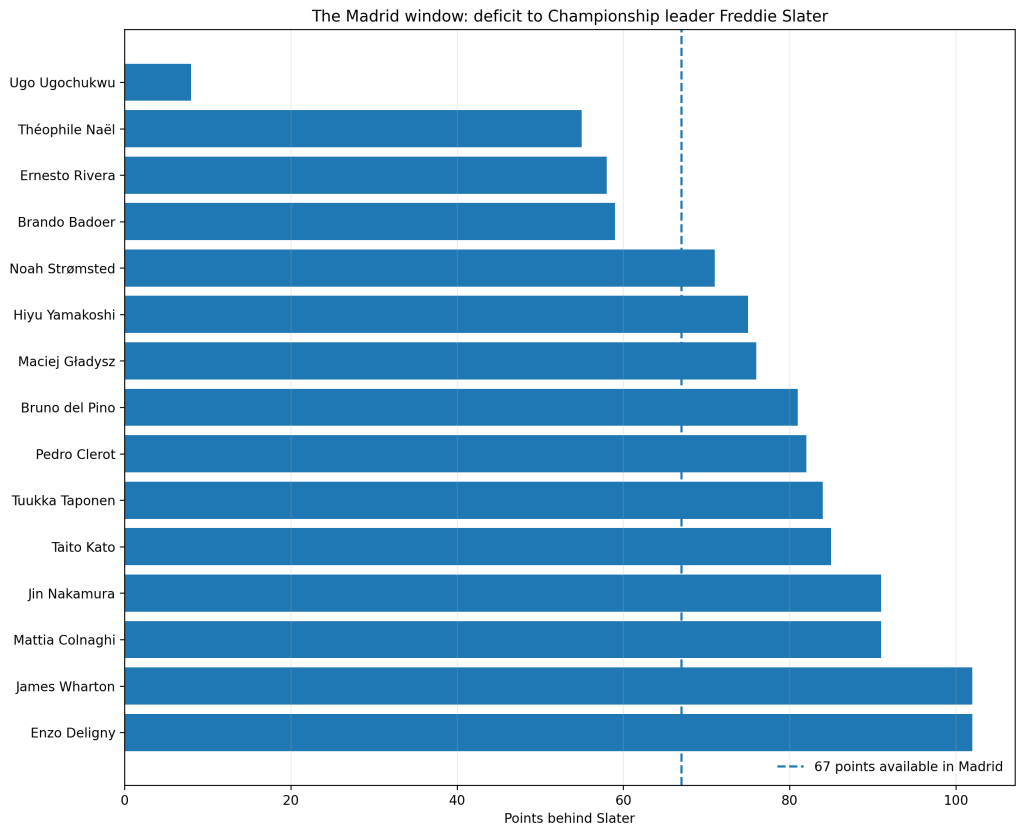
A more revealing number than 106 is 67. That is the maximum available at Madrid alone, and it provides a useful way of separating the drivers who can currently reach the final round with their existing deficit intact from those who already need to make ground at Monza.
Ugochukwu is eight points behind Slater. Naël is 55 behind. Rivera is 58 behind. Badoer is 59 behind. All four are presently within 67 points of the Championship leader. Including Slater himself, that gives five drivers who currently sit inside what can effectively be considered the “Madrid window”.
Strømsted is the first driver outside it. He is 71 points behind Slater. Therefore, even if the standings remained unchanged after Monza, the 67 available in Madrid would no longer be enough. Strømsted must gain at least four points on Slater in Italy simply to reach the finale with a mathematical chance.
Yamakoshi must gain at least eight relative to Slater. Gładysz needs nine. Del Pino needs 14. Clerot needs 15. Taponen needs 17 and Kato 18. Nakamura and Colnaghi both need a 24-point swing at Monza, while Wharton and Deligny require 35.
Those are not the points they must score. They are the minimum amount by which they must outscore Slater.
That distinction is crucial. If Slater scores 20 points at Monza, for example, Wharton would need at least 55 — impossible because only 39 are available. His Championship would therefore be over regardless of what happened elsewhere. Thus, for the drivers further down the order, Monza is not simply about keeping their title hopes alive. It is about overcoming the Championship leader directly before Madrid even begins.
Figure 3: The “Madrid Window”
Slater has transformed the 2026 F3 Drivers’ Championship in two weekends
The most remarkable aspect of the current standings is how quickly the direction of the title fight changed.
Ugochukwu led Slater after each of the opening five rounds. After Melbourne, the American held a seven-point advantage, 25 to 18. Monaco increased it to nine, with Ugochukwu on 43 and Slater on 34. Barcelona made the gap 11, Spielberg increased it to 16 and Silverstone moved it out to 18. At that stage Ugochukwu had 104 points and Slater 86. The Campos Racing driver had not merely led the standings; he had steadily taken points out of Slater at every round. The individual gains were rarely enormous, but their consistency was beginning to create meaningful separation.
Then came Spa. Ugochukwu failed to score across the weekend, while Slater collected 17 points from the Feature Race column. Rivera won the race, Yamakoshi finished second and Slater completed the podium, reducing Ugochukwu’s Championship advantage from 18 points to just one.
Budapest completed the reversal. Slater arrived one point behind and left eight ahead after taking his first FIA Formula 3 victory in the Feature Race. Ugochukwu drove from sixth to second and kept the pressure on his rival, but the result represented another nine-point swing in Slater’s favour.
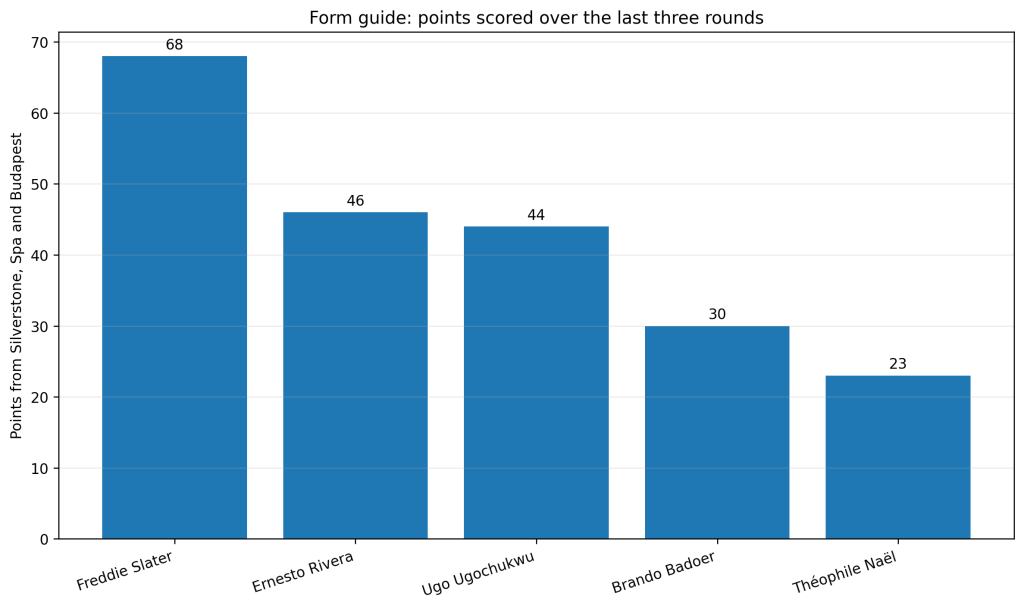
Across Silverstone, Spa and Budapest, Slater scored 68 points. Ugochukwu scored 44. That is a 24-point advantage over the three-round period. More importantly, if the comparison begins after Silverstone — when Ugochukwu led by 18 — the final two rounds produced a 26-point Championship swing. Slater went from 18 behind to eight ahead.
It has transformed the psychology of the title fight. For much of the season Ugochukwu was the driver gradually building a cushion. Now Slater is the driver carrying both the points lead and the strongest recent scoring sequence into the final two rounds.
Figure 4: Form guide (top 5 drivers) across Silverstone, Spa, and Budapest
Slater’s consistency has become his biggest 2026 F3 Drivers’ Championship weapon
Freddie Slater may only have one race victory to his name in the 2026 FIA Formula 3 season, but the Championship leader’s position at the top of the standings has been built on something arguably more valuable: consistency.
The Briton’s breakthrough victory did not arrive until the Budapest Feature Race, while several of his closest rivals had already established themselves as multiple winners. Ugo Ugochukwu has won twice, as have Théophile Naël and Ernesto Rivera, while Brando Badoer has also stood on the top step after taking the Monaco Feature Race.
Yet none has accumulated as many points as Slater. The explanation lies in how he has scored rather than simply how often he has won. Across the seven Feature Races completed so far, Slater has recorded returns of 18, 16, four, 15, 20, 17 and 26 points. Even Barcelona, his least productive Feature Race weekend, still added four points to his total.
He is the only driver in the Championship to have scored in every Feature Race, giving him a seven-from-seven record in the races that traditionally carry the largest rewards.
That consistency has allowed Slater to remain near the front even when outright victories were not available and has become increasingly important as the Championship enters its final two rounds.
Why Slater’s Feature Race scoring matters even more now
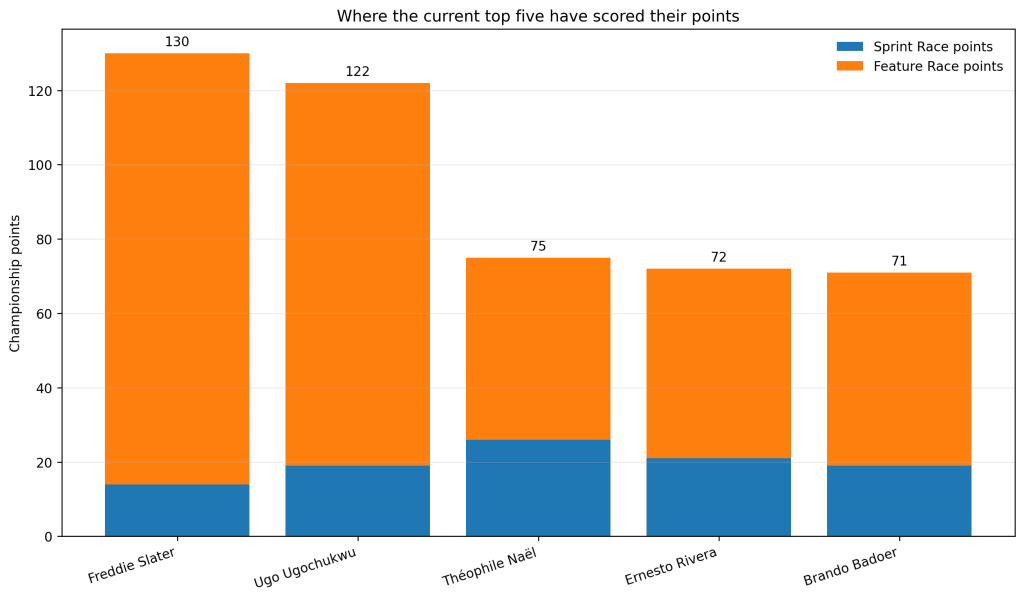
Of Slater’s 130 points, 116 have come from Feature Race columns, equivalent to 89.2% of his Championship total. His Sprint Race contribution stands at only 14 points.
Ordinarily, that would simply be an interesting feature of his campaign. The unusual structure of the final two weekends makes it far more relevant.
Only two Sprint Races remain, offering a theoretical combined maximum of 22 points. By comparison, three Feature Races remain — one at Monza and two at Madrid — with a combined maximum of 84 points once the available pole position and fastest-lap bonuses are included.
That means 79.2% of the remaining maximum score is connected to the Feature Race side of the weekend.
The Championship has therefore become increasingly weighted towards the area in which Slater has been most reliable.
That does not guarantee the Briton the title, particularly with 106 points still available, but it strengthens the statistical case in his favour. The majority of the remaining points will be awarded through the sessions in which Slater has produced his most consistent results throughout the campaign.
Figure 5: Sprint Race versus Feature Race among the top five
Ugochukwu’s numbers keep the title fight wide open
Slater’s Feature Race record strengthens his position, but Ugochukwu’s own statistics explain why an eight-point advantage remains anything but comfortable.
The Campos Racing driver has scored 103 of his 122 points through Feature Race columns, meaning 84.4% of his total has come from the same area of the weekend that will dominate the remaining rounds. Ugochukwu has scored in six of the seven Feature Races completed so far. Spa-Francorchamps remains the only exception, and that Belgian weekend has become one of the defining moments of the Championship.
Before Spa, Ugochukwu had built an 18-point advantage through consistently strong scoring. His failure to add to his total allowed Slater to reduce the gap to just one point in a single weekend before Budapest completed the reversal.
However, Ugochukwu needs to gain only nine points on Slater across the remaining 106 to move ahead on points, before any potential countback is considered. In the context of three Feature Races, that is a small swing. One particularly strong Sunday could be enough to completely reshape the Championship again.
One Feature Race could erase the entire gap
The size of Ugochukwu’s task becomes clearer when the Feature Race points system is applied to the current eight-point deficit.
If the American were to take pole position and win one of the remaining Feature Races, he could score 27 points before fastest lap is considered. If Slater finished directly behind him in second without the pole bonus, he would score 18. The difference would be nine points. In other words, one pole position and one Feature Race victory, with Slater finishing second, could be sufficient for Ugochukwu to erase the entire current Championship deficit.
There are three Feature Races remaining.
That is why Slater’s recent momentum should not be confused with a decisive advantage. The Briton has transformed the Championship over the last two rounds, but the points structure allows Ugochukwu to respond rapidly. Thus, an eight-point lead is valuable because it gives Slater the initiative. It is not large enough to allow him to manage the final weekends conservatively.
For both drivers, qualifying position and Feature Race execution will remain central to the title fight.
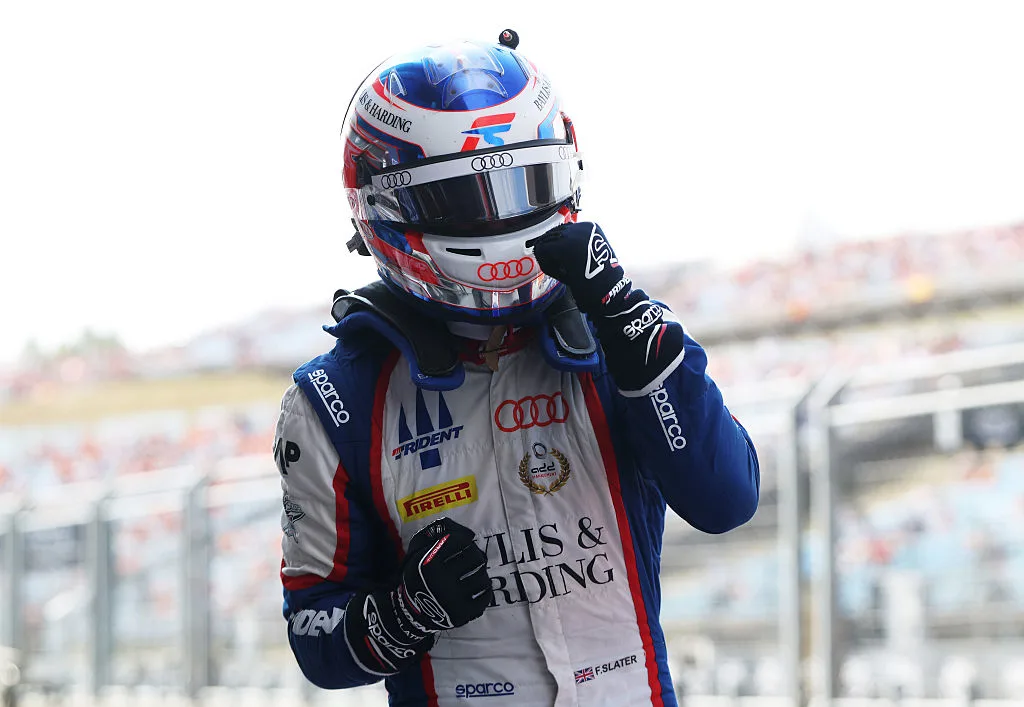
Slater’s scoring efficiency raises the bar for the outsiders
The difficulty facing Naël, Rivera and Badoer becomes clearer when their season-long scoring rates are compared with those of the leading pair.
Seven conventional F3 rounds have offered a theoretical maximum of 273 points to drivers who contested all of them. Slater has collected 130, meaning he has converted approximately 47.6% of that maximum. Ugochukwu’s 122 points represent 44.7%.
There is then a significant drop. Naël’s 75 points equate to 27.5% of the maximum available to him, while Badoer’s 71 represent 26.0%.
Rivera requires slightly different treatment because he missed Melbourne. His 72 points have come across six rounds, during which 234 points were theoretically available. That gives him a capture rate of 30.8%.
These figures are not forecasts. F3 remains too unpredictable for a simple scoring percentage to predict Monza or Madrid accurately. They do, however, demonstrate the scale of the improvement required from the chasing group if they are to turn mathematical possibilities into genuine Championship challenges.
Slater does not need perfection to shut the door
If Slater simply maintained approximately his existing 47.6% scoring rate across the final 106 points, he would add around 50 and finish the season on roughly 180 or 181.
That is particularly significant when compared with the mathematical ceilings of the drivers behind Ugochukwu. Naël can reach a maximum of 181 points. Rivera can reach only 178, while Badoer’s absolute ceiling is 177.
Slater therefore does not need to dominate the final two weekends to make the Championship inaccessible to those three. If he continues collecting points at anything close to his existing rate, their theoretical maximums quickly become irrelevant.
The outsiders face a much steeper requirement. Naël needs 56 of the remaining 106 points merely to reach 131 and surpass Slater’s current score, assuming the Championship leader scores nothing else. Rivera needs 59 points and Badoer requires 60. Even before Slater scores again, all three need to increase their points-capture rates substantially.
That is the statistical wall confronting the chasing group.

Naël’s Sprint strength may be less useful in the run-in
Naël remains third in the Championship and is mathematically the closest challenger outside the leading pair, but the composition of his 75 points presents a problem. The Campos Racing driver has collected 26 Sprint Race points, the highest total among the current top five. Slater has scored 14, Ugochukwu 19, Rivera 21 and Badoer 19.
Naël’s ability to capitalise on the reversed-grid Saturday format has therefore helped keep him near the front despite several difficult Feature Races. The problem is that only two Sprint Races remain, with a maximum of 22 points available from them. Even if Naël won both and took fastest lap in each, he would recover less than half of his present 55-point deficit to Slater if the Championship leader failed to score in either race.
The title fight will therefore be decided primarily through the Feature Races. That shifts the emphasis towards the area in which Naël’s recent results have been considerably weaker.
Naël needs his Sunday form to change immediately
Naël has scored Feature Race points at only three of the seven rounds so far, with Melbourne, Monaco and Barcelona accounting for those returns. Barcelona remains the standout weekend of his campaign. He collected 30 points across the round, including 27 from the Feature Race column, and at that stage looked capable of developing into one of Ugochukwu’s principal Championship challengers.
Since then, however, Naël has failed to score in four consecutive Feature Races.
That record becomes particularly significant when 84 of the remaining 106 theoretical points are connected to the three Feature Races and their qualifying bonuses. Naël cannot rely on the scoring pattern that has kept him third so far. His Sprint performances may have supported his Championship position, but the route to the title now runs overwhelmingly through Feature Race results.
He therefore needs more than a modest improvement on Sundays. To genuinely threaten Slater and Ugochukwu, Naël requires a run of Feature Race results capable of reversing more than half of his current deficit while hoping both drivers ahead fail to maintain their season-long scoring levels.
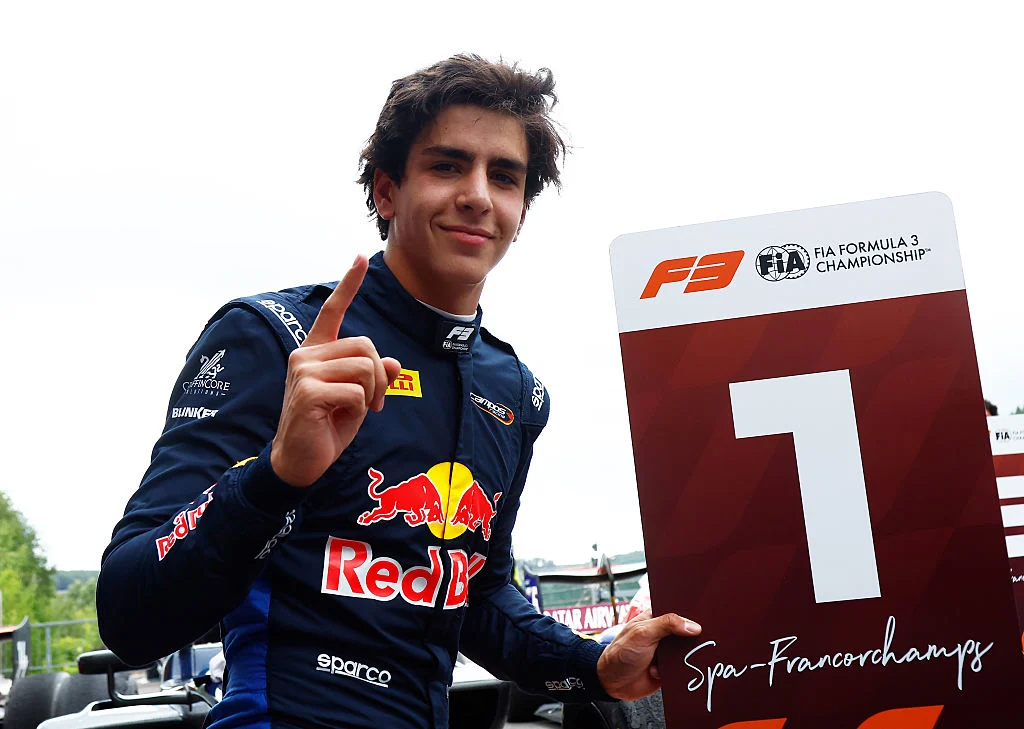
Rivera has become the outsider to watch
If the Championship were measured over the most recent rounds rather than the full season, Rivera would be much closer to the centre of the title discussion. The Campos Racing rookie sits fourth on 72 points, 58 behind Slater, but 46 of those have been scored across the last three rounds. That represents 63.9% of his entire Championship total. Only Slater, with 68, has scored more during that period. Ugochukwu has collected 44 points across Silverstone, Spa and Budapest, Badoer 30 and Naël 23.
The comparison becomes even more striking when the most recent two weekends are isolated. Rivera and Slater have both scored 44 points across Spa and Budapest, making the Championship leader and the fourth-placed rookie the joint-highest scorers over that period. That late-season acceleration has transformed Rivera from a driver on the fringes of the top ten into one of the most interesting outsiders in the title conversation.
Rivera’s missed Melbourne round adds important context
Rivera’s current position should also be viewed in the context of the round he did not contest.
The Mexican missed Melbourne and has therefore accumulated his 72 points from only six weekends. His average of 12 points per event remains behind Slater and Ugochukwu, but it is stronger than the equivalent rates recorded by Naël and Badoer. He has also scored in five of the six Feature Races he has contested.
Rivera’s Spa victory was the clearest demonstration of his recent progress. Starting fourth, he managed his tyres through the opening phase before moving forward and taking his first Feature Race win, adding 25 Sunday points to the three he had already collected from the Sprint. Another 16 points followed in Budapest.
The problem is that the Championship cannot compensate for the round Rivera missed. His 58-point deficit remains, and his late surge has come after Slater and Ugochukwu had already built substantial advantages.
Therefore, trong form has made Rivera relevant again, but it has not yet put the title in his own hands.
What Rivera needs to become a genuine threat in the 2026 F3 Drivers’ Championship fight
Rivera could continue scoring at the same rate as Slater and still fail to catch him if the Championship leader does the same. For his title challenge to become genuinely realistic, two things therefore need to happen simultaneously.
Rivera must continue producing the strongest run of his rookie season, while both Slater and Ugochukwu must surrender a meaningful number of points. That is what separates his situation from that of the leading pair. Slater and Ugochukwu can determine the Championship primarily through their own results. Rivera cannot.
Nevertheless, if Monza produces the type of unpredictability Formula 3 regularly delivers, Rivera appears to be the outsider best placed to capitalise. Another weekend on the level of Spa could dramatically reduce his deficit, particularly if the leaders encounter qualifying trouble, contact or penalties.
Rivera does not currently control the Championship equation, but his recent form means he is perhaps the driver most capable of making the calculation uncomfortable for Slater and Ugochukwu before Madrid.
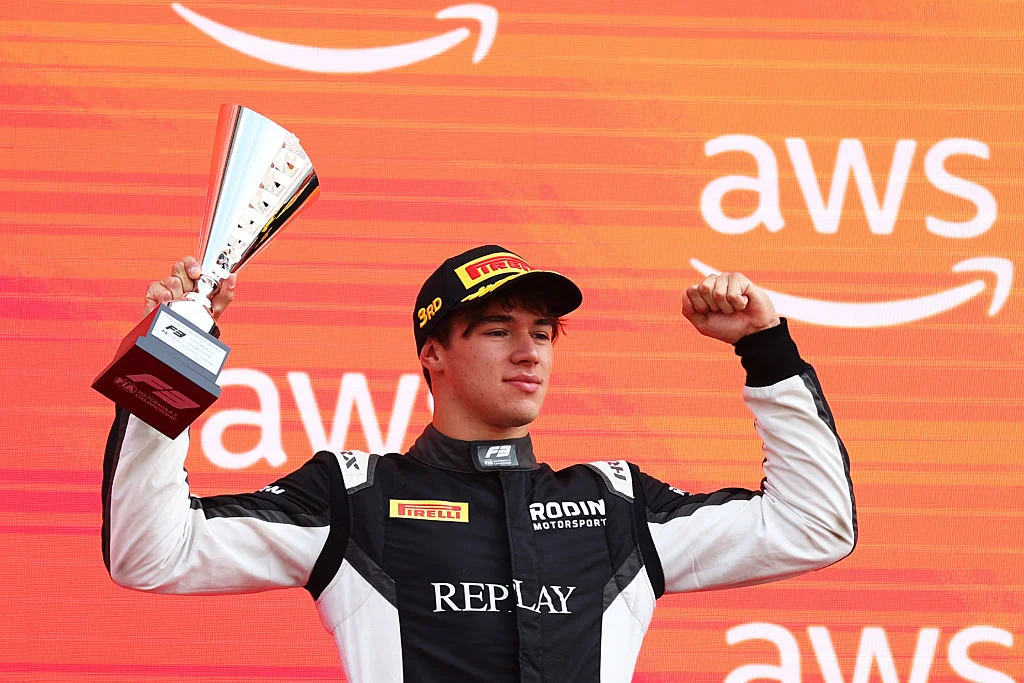
Badoer has shown the peaks, but consistency remains the problem
Only one point separates Brando Badoer from Ernesto Rivera and four from Théophile Naël, leaving the three outsiders tightly grouped despite taking very different routes to their current Championship positions. Badoer has already shown that he can deliver the kind of result required to influence the title fight, most notably with his Monaco Feature Race victory, which brought 25 points in a single afternoon. His Budapest podium also underpinned a 21-point weekend and demonstrated that he remains capable of producing major scores late in the season.
The issue has been sustaining that level. Badoer scored 28 points across Melbourne and Monaco before adding another 13 in Barcelona, but then failed to score at both Spielberg and Silverstone. Spa produced nine points before Budapest returned him to the front with 21. Those peaks have kept him mathematically involved, but the gaps between them explain why he remains 59 points behind Freddie Slater despite already having a Feature Race victory to his name.
Badoer therefore needs more than another isolated strong weekend. A Budapest-style return at Monza would help, but it may still be insufficient if Slater and Ugo Ugochukwu continue scoring heavily. Like Naël and Rivera, his route back into contention depends not only on producing major results himself, but on doing so when the two Championship leaders lose significant points.
Monza cannot crown the Champion, but it can reshape the 2026 F3 Drivers’ Championship fight
Whatever happens at Monza, the 2026 Formula 3 Drivers’ Championship cannot be decided there. Even in the most extreme scenario in Slater’s favour, where he scores the maximum 39 points and Ugochukwu fails to score, Slater would move from 130 to 169 while the Campos Racing driver remained on 122. The resulting 47-point margin would still be smaller than the 67 available at Madrid.
The reverse is also true. If Ugochukwu scores all 39 points at Monza and Slater takes none, Ugochukwu would move to 161 against Slater’s 130, creating a 31-point lead. Slater would still remain comfortably within range at the finale.
The two main contenders are therefore guaranteed to arrive in Madrid with a mathematical chance of becoming Champion. For the drivers behind them, however, Monza carries much greater elimination potential. Naël is 55 points behind Slater and can afford to lose only another 12 before falling outside the 67-point Madrid window. Rivera, 58 behind, has nine points of breathing room, while Badoer has eight.
Monza will not decide the title, but it could determine whether Madrid begins as a five-driver mathematical contest, a three-driver fight or, more realistically, a direct confrontation between Slater and Ugochukwu.
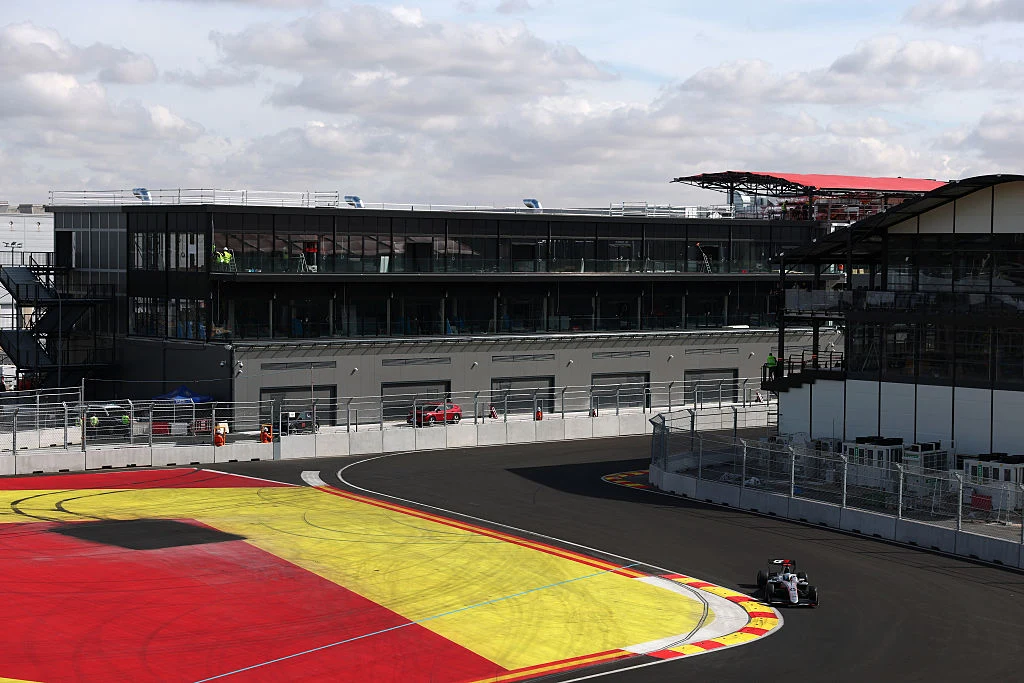
The drivers outside the Madrid window already need to gain on Slater
Noah Strømsted is the first driver currently outside the 67-point margin that can theoretically be overturned at Madrid. He trails Slater by 71 points and must therefore outscore the 2026 F3 Drivers’ Championship leader by at least four at Monza simply to reach the final round with a mathematical chance.
The requirement becomes progressively more difficult further down the standings. Hiyu Yamakoshi needs an eight-point swing relative to Slater, Maciej Gładysz needs nine, Bruno del Pino 14 and Pedro Clerot 15. Tuukka Taponen requires 17 points more than Slater at Monza, while Taito Kato needs 18. Jin Nakamura and Mattia Colnaghi, both 91 points behind, need a 24-point swing.
At the bottom of the mathematically eligible group, James Wharton and Enzo Deligny trail Slater by 102 points. They would need to gain 35 points on him at Monza during a weekend in which only 39 are available.
That is why the apparent breadth of the Championship is misleading. Sixteen drivers remain mathematically eligible entering Monza, but many are already relying on extremely specific scenarios. For several of them, even a modest Slater score could make Madrid mathematically irrelevant before the Italian weekend is finished.
Monza could dramatically reduce the number of contenders for the 2026 F3 Drivers’ Championship
The difference between mathematical possibility and realistic contention becomes especially clear when the drivers near the bottom of the surviving group are considered. Wharton and Deligny, for example, need to remain within 67 points of Slater after Monza. If Slater scores only five points during the weekend, both would need all 39 available simply to preserve their mathematical eligibility for Madrid.
The scenarios are less extreme for Strømsted and those immediately behind him, but they still require those drivers to actively gain points on the Championship leader. Simply matching Slater at Monza is no longer enough. For the lower-ranked contenders, survival requires both a strong personal weekend and a weaker one from the driver currently leading the standings.
That turns Monza into an elimination round for much of the field. The drivers closest to Slater are trying to preserve a viable 2026 F3 Drivers’ Championship route, while those further back are effectively fighting against both the leader and the mathematical limit imposed by Madrid’s 67 available points.
Sixteen drivers may arrive in Italy with a theoretical title chance, but the number still carrying one to Spain could be considerably smaller. The significance of Monza therefore lies less in what it can decide at the top and more in how many Championship hopes it can end before the finale begins.
Madrid testing leaves little between Slater and Ugochukwu
Madrid introduces another major variable because Formula 3 has never previously raced at MADRING. The Championship completed a two-day test there on August 24 and 25, giving teams and drivers their first opportunity to gather meaningful data at the venue that will ultimately decide the title.
For the leading pair, the most notable outcome was how little appeared to separate them. Ugochukwu topped both morning sessions, while Slater was quickest in both afternoons, effectively splitting the four sessions two apiece. Ugochukwu produced the fastest outright lap of the test with a 1:49.034 on the second morning, while Slater led the final afternoon with a 1:49.685. Ugochukwu’s 1:49.790 in that same session left just 0.105s between them.
Testing times cannot be treated as a direct prediction of competitive order because fuel loads, tyre programmes and run plans vary considerably. The final afternoon also placed greater emphasis on longer running. Nevertheless, there was no obvious sign that either title contender struggled to adapt.
Ugochukwu left with the fastest outright lap, while Slater topped both afternoon sessions. The two drivers who have separated themselves from the field in the standings also emerged as the recurring names at the front of the timing screens at the circuit where the Championship will be settled.
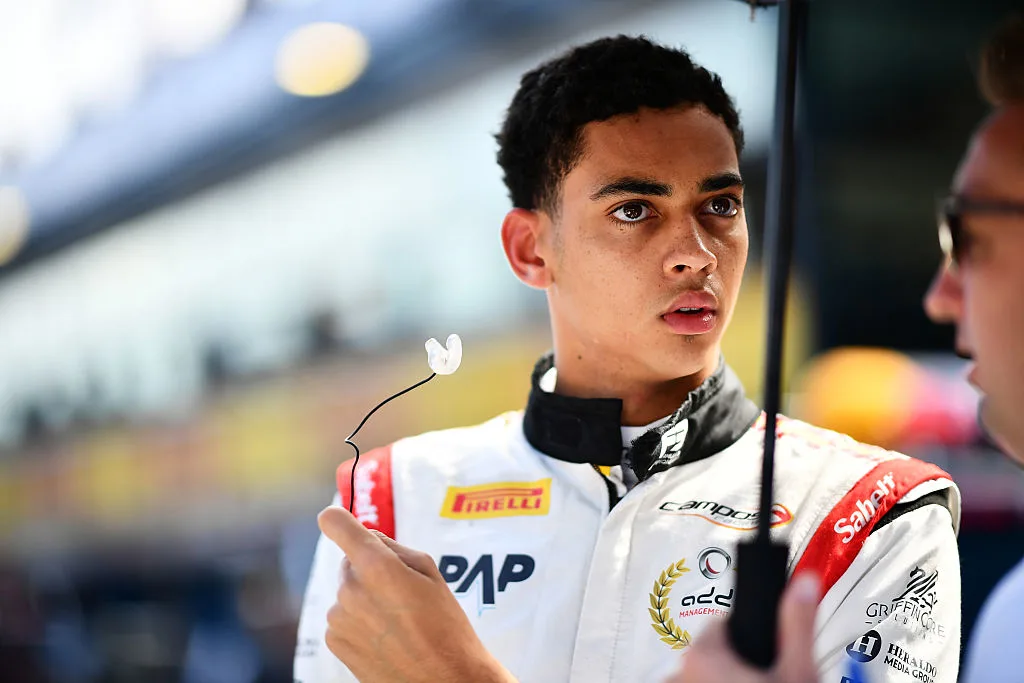
Campos could influence the 2026 F3 Drivers’ Championship title from several directions
The composition of the Championship standings gives Campos Racing an unusual amount of influence heading into the final rounds. Ugochukwu sits second on 122 points, while Naël is third with 75 and Rivera fourth on 72. Both Naël and Rivera remain mathematically capable of becoming Champion themselves, so neither can simply be treated as a supporting player in Ugochukwu’s campaign.
Their presence near the front could nevertheless materially affect the points exchanged between Slater and Ugochukwu. If Rivera repeats his Spa performance and wins a Feature Race, neither title leader can collect the 25 points for victory. If Naël takes pole, the two-point bonus is removed from both. More importantly, a Campos driver finishing between Ugochukwu and Slater could turn a relatively small performance difference into a much larger Championship swing.
The same principle applies to Badoer, Strømsted and any other driver capable of running near the front. With only eight points separating Slater and Ugochukwu, the title may ultimately be influenced as much by the drivers between them as by their own finishing positions.
That becomes especially important at Madrid, where three races and two qualifying sessions create repeated opportunities for other drivers to intervene in the points battle.
Slater and Ugochukwu remain the only drivers in full control
The remaining contenders can be divided most clearly by how much of their Championship outcome remains within their own control. Slater and Ugochukwu occupy a different position from everyone behind them because neither needs another driver to fail in order to create a route to the title.
If Slater outscores Ugochukwu across the final two weekends, he remains ahead. If Ugochukwu gains at least nine points on Slater, he can move beyond him on points, subject to the relevant countback situation if they finish level. Their task is therefore largely direct: beat the other driver across the remaining 106 points.
Naël, Rivera and Badoer do not have that luxury. All three can still produce exceptional results and remain close enough to matter, but even a perfect finish may not be enough if Slater or Ugochukwu continue accumulating points.
That distinction is more important than simply listing the mathematical contenders. The Championship remains open to a much larger group, but only two drivers can realistically determine the outcome through their own results alone.
For everyone else, the final two weekends are as dependent on what happens ahead of them as on what they achieve themselves.
Naël, Rivera and Badoer need the leaders to stumble
Naël, Rivera and Badoer form the clearest group of serious outsiders. All three remain within the 67 points currently separating Slater from the outer edge of the Madrid window, and each has already demonstrated enough pace to win races this season.
Their mathematical ceilings, however, show how dependent they have become on the leading pair losing points. Naël can finish the season with no more than 181, Rivera can reach 178 and Badoer 177. Slater is already on 130 before Monza begins.
That means even a perfect final two rounds would not guarantee any of the three the 2026 F3 Drivers’ Championship. Their challenge is fundamentally different from that of Slater and Ugochukwu because they need two things to happen at once: they must score at a title-winning rate themselves while also relying on both leading contenders to surrender substantial points.
The opportunity remains, particularly because the expanded Madrid format leaves more points available than at a conventional finale. However, none of the three can simply win every remaining race and know that the Championship will follow.
The door remains open, but the outsiders cannot open it entirely by themselves.
From Strømsted down, the 2026 F3 Drivers’ Championship scenarios become increasingly theoretical
The third level of the title fight begins with Strømsted. He and the drivers behind him remain mathematically eligible, but all already require a significant swing relative to Slater at Monza simply to remain alive for Madrid.
The further down the standings the calculation moves, the closer the required scenario becomes to near-perfection. Wharton and Deligny provide the clearest example. Both need 103 of the remaining 106 points merely to reach 131, assuming Slater fails to score another point.
That represents 97.2% of every point still available.
Such a result is mathematically possible, but competitively it would require an extraordinary combination of near-perfect performances, bonus points and major problems for almost every driver ahead. That is why describing the 2026 F3 Drivers’ Championship as a 16-driver title battle would be technically accurate but analytically misleading.
The mathematics remain broad because Madrid offers an unprecedented number of points. The realistic title picture is much narrower.
The most useful distinction is therefore not simply between drivers who are eliminated and those who are not, but between those who can still influence their own Championship fate and those whose chances now depend on an increasingly unlikely sequence of events.
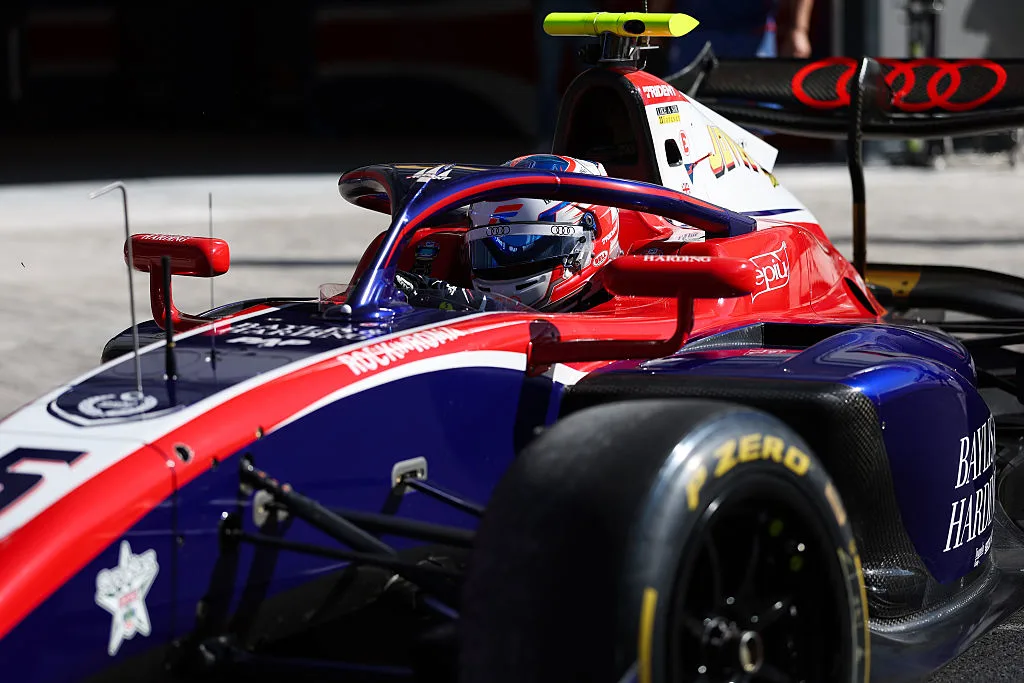
Slater carries the strongest statistical case into Monza
On the evidence accumulated across the season, Slater deserves to arrive at Monza as the Championship favourite. He holds an eight-point advantage and has scored 68 points across the last three rounds, 24 more than Ugochukwu during the same period. Most significantly, he has transformed an 18-point deficit after Silverstone into the current lead, producing a 26-point swing across Spa and Budapest.
His Feature Race consistency strengthens that position further. Slater is the only driver to have scored in all seven Feature Races, while almost 80% of the remaining maximum points are connected to the three Feature Races still to come and their associated qualifying bonuses.
His season-long scoring efficiency also suggests that maintaining anything close to his existing level would quickly make the mathematical ceilings available to Naël, Rivera and Badoer difficult to reach. Slater does not need a perfect conclusion to the season to strengthen his grip on the 2026 F3 Drivers’ Championship; he needs the same steady accumulation that has carried him to the lead in the first place.
Those factors make him the statistical favourite, but they do not make his advantage secure. Eight points remains a narrow margin with 106 still available.
Ugochukwu remains close enough to change the picture immediately
Slater’s advantage is meaningful, but it is far from comfortable. Ugochukwu has been his closest match throughout the season and has built much of his own Championship campaign around strong Feature Race performances. His 103 points from Feature Race columns are comfortably clear of every driver other than Slater.
More importantly, Ugochukwu needs to gain only nine points on the Championship leader across the final 106 to reverse their positions. The points structure means that swing can occur in a single race. A Feature Race victory from pole, with Slater finishing second, would be sufficient to wipe out the current deficit before fastest lap is even considered.
The Madrid test also provided little evidence that the new circuit will fundamentally favour one contender over the other. Ugochukwu produced the fastest outright lap across the two days, while Slater topped both afternoon sessions.
The 2026 F3 Drivers’ Championship has therefore changed direction without becoming one-sided. Slater now carries the advantage, the recent momentum and the stronger consistency profile, but Ugochukwu remains close enough that one high-value result could reverse the standings again.
That is why the final two rounds continue to centre on the same two drivers.
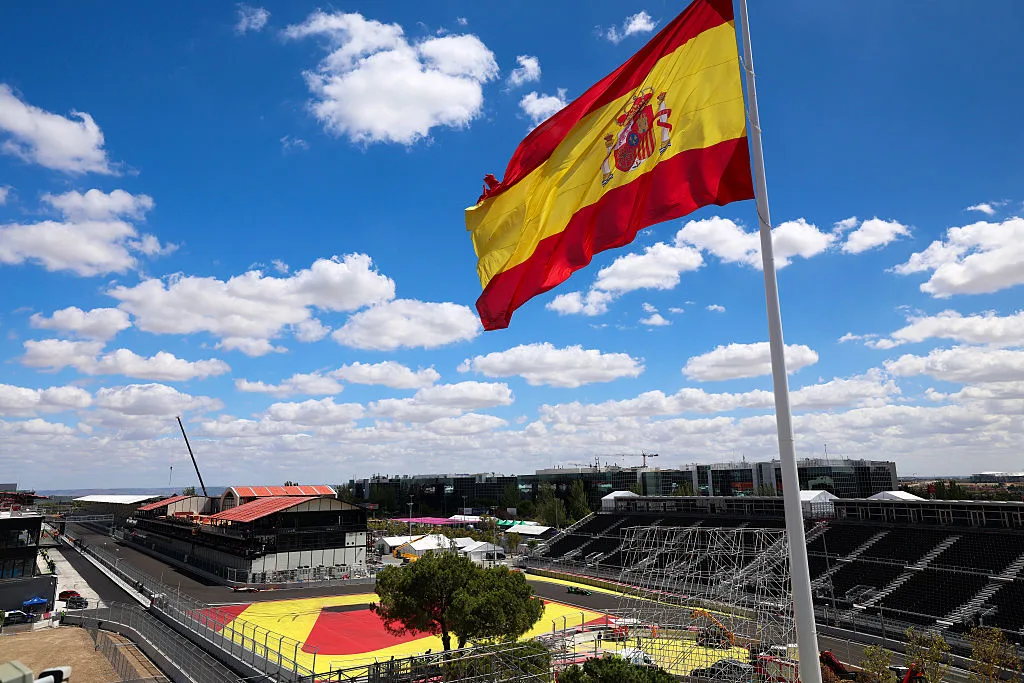
Monza will determine what kind of finale Madrid receives
Behind the leading pair, Naël remains the closest mathematical challenger, Rivera arrives with arguably the strongest recent form among the outsiders and Badoer remains only one point behind him. All three can still reach Madrid close enough to matter, but Monza will determine whether their title chances remain realistic or become purely mathematical.
For the rest of the field, the Italian round is even more decisive. Several drivers already need to gain substantially on Slater simply to remain eligible for the finale. A strong weekend from the Championship leader could eliminate much of the surviving group before the paddock leaves Monza.
Madrid then offers an unprecedented 67 points across one Sprint Race, two Feature Races and two qualifying sessions. That structure ensures the title cannot be settled early, but it also means the precise gap after Monza will matter more than at almost any conventional F3 finale.
Monza cannot crown the 2026 Champion. What it can do is decide how many drivers arrive in Spain with a credible chance of becoming one.
Sixteen remain alive, but the 2026 F3 Drivers’ Championship keeps returning to two names
The conclusion to the 2026 FIA Formula 3 season contains an unusual contradiction. The revised Madrid format has kept the mathematical possibilities exceptionally broad, yet the performance data has produced an increasingly clear divide at the front.
Sixteen drivers remain capable of becoming Champion on paper, while five, including Slater, currently sit inside the 67-point margin that could theoretically be overturned during Madrid alone. Naël, Rivera and Badoer remain close enough to capitalise if the leaders falter, while those further back require increasingly extreme scenarios simply to survive Monza.
Yet the statistical analysis repeatedly returns to Slater and Ugochukwu. Slater has the eight-point lead, the stronger recent momentum and the only seven-from-seven Feature Race scoring record in the field. Ugochukwu remains his closest match, has accumulated 103 Feature Race points himself and needs only a nine-point swing from a possible 106 to regain the advantage.
That leaves the Championship finely poised despite the growing gap behind them.
Monza cannot decide the title, but it may determine whether anyone else remains capable of joining the fight. Madrid will then settle the rest.